


A video of a motorcyclist showing off his skills as he negotiated the sharp bends of the Taipei-Yilan Highway was uploaded on the video-sharing Web site YouTube, allowing the police to locate the 20-year-old driver by identifying his license plate number from the footage. He admitted what he did was very dangerous and told the police he would never do it again.
The video shows a person riding a 125cc motorcycle showing off his skills at negotiating a sharp bend four times, leaning so close to the ground that his knee was rubbing against it. Netizens that saw the video eventually notified the police because they thought it looked very dangerous. The police said the motorcyclist, surnamed Chang, was repeatedly leaning his bike as he sped around curves near the 33km marker on Beiyi Highway. With one foot hooked around the seat, the knee of the other leg touched the ground while he leaned left and right at various turns, police said these were techniques you would only see at Grand Prix competitions. Onlookers filmed the dangerous stunts and uploaded them onto YouTube. Netizens subsequently reported what they saw to the police.
When the police summoned Chang for questioning so they could write up a police report, he admitted to speeding through the four sharp curves and leaning his bike at a steep angle, and said he regreted it. Motorcyclists at Grand Prix motorbike races are trained professionally before being allowed to race through sharp curves at high speeds by leaning their bikes close to the track. Chang, however, has never received proper training; therefore, it was very dangerous for him to make these sharp turns at such high speeds on Beiyi Highway, where the road is both circuitous and narrow.
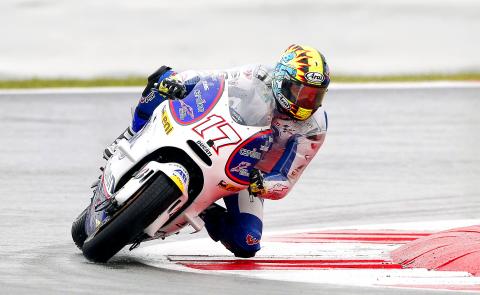
Photo: EPA
照片:歐新社
New Taipei City police said that motorcyclists might lose their balance and hit other vehicles if they go too fast or lean too much while driving on Beiyi Highway. They also said they will be clamping down on this sort of dangerous driving.
(LIBERTY TIMES, TRANSLATED BY TAIJING WU)
一位機車騎士為了炫燿技術,在北宜公路上飆車過彎,影像畫面遭人上傳到YouTube網站。警方根據網站上的影片,以車號找到二十歲的騎士。他承認此行為很危險,並向警方表示「下次不敢了」。
影片中的騎士駕著一二五CC摩托車,來回四次表演過彎特技,連膝蓋都摩擦到地面。網友認為此舉太危險,所以向警方檢舉。警方表示,張姓騎士就在北宜公路三十三公里處,一腳勾著坐墊,另一腳膝蓋摩擦地面,左右來回壓車,表演摩托GP賽事才會看見的過彎技術,路過的觀眾拍下危險畫面,並上傳到YouTube,熱心網友向警察檢舉。
警方要求住在新北市的張某到警局做筆錄,他承認在北宜公路騎乘機車來回壓車共四次,並深表悔意。摩托GP賽事的車手需要經過專業的訓練,才能在賽車跑道上使用壓車過彎的技術,張某並未受過專業訓練,且在彎道多、路幅窄的北宜公路路段壓車過彎,真的很危險。
新北市警局說,車速過快或壓車騎過北宜公路,也可能會因重心不穩而碰撞其他車輛,警察將嚴加取締危險駕駛。
(自由時報記者卓冠廷)

The US-Israeli war with Iran, which began on Feb. 28, has killed thousands of people, destabilized the Middle East and rocked global energy markets by effectively closing the strait. WHAT IS THE STRAIT OF HORMUZ? Lying between Oman and Iran and linking the Gulf north of it with the Gulf of Oman to the south and the Arabian Sea beyond, the strait is 33km wide at its narrowest point, with a shipping lane just 3km wide in either direction. Perhaps the world’s most important energy shipping channel, the waterway is about 167km long. Following through on an old threat, Tehran effectively closed the strait

Have you ever found yourself desperately feeding coins into a claw machine just because you’ve already spent so much trying to win that stuffed animal? Or maybe you’ve continued watching a boring movie simply because you already paid for the ticket? If so, you’ve experienced the “sunk cost fallacy.” A sunk cost refers to time, money or effort that has already been spent and cannot be recovered. This psychological trap is surprisingly common. You might keep playing a video game you no longer enjoy because you’ve invested countless hours in building your character, or maintain a toxic friendship because you’ve known

A: Which TV drama series have been global hits so far this year? B: The US drama “Stranger Things 5,” South Korean drama “Can This Love Be Translated?” and Chinese megahit “Pursuit of Jade” are all popular lately. A: Isn’t “Pursuit of Jade” the costume idol drama about the romance between a charming marquis and a pig-slaughterer? Actor Zhang Linghe and actress Tian Xiwei are both so attractive. B: Plus, Netflix’s Korean-Japanese gay romance drama “Soul Mate” — starring Korea’s Ok Taec-yeon and Japan’s Hayato Isomura — is set to premiere in May. A: These hit international dramas

1. 他甚至還自認為是個了不起的領導人。 ˇ He even went so far as to think himself a great leader. ˇ He even went so far as to think of himself as a great leader. χ He even went so far as to think himself as a great leader. 註:認為某人或某事為何等樣人或何等樣事,可用 think+受詞+受詞補語,或 think of ... as ...,正句第一句比第二句普遍些。用了 of,後面用 as;沒有 of,就不可以用 as。又如: I thought him quite a joke. I thought of him as quite a joke. 2. 你不應該打擾他休息。 ˇ You should not intrude upon him during his time off. χ You should not intrude him during his time off. 註:intrude 作「闖進」、「打擾」、「侵入」解時,是不及物動詞,後面跟 upon。 3. 男孩正在玩陀螺。 ˇ The boy is playing with his top. χ


 RSS
RSS