


Paul the octopus, who shot to fame during the football World Cup last year for his flawless record in predicting the outcome of games, will get a shrine to mark three months since he died, his aquarium in Oberhausen, Germany said last Monday.
The tentacled tipster was honored on Jan. 20 with a “Paul Corner” at his former home, containing his ashes and a “huge memorial,” the center in western Germany said.
“There will be a statue around 1.8m (6ft) high of Paul, on top of a football, in the middle of which will be a see-through window with the golden urn containing Paul’s ashes,” spokeswoman Tanja Munzig told AFP.
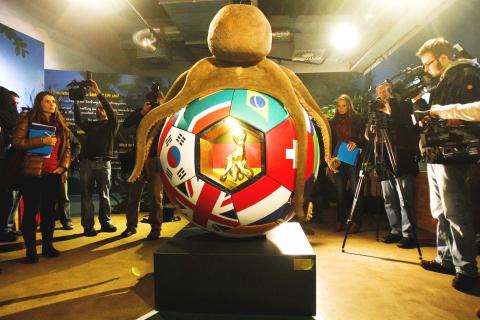
Photo: REUTERS 照片:路透
Watched by a myriad of reporters, Paul would head to one box, wrench open the lid and gobble the tasty morsel, with the box he plumped for being deemed the likely winner.
Paul’s astonishing ability made him a global media phenomenon. His later predictions were carried live on rolling news channels in Germany.
He died peacefully in his sleep aged nearly three in October last year, sparking hundreds of messages of condolence from his Facebook fan club, whose ranks have more than tripled since his death to 200,000.
The aquarium unveiled a replacement, a French octopus named Paul II on Nov. 3 last year.
The new cephalopod has not yet been tested on the field of play although speculation is rife that he could be wheeled out for the next European championship in Ukraine and Poland in 2012.
(AFP)
章魚哥保羅,因去年世界足球賽期間預測球賽結果萬無一失,讓牠一舉成名。在保羅逝世三個月後,德國奧伯豪森水族館上週一宣布,將為牠建紀念館。
德國西部的這間水族館表示,為這位有觸手的預測王打造的紀念館,位於其生前住所,一月二十日揭幕並被命名為「保羅角」,館內展示保羅的遺灰與一尊「大型紀念雕像」。
水族館發言人唐雅‧姆茨格告訴法新社說,「館內有一尊大約一點八公尺(約六英呎)高的保羅雕像,底座是一顆足球,其中有一扇透明窗,可看到內裝有保羅遺灰的金色灰罈供人瞻仰。」
在大量記者的見證下,保羅游向一個盒子並拉開盒蓋吃下盒內美味的食物,牠所挑選的盒子即是被視為最有可能贏的國家。
保羅驚人的能力讓牠成為全球媒體矚目的焦點。牠後續的預測在德國皆是以現場實況循環播出。
去年十月,保羅安詳地在睡夢中去世,享年近三歲。隨著死訊傳開,牠的臉書湧入上百篇粉絲悼念留言,人氣上升三倍,粉絲多達二十萬人。
水族館去年十一月三日推出一隻出生於法國的章魚,命名為保羅二世,成為保羅的接班。
雖然外界充斥各種猜測,指稱牠可能於二零一二年烏克蘭及波蘭共同舉辦的歐洲國家盃上場預測,不過這隻新的頭足類動物是否有這樣的能力要等試過才知道。
(法新社/翻譯:林亞蒂)
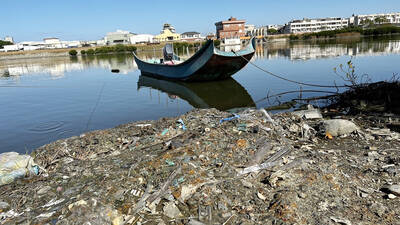
Many consumers are guilty of filling drawers or closets with old laptops, cellphones, fitness trackers and other electronic devices once they are no longer needed. It’s hard to know where to recycle such items, or it seems costly and inconvenient to do so. The world generates millions of tons of electronic waste — also called e-waste — each year. According to the UN’s most recent estimate, people worldwide produced 62 million metric tons of e-waste in 2022, and only about 22 percent of it was properly recycled. The US’ Environmental Protection Agency estimates that less than a quarter of e-waste is

You’re sitting in class when a classmate asks to borrow a pencil. It seems like a small favor, so you agree without hesitation. The following week, the same classmate asks to share your notes. Later, they request help with a group project. You agree each time — after all, you helped out the first time — but before you know it, it has become automatic. This scenario demonstrates the “foot-in-the-door technique,” a psychological concept that shows how agreeing to small, acceptable demands makes it easier to accept larger ones later on. The name for this strategy comes from door-to-door

A: The four-day Tomb Sweeping Day long weekend begins Friday and will run until Monday. Are you going to sweep your ancestors’ tombs? B: I did in advance last weekend, so I can go to Kaohsiung to see the musical “The Phantom of the Opera.” A: Wow, is “Phantom” touring Taiwan again? It debuted in 1986, so this year marks the 40th anniversary of the show. B: And it’s not just touring Kaohsiung starting March 31, but also Taipei starting April 21 and Taichung starting May 26. A: “Phantom” is one of the world’s Four Major Musicals. I’ve seen all of them, except “Les

對話 Dialogue 清清:這禮拜又有連假了,這次一共放四天。 Qīngqing: Zhè lǐbài yòu yǒu liánjià le, zhè cì yígòng fàng sì tiān. 華華:你是要過兒童節還是清明節? Huáhua: Nǐ shì yào guò Értóng jié háishì Qīngmíng jié? 清清:都要過啊!不管幾歲,都要有童心,才能永遠都年輕,知道嗎? Qīngqing: Dōu yào guò a! Bùguǎn jǐ suì, dōu yào yǒu tóngxīn, cái néng yǒngyuǎn dōu niánqīng, zhīdào ma? 華華:好啦!能當個長不大的孩子也好,就不會有那麼多煩惱了。 Huáhua: Hǎo la! Néng dāng ge zhǎngbúdà de háizi yě hǎo, jiù bú huì yǒu nàme duō fánnǎo le. 清清:還好春天有這兩個節假日,常常可以變成連假休息一下。 Qīngqing: Háihǎo chūntiān yǒu zhè liǎng ge jiéjiàrì, chángcháng kěyǐ biànchéng liánjià xiūxi yíxià. 華華:對啊!上禮拜我已經先跟家人去掃墓了,就怕清明節當天人太多。 Huáhua: Duì a! Shàng lǐbài wǒ yǐjīng xiān gēn jiārén qù sǎomù le, jiù pà Qīngmíng jié dāngtiān rén tài duō. 清清:親人雖然過世了,但有清明節掃墓的習俗,讓我們在不同的世界還是能「聚」一下、說說話,真的很有意義。 Qīngqing: Qīnrén suīrán guòshì le, dàn yǒu Qīngmíng jié


 RSS
RSS