


In Naperville, Illinois, USA, just outside Chicago, there is a new taxi company. And you can take your car home with you.
The taxi service, run by Smith Cos, started the towing taxi service last week.
The company hopes that businessmen and women who are out drinking at their favorite place will use their service. That way, they can drive when they go out at night but still get their car home safely.

Photo: AP
The price of a ride is not cheap. If you call in advance to order a ride, you will have to pay US$65 (NT$2,163). If it is an unplanned pickup, the cost is US$85 (NT$2,828). Riders will also have to pay US$2 (NT$66) for every 1.6km they ride.
Naperville police Captain Gary Bolt said he does not know if the idea is practical. "I applaud their efforts, but I just don't know how well it will be received." (Jason Cox, Staff Writer with AP)
在美國伊利諾州芝加哥城外的拿波維爾,有一家新的計程車行。你還可以把自己的車子一起拖回家。
由史密斯.寇斯經營的計程車行於上週開始提供計程拖吊車服務。
這家車行希望出外暢飲的生意人和女性可以利用他們的服務。如此一來,顧客就可以在夜間開車外出,卻還可讓車子安然返家。
搭一趟車的價格並不便宜。假如你提前預約,得支付六十五美元(新台幣兩千一百六十三元)。假如非事先預約,價格為八十五美元(新台幣兩千八百二十八元)。每搭乘一點六公里,乘客還得支付兩美元(新台幣六十六元)。
拿波維爾警察隊長蓋瑞.鮑爾特表示,他不知道這個點子實用與否。「我推崇他們的努力,但我不知道民眾的接受度如何。」 (翻譯︰賴美君)
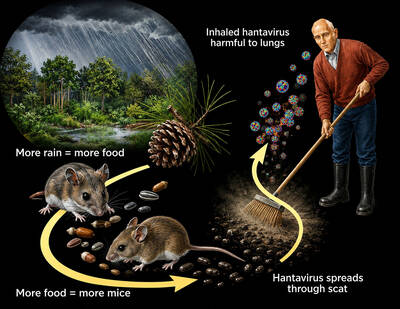
An outbreak aboard a cruise ship of a rare rodent-borne illness called hantavirus has left three passengers dead and sickened others, but global health officials say the risk to the general public remains low because the germ does not easily spread between people. “This is not the next COVID, but it is a serious infectious disease,” said Maria Van Kerkhove, director of epidemic and pandemic preparedness at the World Health Organization (WHO). “Most people will never be exposed to this.” The virus usually spreads when people inhale contaminated residue of rodent droppings. Hantaviruses have been around for centuries and are thought to

Have you ever wondered how people navigate the world when they can’t see a map? For individuals with visual impairments, conventional maps are nearly impossible to use. This is where tactile maps come in — essential tools that allow people to “see” the world through touch. A tactile map is specially designed with raised lines, textures, and symbols to represent geographical features such as roads, rivers, and buildings. Users explore it with their fingertips. However, these maps are not exclusively for people with visual disabilities. They serve as valuable multisensory learning tools that enhance spatial understanding for everyone, making

1. 他病了三天。 ˇ He has been sick for three days. χ He has been sick since three days. 註︰這裡現在完成時態 have / has been 表示從過去某一時日到現在的一段時間存在的行為或狀態,與它連用的時間副詞應為 「for +若干時」,如 for a year, for three hours 等,意思是歷時多少。 2. 他自從星期三以來都很忙。 ˇ He has been busy since Wednesday. χ He has been busy from Wednesday. 註︰「自從……以來」,該用 since。說從某一天(某一時刻)到某一天(某一時刻)才用 from,如 from Monday till Friday。 3. 房間角落裡散放著一些零星物件。 ˇ There were some odds and ends lying in the corner of the room. χ There were some odds and ends lying at the corner of the room. 註︰「在房間角落裡」該用介詞 in。例如: He stood in the corner. There is a lamp in the corner of the room. at the corner 指房子外部的拐角。例如: A little boy

A: In early May, there were concerts by Icyball, Chyi Yu, Korea’s EXO and Japan’s Anisama, but I missed them all. What a shame. B: That’s OK. There are shows coming up by various artists, including Power Station, Accusefive, Japanese singer Mika Nakashima, Chinese-Icelandic jazzer Laufey, and even Singaporean diva Stefanie Sun. A: After a 12-year hiatus, Stefanie is finally returning to Taipei again. B: In late May, there will be more shows by Crowd Lu, WeiBird, Korea’s Donghae, 2AM, EXID, and Thailand’s BUS. A: The Thai boyband is so popular. It looks like “T-pop” is catching up with J-pop


 RSS
RSS