


Do you ever wake up in the morning feeling so tired that you don't want to get out of bed? If you were a sloth, that wouldn't be a problem!
Every day, sloths spend 15 to 18 hour sleeping. Even when they are awake, they move very slowly. In fact, sloths only move two to three meters per minute, which makes them the slowest mammals in the world.
Even though it might seem that sloths are just lazy, moving so little gives them a lot of advantages. Because sloths move so slowly, it is hard for predators to see them. Also, they don't have to eat very much food because they use so little energy moving around.

PHOTO : AP
The only problem is that sometimes sloths move so little that they don't see another sloth for a whole year! (Marc Langer, staff writer)
你曾經早上起床覺得很累,所以不想起床?假如你是樹獺,這一點都不成問題!
樹獺每天睡十五到十八個小時。即使牠們醒來,行動也相當遲緩。事實上,樹獺每分鐘只移動二到三公尺,這讓牠們成為世界上最遲緩的動物。
即使樹獺看起來很懶散,行動遲緩也給了牠們不少好處。由於樹獺移動緩慢,獵食者很難發現牠們。此外,牠們移動時只消耗一點點精力,所以不必吃太多食物。
唯一的問題是,有時候樹獺動得太少了,所以牠們一整年都看不到同類!
(翻譯:賴美君)
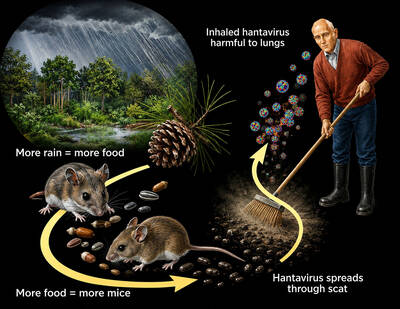
An outbreak aboard a cruise ship of a rare rodent-borne illness called hantavirus has left three passengers dead and sickened others, but global health officials say the risk to the general public remains low because the germ does not easily spread between people. “This is not the next COVID, but it is a serious infectious disease,” said Maria Van Kerkhove, director of epidemic and pandemic preparedness at the World Health Organization (WHO). “Most people will never be exposed to this.” The virus usually spreads when people inhale contaminated residue of rodent droppings. Hantaviruses have been around for centuries and are thought to

Have you ever wondered how people navigate the world when they can’t see a map? For individuals with visual impairments, conventional maps are nearly impossible to use. This is where tactile maps come in — essential tools that allow people to “see” the world through touch. A tactile map is specially designed with raised lines, textures, and symbols to represent geographical features such as roads, rivers, and buildings. Users explore it with their fingertips. However, these maps are not exclusively for people with visual disabilities. They serve as valuable multisensory learning tools that enhance spatial understanding for everyone, making

A: In early May, there were concerts by Icyball, Chyi Yu, Korea’s EXO and Japan’s Anisama, but I missed them all. What a shame. B: That’s OK. There are shows coming up by various artists, including Power Station, Accusefive, Japanese singer Mika Nakashima, Chinese-Icelandic jazzer Laufey, and even Singaporean diva Stefanie Sun. A: After a 12-year hiatus, Stefanie is finally returning to Taipei again. B: In late May, there will be more shows by Crowd Lu, WeiBird, Korea’s Donghae, 2AM, EXID, and Thailand’s BUS. A: The Thai boyband is so popular. It looks like “T-pop” is catching up with J-pop

Since 2005, the third Monday in January has come to be known as “Blue Monday.” In other words, that day is believed to be the most depressing day of the year. This concept seems logical at first. After all, Monday marks the start of the school or workweek after two days of rest and fun. Also, blue is a color that is often associated with sadness. Furthermore, in many parts of the world, January is a time when the weather is cold, rainy, and gloomy. But is there any scientific proof that this January day is truly sadder than any of


 RSS
RSS