


Students at the University of Bath in western England, who last month unveiled the prototype of the CLEVER (Compact Low Emission Vehicle for Urban Transport), hope that it represents a greener future for transport.
The prototype showed the general design and technology of the vehicle rather than its actual, finished appearance.
It is small like a motorcycle, but safe like a car. It runs on natural gas instead of traditional oil-based gas. It also uses less fuel, what would be about 2.6 liters of traditional gas per 100km. Additionally, the car is easier to drive around corners because of a new technology developed by mechanical engineering students Matt Barker, 29, Ben Drew, 27, and their instructors.

The car is designed both for city streets and long-distance highway driving, and is capable of going up to 130 kilometers per hour.
``The goal was ... to combine the efficiency of a motorcycle with the comfort and safety of a car,'' said Drew.
The vehicle is the result of a three-year project funded by the European Union, motivated by a desire to limit pollution. And with the rising cost of fuel, the car's use of natural gas is one of its best parts.
``As fuel prices go up and up, people will look at how else they can get around,'' said Geraint Owen, a lecturer at the university who helped lead the team project.
Unfortunately for today's drivers, according to Ownen, the cars won't be for sale for at least 10 years, and that's only if its makers can find a company that wants to produce them. (AP)
英格蘭西方的巴斯大學學生上個月推出 CLEVER (都會運輸低污染小型車)原型,希望這種車輛可以代表交通運輸更環保的未來。
這款原型車展現的是整體設計與汽車科技,而非實際完工的外觀。
它和摩托車一樣小,但和汽車一樣安全。它以天然氣取代傳統汽油。它也使用較少的燃料,約等於每一百公里消耗 2.6 公升的傳統汽油。此外,由二十九歲機械工程系學生麥特.巴爾克、二十七歲的班.卓爾及其指導教授所研發的新科技,這種車轉彎時也較容易。
這款車子是專為城市街道與遠距公路駕駛而設計,每小時時速可高達一百三十公里。
卓爾說:「目的在於??將摩托車的效率與汽車的舒適及安全結合。」
這種車是歐盟贊助的一項污染減量三年計畫之成果。隨著油價不斷升高,使用天然氣是這種車最好的優點之一。
協助主導這個小組計畫的巴斯大學講師傑瑞特.歐文說:「當油價日益攀高,人們就會另謀他法。」
歐文指出,對現在的駕駛來說,不幸的是他們至少得等上十年才能看到這款車上市,除非創造者能找到願意生產這款車輛的企業。
(美聯社/翻譯:賴美君)

A: Taiwan legalized same-sex marriage on May 24, 2019, so this week marks the seventh anniversary of that milestone. By the end of 2024, a total of 32,126 LGBT couples had tied the knot. B: How many of them got married to foreign partners? A: In 2024, there were 504 cross-border same-sex marriages. By the end of that year, there were 130 cross-strait same-sex marriages between Taiwanese and Chinese — accounting for only about 0.4 percent of the total. B: I’ve heard that a seven-year marriage brings the “seven-year itch.” I bet some couples regret their decisions now. A:

A: While Taiwan is celebrating the 7th anniversary of legalizing same-sex marriage, a poll shows that the support rate for same-sex marriage rose sharply from 37.4 percent seven years ago to 69.9 percent last year. B: Actually, I’m a bit curious about the size of Taiwan’s LGBT population. A: I’m not sure. But if we take a Gallup poll in the US as an example, 9.3 percent of American adults identified as LGBT in 2024. B: Wow, is it because the Americans are relatively open? In many other countries, the figures hover around 5 percent. A: Based on this,

Taiwan Travelogue, the novel by Taiwanese author Yang Shuang-zi and translated into English by Lin King, won the prestigious International Booker Prize in London on May 19. It marks the first time a Taiwanese literary work has received the International Booker Prize, setting a historic milestone both for Taiwanese literature and for the award itself. Prior to this achievement, Taiwan had only once appeared on the Booker radar, when Taiwanese author Wu Ming-yi was longlisted for the Booker Prize in 2018 with The Stolen Bicycle. The International Booker Prize honors works of fiction translated into English and published in the UK or Ireland.
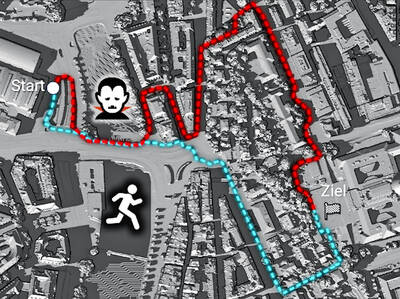
As climate change and urbanization push city temperatures higher, walking outdoors is becoming increasingly uncomfortable in many parts of the world, especially when prolonged time spent in sunlight is involved. As a result, outdoor lovers are now seeking cooler, shaded walking routes. However, most mainstream map apps still do not __1__ shaded footpaths. Enter routing.osm.ch — a Swiss web-based route planner that introduces a novel solution to this problem. Its “Vampire mode,” named after the legendary creatures’ fear of being __2__ natural light, was developed by a Swiss research team led by Professor Stefan Keller. The platform combines open data from


 RSS
RSS