


An Egyptian-German archaeological team has discovered 17 more statues of Sekhmet, an ancient Egyptian goddess who has the head of a lion and the body of a woman, Egyptian Culture Minister Farouk Hosni has said.
The life-sized statues were found when the team was doing restoration on a temple on the west bank of the Nile river in the southern Egyptian city of Luxor.
Early this month, the team had discovered six similar black statues which show Sekhmet sitting on a throne and holding the ``key of life'' in her left hand. Two of those statues were broken, and only the bottom parts were found.
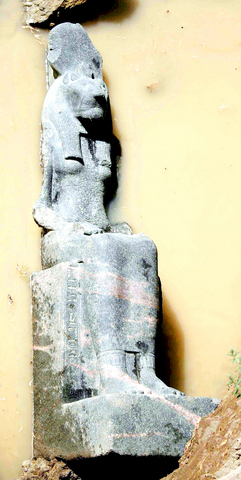
PHOTO: EPA
Hosni did not say whether or not the newest 17 statues had been broken. Each statue will be removed from the site for maintenance.
The name of the king that the temple was built for, Amenhotep III, was delicately engraved on both sides of the statues. The beauty of the statues shows that art had become very advanced by the time they were made. Amenhotep III lived around the 14th century BC.
Sekhmet was considered the goddess of war and recovery. Ancient Egyptians also believed that she protected the king, which could explain why so many statues of her were found at his temple. (AP)
埃及文化部長法魯克.胡斯尼表示,一個由埃及與德國共組的考古隊又發現了十七尊古埃及女神塞赫邁特的獅頭人身雕像。
這支考古隊在埃及南部路克索市的尼羅河西岸進行一間神廟重建工作時,發現了這些真人大小的雕像。
這個考古隊在本月初已發現了六尊相似的黑色雕像,模樣為塞赫邁特坐在寶座上,左手拿著「生命鑰匙」。其中有兩尊雕像已毀損,只有底部被發現。
胡斯尼並未說明最新出土的十七具雕像是否已損壞。所有雕像將被搬離原址以便維護。
這處神廟是為了國王阿門諾特三世建造的,他的名字被精細地刻在這些雕像的兩側。這些雕像精美,顯示當時的藝術已相當先進。阿門諾特三世大約活在西元前十四世紀左右。
塞赫邁特被視為戰爭與復甦女神。古埃及人也相信她保護著國王,這點可以解釋在阿門諾特三世的神廟為何可以發現如此多的雕像。
(美聯社/翻譯:賴美君)
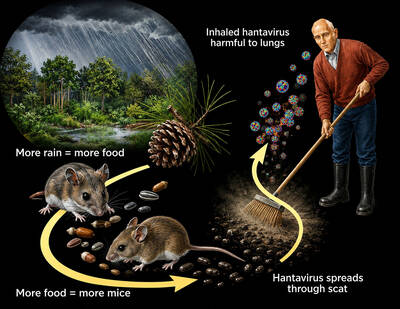
An outbreak aboard a cruise ship of a rare rodent-borne illness called hantavirus has left three passengers dead and sickened others, but global health officials say the risk to the general public remains low because the germ does not easily spread between people. “This is not the next COVID, but it is a serious infectious disease,” said Maria Van Kerkhove, director of epidemic and pandemic preparedness at the World Health Organization (WHO). “Most people will never be exposed to this.” The virus usually spreads when people inhale contaminated residue of rodent droppings. Hantaviruses have been around for centuries and are thought to

Have you ever wondered how people navigate the world when they can’t see a map? For individuals with visual impairments, conventional maps are nearly impossible to use. This is where tactile maps come in — essential tools that allow people to “see” the world through touch. A tactile map is specially designed with raised lines, textures, and symbols to represent geographical features such as roads, rivers, and buildings. Users explore it with their fingertips. However, these maps are not exclusively for people with visual disabilities. They serve as valuable multisensory learning tools that enhance spatial understanding for everyone, making

1. 他病了三天。 ˇ He has been sick for three days. χ He has been sick since three days. 註︰這裡現在完成時態 have / has been 表示從過去某一時日到現在的一段時間存在的行為或狀態,與它連用的時間副詞應為 「for +若干時」,如 for a year, for three hours 等,意思是歷時多少。 2. 他自從星期三以來都很忙。 ˇ He has been busy since Wednesday. χ He has been busy from Wednesday. 註︰「自從……以來」,該用 since。說從某一天(某一時刻)到某一天(某一時刻)才用 from,如 from Monday till Friday。 3. 房間角落裡散放著一些零星物件。 ˇ There were some odds and ends lying in the corner of the room. χ There were some odds and ends lying at the corner of the room. 註︰「在房間角落裡」該用介詞 in。例如: He stood in the corner. There is a lamp in the corner of the room. at the corner 指房子外部的拐角。例如: A little boy

A: In early May, there were concerts by Icyball, Chyi Yu, Korea’s EXO and Japan’s Anisama, but I missed them all. What a shame. B: That’s OK. There are shows coming up by various artists, including Power Station, Accusefive, Japanese singer Mika Nakashima, Chinese-Icelandic jazzer Laufey, and even Singaporean diva Stefanie Sun. A: After a 12-year hiatus, Stefanie is finally returning to Taipei again. B: In late May, there will be more shows by Crowd Lu, WeiBird, Korea’s Donghae, 2AM, EXID, and Thailand’s BUS. A: The Thai boyband is so popular. It looks like “T-pop” is catching up with J-pop


 RSS
RSS