


Did you know that a long time ago only kings and very rich people had chairs? At that time, ordinary people had to sit on stools or on the ground. If you're sitting in a chair right now, think of yourself as a king!
But even a king couldn't sit in this chair. Only a giant would be big enough for a chair this tall. It is more than 26m high, which means that it is the biggest chair in the world. You can get to the top, but you have to walk up a lot of stairs to get there.
But this isn't just a chair; it is a museum too. If you walk up the stairs, you can go inside the chair where there is a museum about wood. You might not be able to sit in this chair, but at least you can learn something from it! (kayleen hartman, Taipei Times)
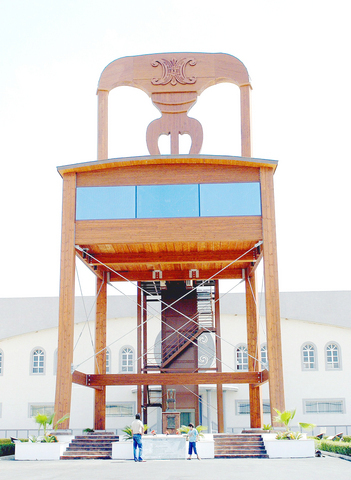
PHOTO : EPA
你可知道,很久以前,只有國王和富貴人家才有椅子坐,那時一般百姓只能坐板凳或地板上,所以如果你現在正坐在椅子上,把自己想成是一位國王吧!
不過,就連國王也無法坐在這張椅子上,只有巨人才坐得上這張高椅子。它高度超過二十六公尺,是世界上最大張的椅子,你可以爬到最上面,不過要走許多階梯才能到。
但是,這不只是一張椅子,它還是座博物館,走上樓梯後,你可以走進椅子瞧瞧,裡頭有一座木材博物館。你可能無法坐在這張椅子上,但是你可以向它學習喔! (何楷琳,台北時報)
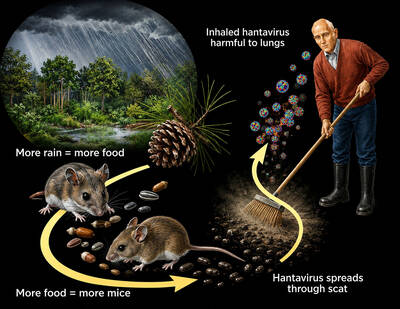
An outbreak aboard a cruise ship of a rare rodent-borne illness called hantavirus has left three passengers dead and sickened others, but global health officials say the risk to the general public remains low because the germ does not easily spread between people. “This is not the next COVID, but it is a serious infectious disease,” said Maria Van Kerkhove, director of epidemic and pandemic preparedness at the World Health Organization (WHO). “Most people will never be exposed to this.” The virus usually spreads when people inhale contaminated residue of rodent droppings. Hantaviruses have been around for centuries and are thought to

Have you ever wondered how people navigate the world when they can’t see a map? For individuals with visual impairments, conventional maps are nearly impossible to use. This is where tactile maps come in — essential tools that allow people to “see” the world through touch. A tactile map is specially designed with raised lines, textures, and symbols to represent geographical features such as roads, rivers, and buildings. Users explore it with their fingertips. However, these maps are not exclusively for people with visual disabilities. They serve as valuable multisensory learning tools that enhance spatial understanding for everyone, making

A: In early May, there were concerts by Icyball, Chyi Yu, Korea’s EXO and Japan’s Anisama, but I missed them all. What a shame. B: That’s OK. There are shows coming up by various artists, including Power Station, Accusefive, Japanese singer Mika Nakashima, Chinese-Icelandic jazzer Laufey, and even Singaporean diva Stefanie Sun. A: After a 12-year hiatus, Stefanie is finally returning to Taipei again. B: In late May, there will be more shows by Crowd Lu, WeiBird, Korea’s Donghae, 2AM, EXID, and Thailand’s BUS. A: The Thai boyband is so popular. It looks like “T-pop” is catching up with J-pop

Since 2005, the third Monday in January has come to be known as “Blue Monday.” In other words, that day is believed to be the most depressing day of the year. This concept seems logical at first. After all, Monday marks the start of the school or workweek after two days of rest and fun. Also, blue is a color that is often associated with sadness. Furthermore, in many parts of the world, January is a time when the weather is cold, rainy, and gloomy. But is there any scientific proof that this January day is truly sadder than any of


 RSS
RSS