


A Dutch artist's quest to see the family car as an actual person has had some interesting results. The artist's work gives the phrase ``a hairy ride'' a whole new meaning.
The 48-year-old artist's name is Olaf Mooij. He has put a variety of classic hairstyles on top of a range of cars, creating art he says was inspired by his father, who treated "his car like a living person."
"When I was a child, my father always said, `Well done boy!' to his car after a long drive, and gave it a friendly punch," Mooij said.
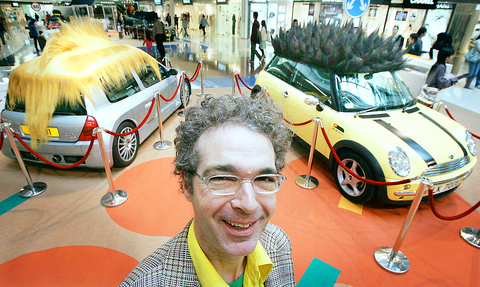
PHOTO: AFP
"That made an impression on me and (later) gave me the idea to give cars a personality, when I became an artist," he said.
Mooij didn't give a reason for why he matched certain cars to certain styles. He gave one car a bright orange hairdo that's long in the back and short in the front. He gave another car a samurai's topknot. A classic Mini Cooper wears a dignified grey part while a modern Mini has a black, spiked-up hairdo.
"A car represents the spirit of a certain time and represents a certain group of people. A car is alive," Mooij said.
Along with 30 other smaller artworks, the four "Hair Cars" were displayed at a Hong Kong shopping mall earlier this month.
"I try to make artworks that are related to people to help them understand art. I also want to put humor in my art that will make people smile," Mooij told reporters.
"Imagine there's a car driving down the street with beautiful, long, blond hair waving in the wind," he said.
Mooij usually lives and works in the Netherlands. He has been an artist for 23 years and has shown his work in Canada, the US and Spain. (AFP)
荷蘭一位藝術家致力於將房車視為真人,產生了一些相當有趣的結果。他的作品賦予「a hairy ride」(刺激兜風)(註: hairy 在此為雙關語,有「刺激」與「多毛」之意)全新的意義。
這位四十八歲的藝術家名字為歐拉夫.慕基,他已為各種車款的車頂覆上琳瑯滿目的經典髮型,創作出他自稱是受到其父啟發的藝術。他的父親將「他的車子視為真人相待」。
慕基說:「當我還是孩童時,父親長途開車後,總會對車子說『做得好,孩子!』,再友善地搥擊車子一下。」
他說:「這點讓我印象深刻,當我成了藝術家後,這也給了我將車子賦予個性的點子。」
慕基並未說明他為何將特定的車子配上特定的髮型之理由。 他給了一輛車子前短後長的亮橘色髮型,還給另一輛車子日本武士的髮髻。一輛經典的Mini Cooper車款戴上了一頂旁分的嚴肅灰髮,現代款的Mini則有著刺蝟般的黑髮。
慕基說:「一部車代表某個特定年代的精神,也代表著一群特定的人。車子是有生命的。」
這四部「毛毛車」連同其它三十件較小的作品本月初在香港一家購物中心展出。
慕基告訴記者:「我試著創作出與人們有關的藝術作品,協助民眾瞭解藝術。我也希望為我的藝術注入幽默感,讓人們會心一笑。」
他說:「想像一下街上有一輛車子,它美麗的金色長髮在風中飄盪。」
慕基平時在荷蘭生活並工作,身為藝術家已有二十三年的時間,作品曾在加拿大、美國與西班牙展出。 (法新社)


You’re sitting in class when a classmate asks to borrow a pencil. It seems like a small favor, so you agree without hesitation. The following week, the same classmate asks to share your notes. Later, they request help with a group project. You agree each time — after all, you helped out the first time — but before you know it, it has become automatic. This scenario demonstrates the “foot-in-the-door technique,” a psychological concept that shows how agreeing to small, acceptable demands makes it easier to accept larger ones later on. The name for this strategy comes from door-to-door
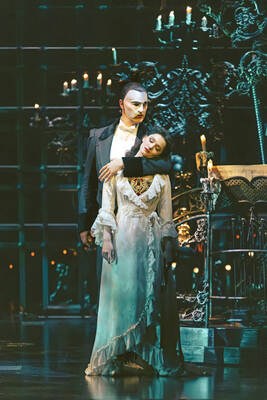
A: The four-day Tomb Sweeping Day long weekend begins Friday and will run until Monday. Are you going to sweep your ancestors’ tombs? B: I did in advance last weekend, so I can go to Kaohsiung to see the musical “The Phantom of the Opera.” A: Wow, is “Phantom” touring Taiwan again? It debuted in 1986, so this year marks the 40th anniversary of the show. B: And it’s not just touring Kaohsiung starting March 31, but also Taipei starting April 21 and Taichung starting May 26. A: “Phantom” is one of the world’s Four Major Musicals. I’ve seen all of them, except “Les

A: Apart from the musical The Phantom of the Opera, off-Broadway classic “I Love You, You’re Perfect, Now Change” and musical-themed concert “Broadway Hits Live” are also touring Taiwan. B: Musical-themed concert? That sounds interesting. A: Set for April 18 and 19, the show will feature a group of Broadway vocalists and dancers — with British singer Keala Settle as a special guest. B: So the audience can enjoy all the timeless hits from various shows at one concert. . . I like that. A: And there’s more: Andrew Lloyd Webber’s classic musical Jesus Christ Superstar will finally visit Taiwan for the first time

Despite being a basic tool, pens come in a wide variety of forms. Classic styles include fountain pens, which deliver liquid ink smoothly through metal tips. Another common type is the ballpoint pen, which is easy to use. There are even special felt pens that are especially popular among artists. __1__ They have a small hole at the top. So why is it there in the first place? Could it actually be a design flaw? __2__ Since 1991, companies such as BIC have been producing ballpoint pens with holes in their caps for two main reasons: quality control


 RSS
RSS