


The founder of POSCO (Pohang Steel Corp,
(
Taiwanese often boast about how Chao Yao-tung (
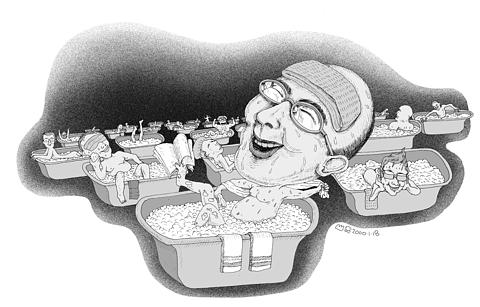
ILLUSTRATION: MOUNTAIN PEOPLE
Under Park's 24-year leadership, POSCO became the largest single steel refinery in the world, three times the size of China Steel Corp. The completion of POSCO's second refinery in 1988 gave wings to Korea's steel industry. With an annual steel production of 1,750 tons, it pushed Korea into fifth place in global steel production at the time.
In the past, Koreans would probably never have dared dream that POSCO would one day achieve so much. The planning and preparations for construction of the POSCO refinery experienced many setbacks. First, a syndicated loan group of banks from five countries pulled out at the last minute. Then, the project was boycotted by the World Bank. Finally, the project managed to make up for lost time after Japan offered a helping hand by providing a much-needed loan. The Koreans, hardworking by nature, pushed themselves to the limit and completed the first phase of the construction in 38 months, much to the astonishment and admiration of the Japanese consultants.
Park, who was in charge of the construction, set an outstanding example for others to follow. Allowing himself only three hours of sleep a day, Park created a miracle with his Spartan management style. With Japanese technology and funding, POSCO actually produced steel products superior to the Japanese. As a result, the leading Japanese producers became alarmed by this Korean newcomer, and boycotted the construction of a second POSCO refinery. It was too late, however, as POSCO was ready to stand on its own now that it had obtained the necessary technology.

In his early days, Park lived in Japan with his father, who was doing business there. He graduated from the School of Engineering at Japan's prestigious Waseda University. This experience helped shape his meticulous and detail-obsessed character. While studying in Japan, he was evacuated to the countryside to escape air raids during the war. While there, he saw how farm women would wash themselves after returning from the fields before proceeding to cook meals. The experience gave him a valuable lesson and inspired his "bathing and quality-control theory."
After World War II, Park returned to South Korea. Witnessing the chaos of Korea's domestic politics, he decided to join the military. In the military academy he met Park Chung Hee (
In April, 1968, Park was ordered to make preparations for the construction of a major steel refinery, and he was determine to do all he could to help lay the foundations of one of the state's basic industries. Thereafter, Park became engaged in the steel business. His dedication to the refinery may be characterized as feverish.
In 1978, during the third phase of the POSCO steel refinery's construction, the head of the construction company was once summoned and upbraided by Park because the project was running behind schedule. Park ordered the man to do 20 minutes of push-ups in front of all the participants of the staff meeting. On another occasion, the workers had inadvertently built the foundations 10cm higher than planned due to the tight schedule. After Park discovered the mistake, he completely destroyed the building, which was already 80 percent complete.
Park's style was criticized as bullying and unreasonable at times. He has been described as "the crazy man" in Korean political circles. However, Park did not care and he continued his pursuit of perfection.
Textile exports from Korea were reaching their peak toward the end of the 1970s. Once, during Park's visit to the US, he went to a department store and could not find "made-in-Korea" clothing on the entire 8th floor of the store. Later on, he discovered that all Korea-made clothing was sold at the discount market located in the basement. The store clerk told him that Korea-made clothing could only be sold as cheap discount items because of the poor quality of their manufacture. At the time, Park was filled with shame.
After he went back to Korea, Park went looking for the operators of export-clothing manufacturers. He asked the operators to let the female workers take a bath frequently, and change and launder their underwear often so that they could keep their body clean and their spirits up. He believed that, as a result, the workers would be more detailed-oriented and cautious and the products would be much improved. This advice derived from Park's management philosophy derived from his experience of seeing the attention to personal hygiene of the farm women during the war.
Because the weather in Korea is extremely cold in winter and there is often a shortage of resources, taking a bath is considered a luxury to the Koreans. Some Koreans have even speculated that "bath-taking could cause the fall of a nation " as a justification for their refusal to bathe. However, Park took a stand different from most and loudly promoted his "bathing and quality-control theory" to break Koreans' bad of habit of not bathing regularly.
Park always checked the bathroom first when he inspected a workers' dormitory or visited an employee's home. Despite opposition, Park used five billion won (about NT$400 million at the time) to construct high-standard bathroom facilities at POSCO, so that the more than 16,000 POSCO workers could maximize their work efficiency in a clean environment.
Park believes that a person who is upright spiritually and physically would naturally arrange his surroundings in an orderly fashion. On the other hand, someone who feels dirty would overlook the mess and dirt in his environment. Afterwards, a slovenly and lazy mentality would take shape and a person would lose discipline and do things in a careless and disorganized manner.
The success of POSCO even made Deng Xiaoping (鄧小平) envious. In the mid-1980s, when Deng visited the New Nippon Steel Corp in Japan, he said to the company's chairman, Inayama Yoshihiro (稻山嘉寬), "hopefully, you can also build for us a refinery like the POSCO refinery." At the time Inayama answered "but you don't have a Park Tae Joon!"
The success of POSCO may be attributed to the following reasons:
1) Government support and the full powers given to Park, which meant that 2) Park was able to run the business fairly and honestly without political pressure and the burden of favoritism. Under the strong leadership of the "crazy man," POSCO employees have high morale and are proud of the opportunity to contribute to national development. Park's motto puts it best: "Dedicate your brief life to your everlasting country." This is the spirit of POSCO. The theory about bathing that Park had learned from the Japanese farm women is the common belief of all POSCO personnel, as well as the driving force behind the success of this large corporate community.
In 1992, Park was forced to take refuge in Japan after disagreeing with Kim Young Sam's (金泳三) political ideals. When Kim Dae Jung (金大中) came to power, Park returned to Korea to join the camp of Kim Jong Pil (金鍾泌) who partnered Kim Dae Jung in the establishment of a unified South Korean government.
Last week, it was finally Park's turn to succeed Kim Jong Pil as Prime Minister. Let us wait and see if the "bathing and quality-control theory" of this neurotic for cleanliness can clean up the long accumulated corruption in South Korea's political and economic arena.
Rick Chu is the associate editor in Chief of the Taipei Times.


RESILIENCE: Taiwan plays a key role in semiconductors, energy, information infrastructure and advanced manufacturing, AIT Director Raymond Greene said Taiwan’s continued investment in deterrence and resilience remains vital, especially in uncrewed systems and other emerging technologies, American Institute in Taiwan (AIT) Director Raymond Greene said yesterday. Greene made the remarks at the annual National Strategic Summit on Supply Chain Resilience held by the Research Institute for Democracy, Society and Emerging Technology (DSET), a government-backed think tank. As Taiwan last year became the US’ fourth-largest trading partner and supply chain security is becoming more important, cooperation in emerging technologies continues to deepen between the two countries, he said. The US is committed to accelerating innovation, building key infrastructure, strengthening cooperation

The National Chungshan Institute of Science and Technology yesterday showcased its locally developed variants of the Vision 60 robotic patrol dog, which it plans to deploy on the nation’s outlying territories in the South China Sea. The variants were produced under the Joint Lab project — created by the institute and domestic companies — and assembled with domestically produced motors, lenses and artificial intelligence (AI) systems alongside licensed tech from the US, Missile and Rocket Systems Research Division deputy director Jen Kuo-kang (任國光) told the media event at a military base in Taipei’s Dazhi (大直) area. Taiwan has built up its strengths
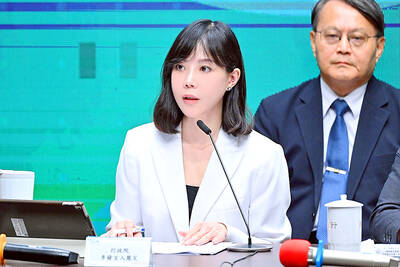
RIGHT DIRECTION: Taiwan’s efforts to prevent forced labor include a proposal to ‘fully prohibit’ employers from withholding workers’ documents, an official said Taiwan is to establish a mechanism to restrict imports of goods linked to forced labor, the Executive Yuan said yesterday, after the US proposed imposing additional tariffs on Taiwanese goods over labor concerns. “The Ministry of Labor and the Ministry of Economic Affairs are to establish an interministerial review procedure,” Executive Yuan spokesperson Michelle Lee (李慧芝) said at a news briefing in Taipei. “The government is to use the Foreign Trade Act [貿易法] as the legal basis to restrict imports of goods produced with forced labor” and bring its supply chain governance more in line with international standards on human rights, resilience
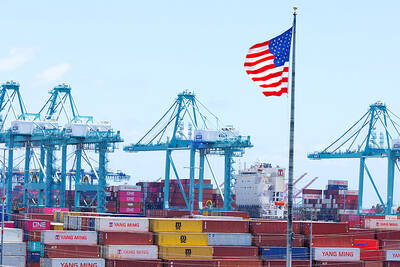
NOT IMMEDIATE: Taiwan has a chance to appeal the proposed 10 percent tariff before it starts, while other countries face a 12.5 percent tariff from the trade office Taiwan is among 60 economies determined by the US to have failed to impose or enforce a ban on the importation of goods produced with forced labor, according to a notice released on Tuesday by the Office of the US Trade Representative (USTR), which proposed imposing an additional 10 percent or more tariff on them. The USTR in a statement said that following an investigation, it had determined under Section 301 of the Trade Act of 1974 that the failure of the 60 economies to impose and effectively enforce a prohibition on the importation of goods produced with forced labor is


 RSS
RSS