


The Legislative Yuan yesterday approved a special defense procurement budget for this year of more than NT$8.811 billion (US$280.75 million) to fund purchases of five US weapons systems.
Lawmakers also passed 35 accompanying resolutions, including a call for the government to fill a funding gap of more than NT$400 billion tied to the development of the “T-Dome” air defense system, covering procurement and commissioned production programs.
Under the special arms procurement act passed by the Legislative Yuan earlier this month, the budget would be financed through government borrowing.
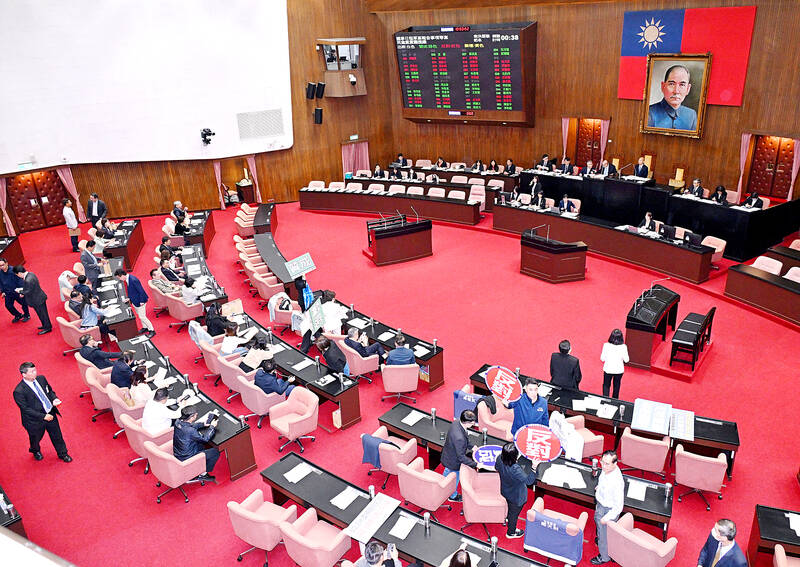
Photo: Fang Pin-chao, Taipei Times
Of the budget, NT$3.9 billion would be allocated for M109A7 self-propelled howitzers, NT$2.8 billion for High Mobility Artillery Rocket Systems (HIMARS), NT$1.8 billion for anti-armor drones, NT$160 million for Javelin anti-tank missiles, and NT$1.4 million for tube-launched, optically tracked, wire command link guided 2B anti-tank missiles.
The budget’s passage is in time for the HIMARS’ payment deadline tomorrow, and is the first annual installment of a broader arms procurement framework approved by lawmakers on May 8.
The framework authorizes up to NT$780 billion in spending between this year and 2033 for US arms purchases, including NT$300 billion for weapons already approved by Washington and NT$480 billion for another package that has yet to be formally announced.
Funding for both arms packages is to be appropriated through annual budgets after Taiwan receives letters of offer and acceptance from the US.
The Executive Yuan approved the first procurement budget on Wednesday last week, proposing about NT$295 billion in spending for the first batch of US arms purchases.
Democratic Progressive Party lawmakers said current regulations exclude key components needed for the “T-Dome” defense system, such as tactical networks, surveillance drones and artificial intelligence-assisted decisionmaking modules.
They warned that could undermine overall system integration and in a resolution called on the Ministry of National Defense to work with the Directorate-General of Budget, Accounting and Statistics and the Ministry of Finance to assess the funding gap in one month, and to consider covering it through annual budgets or supplementary budget proposals.
Chinese Nationalist Party (KMT) lawmakers expressed concerns over the operational effectiveness of the costly anti-armor drone missile systems, citing reports from the Russia-Ukraine battlefield as suggesting that the Altius drones are vulnerable to electronic interference and communication loss, as well as previous test incidents involving crashes and other performance issues.
To address that, the legislature passed a resolution requiring the defense ministry to not rely purely on US military or manufacturer data.
The armed forces must conduct live-fire tests to verify the drones’ strike capabilities and survivability in high-intensity electronic warfare environments, and submit a full report after, the resolution said.
Taiwan People’s Party lawmakers raised questions over changes in reported data for the HIMARS, saying that earlier defense ministry disclosures listed 1,203 precision rocket units, while the current special budget cites 4,320 rounds, despite the overall cost remaining largely unchanged.
The legislature has asked the ministry to explain the discrepancy within two months.
Lawmakers also passed resolutions addressing broader concerns, including a drop in the volunteer force below 80 percent of its target and projections that conscription numbers would fall below 80,000 next year — raising concerns over personnel shortages for high-tech maintenance.
Cybersecurity issues were also highlighted, including a ban on downloading China’s AMap (高德地圖) over fears it could expose tactical positions.
The defense ministry has been asked to submit a long-term recruitment plan and implementation report to avoid a situation where advanced equipment is available, but insufficiently staffed.

A signaling system malfunction disrupted high-speed rail (HSR) services beginning at 8am today, with trains temporarily reduced to three northbound and three southbound trains per hour as authorities conduct inspections. The malfunction occurred on a section of track in Miaoli County during pre-operation checks early this morning, forcing northbound and southbound trains to use a single track, the HSR operator said. The regular schedule has been replaced with three hourly trains offering only nonreserved seating in each direction, stopping at every station, it said, adding that business class cars would still have reserved seating. Departures from terminal stations are scheduled at the top

Taiwan is still in the process of assessing the possibility of recruiting workers from Eswatini, the Ministry of Foreign Affairs said yesterday, adding that its goal is to help Eswatini upgrade its vocational training centers. If there are plans to recruit workers from Eswatini, safeguarding national security, protecting public health and ensuring the employment rights of Taiwanese would be prerequisites, Department of West Asian and African Affairs Director-General Yen Chia-liang (顏嘉良) told a news conference. Key considerations would also include filling labor shortages in specific industries, and fostering bilateral professional and technical exchanges, he said. Yen was asked about the progress of labor

VERBOSE VESSELS: A CGA cutter and a China Coast Guard exchanged verbal barbs for more than a day in Taiwanese-controlled waters before the Chinese vessel left The Taiwanese and Chinese coast guards had a standoff near the strategically located Pratas Islands (Dongsha Islands, 東沙群島) in the north of the South China Sea, the Coast Guard Administration (CGA) said yesterday. The two sides engaged in intense radio exchanges over sovereignty claims during the 33-hour standoff. China Coast Guard vessel 3501 eventually left the restricted waters, 26.6 nautical miles (49.2km) west of the Pratas Islands, at 5pm yesterday, the CGA said. Lying approximately between southern Taiwan and Hong Kong, the Taiwan-controlled Pratas are seen by some security experts as vulnerable to Chinese attack due to their distance — more than
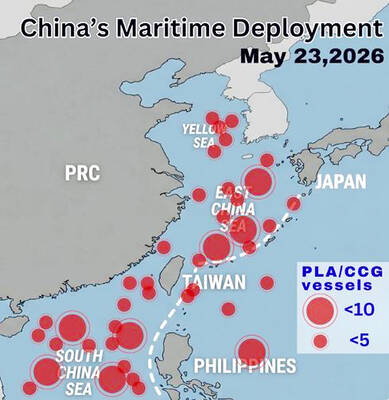
WARNING: China should stop engaging in actions that undermine regional peace and stability, as it would only build resentment among people across the Strait, the CGA said China has deployed more than 100 navy, coast guard and other vessels in waters from the Yellow Sea to the South China Sea and the western Pacific since US President Donald Trump and Chinese President Xi Jinping (習近平) met in Beijing, National Security Council Secretary-General Joseph Wu (吳釗燮) said yesterday. “In this part of the world, #China is the one & only PROBLEM wrecking the #StatusQuo & threatening regional peace & stability,” Wu wrote on X. In a separate post, he said Beijing was coercing Taiwan’s maritime domain, calling it illegal and provocative, after the Coast Guard Administration (CGA) expelled a


 RSS
RSS