


About 20 people were injured at a luxury shopping complex in central Tokyo yesterday after a man sprayed a substance inside, police and fire department officials said.
Tokyo police spokesman Yusuke Koide said that a man sprayed a substance at an ATM on the ground floor of the building, while a local fire department official said “around 20 people were injured” after a report of a “smell.”
The road in front of the mall — in the upmarket shopping district of Ginza — was blocked off following the incident, and fire trucks lined the street.
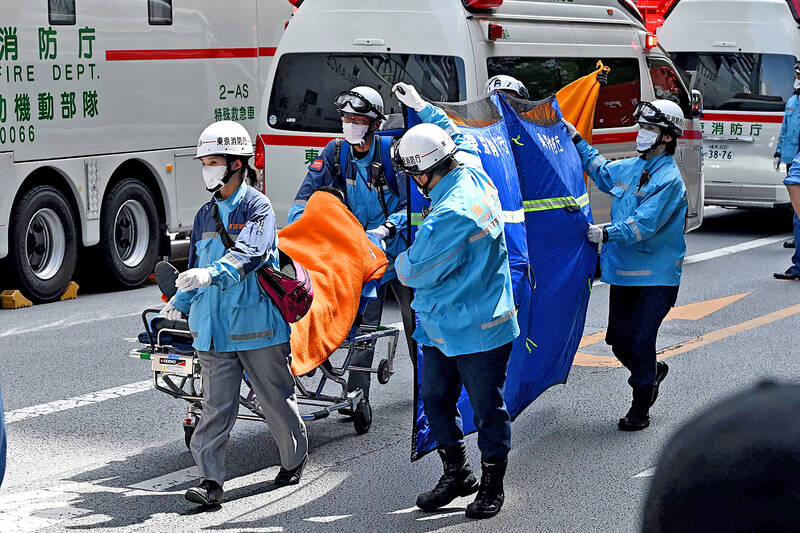
Photo: AFP
However, shoppers continued to come and go from the building using side entrances.
A reporter at the scene saw two people on stretchers being put into an ambulance, while firefighters and officials dressed in hazmat suits took people from the mall into specialized trucks to examine them.
“As of now, 19 people have been transported to hospital,” fire department official Ryosuke Kobayashi told reporters.
Public broadcaster NHK said the injuries appeared to be light.
It said the spray was believed to have contained the irritant capsaicin, the active component of chilli peppers, unidentified investigative sources said.
One 70-year-old woman who was at the mall told the broadcaster that her throat started “stinging and hurting” as she approached the ATM.
“By the time I arrived, the commotion had already started, and I thought there might have been a small fire or something. Once I went into the ATM corner, my throat felt scratchy, almost numb,” she said.
Police are investigating the cause, a fire department officer at the scene said.
Violent crime is relatively rare in Japan, which has a low murder rate and some of the world’s toughest gun laws.
However, there are occasional stabbing attacks and even shootings, including the assassination of former Japanese prime minister Shinzo Abe in 2022.
Fourteen people were injured in a stabbing attack in a factory in central Japan in December last year, during which an unspecified liquid was also sprayed.
Japan remains shaken by the memory of a major subway attack in 1995 when members of the Aum Shinrikyo cult released sarin gas on trains, killing 14 people and making more than 5,800 ill.
Five members of the Aum cult dropped bags of Nazi-developed sarin nerve agent inside morning commuter trains on March 20, 1995, piercing the pouches with sharpened umbrella tips before fleeing.

DRONE CENTRAL: Taiwan aims to become Asia’s democratic hub for drones, with most exports focused on high-quality military-grade models, an official said Taiwan’s drone industry is expected to expand significantly by 2030, producing 100,000 units per month and exporting half of them, the Ministry of Economic Affairs said yesterday. Current drone production capacity is about 15,000 units per month, but the industry can quickly scale up as demand increases, Industrial Development Administration Director-General Chiou Chyou-huey (邱求慧) told a news conference in Taipei. Taiwan’s drone output grew 2.5-fold last year to NT$12.9 billion (US$408.3 million) under a government program to develop the uncrewed vehicle sector, he said. The Executive Yuan in October last year approved plans to invest NT$44.2 billion into domestic production of uncrewed aerial
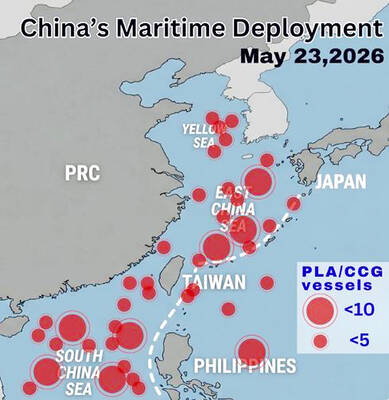
WARNING: China should stop engaging in actions that undermine regional peace and stability, as it would only build resentment among people across the Strait, the CGA said China has deployed more than 100 navy, coast guard and other vessels in waters from the Yellow Sea to the South China Sea and the western Pacific since US President Donald Trump and Chinese President Xi Jinping (習近平) met in Beijing, National Security Council Secretary-General Joseph Wu (吳釗燮) said yesterday. “In this part of the world, #China is the one & only PROBLEM wrecking the #StatusQuo & threatening regional peace & stability,” Wu wrote on X. In a separate post, he said Beijing was coercing Taiwan’s maritime domain, calling it illegal and provocative, after the Coast Guard Administration (CGA) expelled a
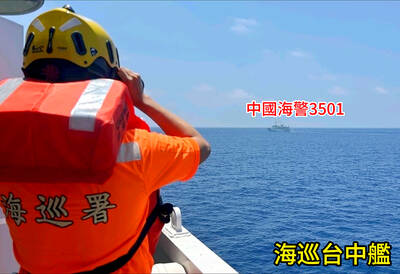
VERBOSE VESSELS: A CGA cutter and a China Coast Guard exchanged verbal barbs for more than a day in Taiwanese-controlled waters before the Chinese vessel left The Taiwanese and Chinese coast guards had a standoff near the strategically located Pratas Islands (Dongsha Islands, 東沙群島) in the north of the South China Sea, the Coast Guard Administration (CGA) said yesterday. The two sides engaged in intense radio exchanges over sovereignty claims during the 33-hour standoff. China Coast Guard vessel 3501 eventually left the restricted waters, 26.6 nautical miles (49.2km) west of the Pratas Islands, at 5pm yesterday, the CGA said. Lying approximately between southern Taiwan and Hong Kong, the Taiwan-controlled Pratas are seen by some security experts as vulnerable to Chinese attack due to their distance — more than
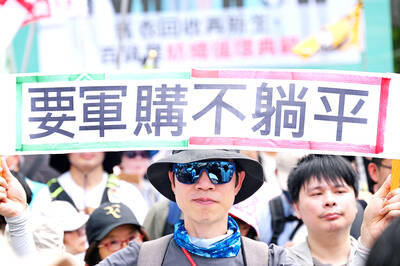
More than 8,000 people took part in a rally in Taipei yesterday to express support for more defense spending, after the opposition slashed the Cabinet’s proposed NT$1.25 trillion (US$39.6 billion) special defense budget and capped it at NT$780 billion. The demonstrators urged the Cabinet to propose another bill. Taiwan Economic Democracy Union convener Lai Chung-chiang (賴中強) said the main problem of the passed budget plan is the removal of funding for critical items, not just that the total amount is smaller. Critical budget items included purchasing or developing uncrewed vehicles, Strong Bow (強弓) missile systems, additional ammunition, artificial intelligence-powered combat systems and Taiwan-US


 RSS
RSS