


Iran yesterday warned that, while some progress had been made, it was not yet close to striking a deal with the US to end the Middle East war, as US President Donald Trump also said he was in no hurry to sign.
World oil prices tumbled on renewed optimism about an agreement, after US Secretary of State Marco Rubio suggested a deal could be reached within the day, but an Iranian Ministry of Foreign Affairs spokesman responded: “No one can make such a claim.”
Trump took to social media to declare: “The deal with Iran will either be a great and meaningful one, or there will be no deal.”

Photo: Reuters
Pakistani Prime Minister Shehbaz Sharif — whose government is spearheading efforts to mediate a negotiated agreement between the US and Iran — met with Chinese President Xi Jinping (習近平) in Beijing.
US and Iranian forces have observed a ceasefire since April 8 while diplomats push for a negotiated settlement, although Iran has maintained controls on Gulf shipping through the Strait of Hormuz and the US Navy has sought to blockade Iran’s ports.
“We thought we might have some news last night, maybe today,” Rubio told reporters during a visit to New Delhi, referring to hopes for a deal.
“We have what I think is a pretty solid thing on the table in terms of their ability to open up the straits, get the straits open,” he said. “We’re either going to have a good agreement or we’re going to have to deal with it another way. We’d prefer to have a good agreement.”
Iranian foreign ministry spokesman Esmaeil Baqaei poured cold water on hopes for a quick final settlement.
“It is correct to say that we have reached a conclusion on a large portion of the issues under discussion, but to say that this means the signing of an agreement is imminent — no one can make such a claim,” he told a weekly news conference.
Baqaei stressed that Iran would continue to manage maritime traffic through the Strait of Hormuz by charging service fees — arguing that this did not amount to Tehran “seeking to collect tolls.”
Israeli Prime Minister Benjamin Netanyahu on Sunday said that he and Trump had agreed that “any final agreement with Iran must eliminate the nuclear threat entirely.”
Ali Vaez, director of the Iran Project at independent monitor the International Crisis Group, said Tehran might have weathered the US assault and feel able to declare a victory, but it would need hundreds of billions of dollars to repair its shattered economy.
“For Iran, the stakes are existential, for the United States they’re short term,” he said.
The US has also spent a fortune of its own and might have to settle for some “vague and pretty generalized promises on the nuclear front with the focus being on reopening the Strait of Hormuz, which wasn’t even closed at the beginning of the conflict,” he said.
“So you have this situation in which basically, yes, both sides will get some of what they need in a memorandum of understanding, but this is coming at an astronomical cost for them and much better options were available to both sides without going through this devastating crisis,” he added.
Iranian officials have said that, despite the long-standing US demand for an end to its uranium enrichment, talks on the issue of Iran’s contested nuclear program have been deferred until after an initial agreement.
The war, which erupted after the US and Israel attacked Iran on Feb. 28 and saw Iran respond with missile and drone attacks across the region, drove energy prices higher.
Crude oil remains expensive, but prices have see-sawed and yesterday’s mood of relative optimism caused prices to plunge by almost 5 percent.
On Saturday, leaders from Saudi Arabia, the United Arab Emirates, Qatar, Egypt, Jordan and Bahrain, as well as representatives from Turkey and Pakistan, joined a call with Trump to discuss the deal.
The focus of international efforts moved to Beijing yesterday, where Sharif and army chief Asim Munir met senior leaders including Xi and Chinese Premier Li Qiang (李強).
Sharif told them that “the world is passing through a critical moment,” Pakistan’s state-run PTV channel reported.

DRONE CENTRAL: Taiwan aims to become Asia’s democratic hub for drones, with most exports focused on high-quality military-grade models, an official said Taiwan’s drone industry is expected to expand significantly by 2030, producing 100,000 units per month and exporting half of them, the Ministry of Economic Affairs said yesterday. Current drone production capacity is about 15,000 units per month, but the industry can quickly scale up as demand increases, Industrial Development Administration Director-General Chiou Chyou-huey (邱求慧) told a news conference in Taipei. Taiwan’s drone output grew 2.5-fold last year to NT$12.9 billion (US$408.3 million) under a government program to develop the uncrewed vehicle sector, he said. The Executive Yuan in October last year approved plans to invest NT$44.2 billion into domestic production of uncrewed aerial
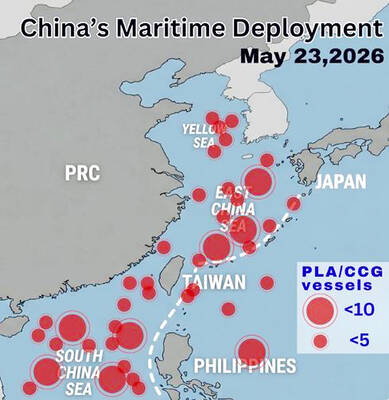
WARNING: China should stop engaging in actions that undermine regional peace and stability, as it would only build resentment among people across the Strait, the CGA said China has deployed more than 100 navy, coast guard and other vessels in waters from the Yellow Sea to the South China Sea and the western Pacific since US President Donald Trump and Chinese President Xi Jinping (習近平) met in Beijing, National Security Council Secretary-General Joseph Wu (吳釗燮) said yesterday. “In this part of the world, #China is the one & only PROBLEM wrecking the #StatusQuo & threatening regional peace & stability,” Wu wrote on X. In a separate post, he said Beijing was coercing Taiwan’s maritime domain, calling it illegal and provocative, after the Coast Guard Administration (CGA) expelled a

VERBOSE VESSELS: A CGA cutter and a China Coast Guard exchanged verbal barbs for more than a day in Taiwanese-controlled waters before the Chinese vessel left The Taiwanese and Chinese coast guards had a standoff near the strategically located Pratas Islands (Dongsha Islands, 東沙群島) in the north of the South China Sea, the Coast Guard Administration (CGA) said yesterday. The two sides engaged in intense radio exchanges over sovereignty claims during the 33-hour standoff. China Coast Guard vessel 3501 eventually left the restricted waters, 26.6 nautical miles (49.2km) west of the Pratas Islands, at 5pm yesterday, the CGA said. Lying approximately between southern Taiwan and Hong Kong, the Taiwan-controlled Pratas are seen by some security experts as vulnerable to Chinese attack due to their distance — more than
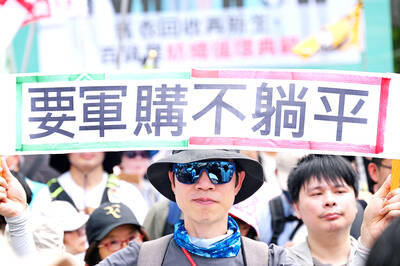
More than 8,000 people took part in a rally in Taipei yesterday to express support for more defense spending, after the opposition slashed the Cabinet’s proposed NT$1.25 trillion (US$39.6 billion) special defense budget and capped it at NT$780 billion. The demonstrators urged the Cabinet to propose another bill. Taiwan Economic Democracy Union convener Lai Chung-chiang (賴中強) said the main problem of the passed budget plan is the removal of funding for critical items, not just that the total amount is smaller. Critical budget items included purchasing or developing uncrewed vehicles, Strong Bow (強弓) missile systems, additional ammunition, artificial intelligence-powered combat systems and Taiwan-US


 RSS
RSS