


The meaning of Taiwanese independence is that “Taiwan is not part of the People’s Republic of China [PRC]” and that “the Republic of China [ROC] and the PRC are not subordinate to each other,” President William Lai (賴清德) said yesterday.
Lai made the remarks at a youth forum for the Democratic Progressive Party’s (DPP) 40th anniversary, and comes after US President Donald Trump warned against Taiwanese independence.
Trump, who wrapped up a state visit to Beijing on Friday, said in an interview that “I’m not looking to have somebody go independent.”
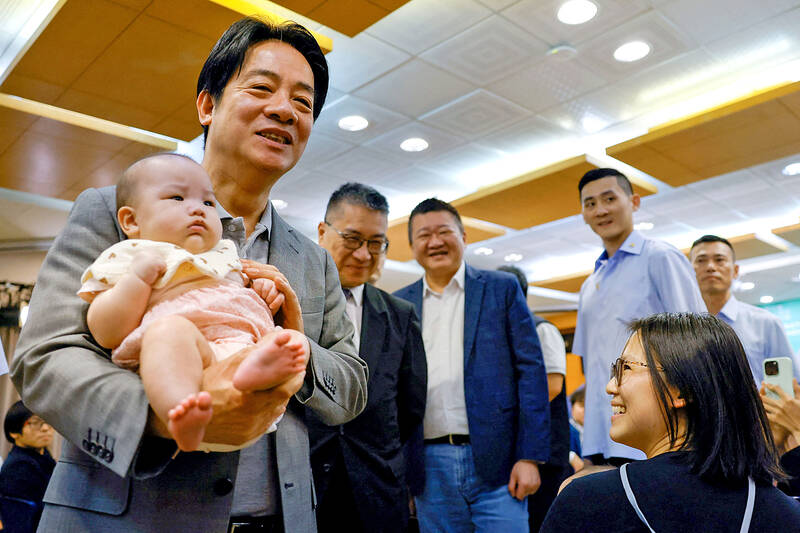
Photo: Ann Wang, Reuters
Sovereignty is the foundation of statehood, Lai said, adding that without Taiwan, there would be no ROC, as the ROC and Taiwan have become inseparable.
Without sovereignty, there would be no democracy, he said.
Regardless of how the international community refers to the nation, all terms refer to the 23 million people of Taiwan, Penghu, Kinmen and Matsu, he said, expressing hope that efforts would be made to safeguard the nation’s sovereignty and democracy, and take care of its people.
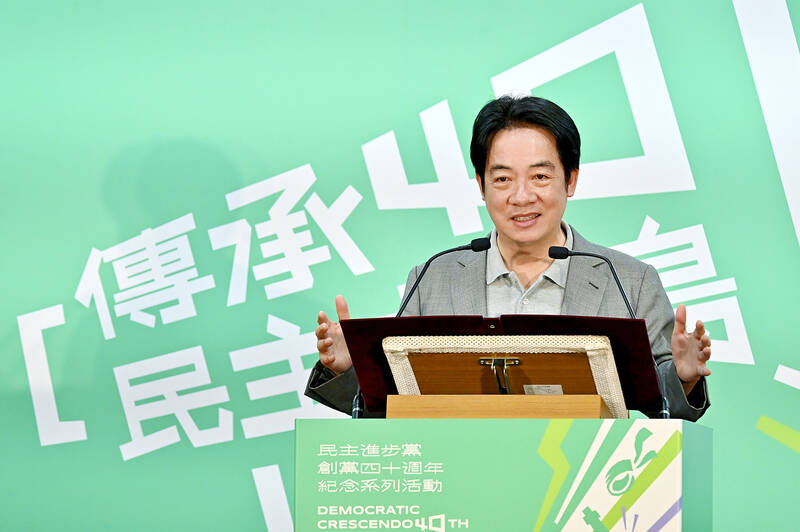
Photo: George Tsorng, Taipei Times
Lai also talked about Taiwan’s democratic pioneers and liberal academics — Free China’s co-founder and publisher Lei Chen (雷震), Yin Hai-kuang (殷海光) and Fu Cheng (傅正), who he said sought to use the idea of a “democratic China” to counter “communist China.”
However, after the Chinese Nationalist Party (KMT) government imposed martial law on May 20, 1949, Lei and others began advocating for the interests of Taiwanese and the nation’s long-term development, he said.
He summarized those into three major propositions.
First, the pioneers believed any attempt to “retake the mainland” was futile and that core national policies should not be based on unrealistic goals.
Second, they supported allowing the formation of new political parties to provide oversight of the government.
Third, Lei proposed that the nation’s name be changed to the Democratic State of China-Taiwan (中華台灣民主國), a state distinct from mainland China.
Those propositions aligned with A Declaration of Formosan Self-Salvation (台灣人民自救運動宣言), a manifesto by Peng Ming-min (彭明敏), Hsieh Tsung-min (謝聰敏) and Wei Ting-chao (魏廷朝) in the 1970s, he said.
The establishment of the DPP on Sept. 28, 1986, was the culmination of the goals of party politics and democratization that Taiwanese society had pursued for decades, he said.
Regarding the goal of creating a state distinct from China, he said that the DPP National Congress in 1991 had proposed drafting a new constitution and establishing a “Republic of Taiwan,” in accordance with the ideas advocated by the pioneers.
However, the Resolution on Taiwan’s Future (台灣前途決議文), passed by the DPP National Congress in 1999, is the guiding principle of the party, he said.
The resolution declares that Taiwan is an independent sovereign state, whose name is the ROC, and that the ROC and the PRC are not subordinate to each other, with any change in the “status quo” to be decided by Taiwanese, he said.
He also brought up the “four commitments” touted by former president Tsai Ing-wen (蔡英文) in her Double Ten National Day speech in 2021.
The Taiwanese government and its people “are committed to maintaining a free and democratic constitutional system; ensuring that the ROC and the PRC will not be subordinate to each other; resisting annexation or encroachment upon Taiwan’s sovereignty; and guaranteeing that the future of the ROC is decided by the will of Taiwanese,” Tsai said.
Whether through the DPP’s Resolution on Taiwan’s Future or Tsai’s “four commitments,” these principles represent the policies pursued by the DPP and its government, Lai said.
Later yesterday through a post on Facebook, Lai outlined five key points after a national security briefing earlier in the day on Trump’s meeting with Chinese President Xi Jinping (習近平).
The five key points were: Taiwan serves as a guardian of peace and stability in the Taiwan Strait and the wider region; China is the main source of regional instability and is attempting to alter the “status quo”; defending the ROC’s status does not equate to pursuing “Taiwanese independence;” security cooperation and arms sales with the US are crucial for regional stability; and Taiwan is a core global interest, with peace in the Taiwan Strait non-negotiable.
“We have also noted that the US government, including President Trump and Secretary of State Marco Rubio, have repeatedly reaffirmed that Washington’s long-standing policy toward Taiwan remains unchanged,” he said. “I want to express my gratitude to the US government for its ongoing support of Taiwan and its commitment to peace and stability in the Taiwan Strait.”


RESILIENCE: Taiwan plays a key role in semiconductors, energy, information infrastructure and advanced manufacturing, AIT Director Raymond Greene said Taiwan’s continued investment in deterrence and resilience remains vital, especially in uncrewed systems and other emerging technologies, American Institute in Taiwan (AIT) Director Raymond Greene said yesterday. Greene made the remarks at the annual National Strategic Summit on Supply Chain Resilience held by the Research Institute for Democracy, Society and Emerging Technology (DSET), a government-backed think tank. As Taiwan last year became the US’ fourth-largest trading partner and supply chain security is becoming more important, cooperation in emerging technologies continues to deepen between the two countries, he said. The US is committed to accelerating innovation, building key infrastructure, strengthening cooperation

The National Chungshan Institute of Science and Technology yesterday showcased its locally developed variants of the Vision 60 robotic patrol dog, which it plans to deploy on the nation’s outlying territories in the South China Sea. The variants were produced under the Joint Lab project — created by the institute and domestic companies — and assembled with domestically produced motors, lenses and artificial intelligence (AI) systems alongside licensed tech from the US, Missile and Rocket Systems Research Division deputy director Jen Kuo-kang (任國光) told the media event at a military base in Taipei’s Dazhi (大直) area. Taiwan has built up its strengths

RIGHT DIRECTION: Taiwan’s efforts to prevent forced labor include a proposal to ‘fully prohibit’ employers from withholding workers’ documents, an official said Taiwan is to establish a mechanism to restrict imports of goods linked to forced labor, the Executive Yuan said yesterday, after the US proposed imposing additional tariffs on Taiwanese goods over labor concerns. “The Ministry of Labor and the Ministry of Economic Affairs are to establish an interministerial review procedure,” Executive Yuan spokesperson Michelle Lee (李慧芝) said at a news briefing in Taipei. “The government is to use the Foreign Trade Act [貿易法] as the legal basis to restrict imports of goods produced with forced labor” and bring its supply chain governance more in line with international standards on human rights, resilience

NOT IMMEDIATE: Taiwan has a chance to appeal the proposed 10 percent tariff before it starts, while other countries face a 12.5 percent tariff from the trade office Taiwan is among 60 economies determined by the US to have failed to impose or enforce a ban on the importation of goods produced with forced labor, according to a notice released on Tuesday by the Office of the US Trade Representative (USTR), which proposed imposing an additional 10 percent or more tariff on them. The USTR in a statement said that following an investigation, it had determined under Section 301 of the Trade Act of 1974 that the failure of the 60 economies to impose and effectively enforce a prohibition on the importation of goods produced with forced labor is


 RSS
RSS