


Taiwan has begun planning for 6G, with a spectrum strategy expected to be proposed by the end of this year, the Ministry of Digital Affairs said yesterday.
The government has been examining next-generation communication spectrums and techniques in preparation for 6G commercial operations, Department of Resources Management director-general Tseng Wen-fang (曾文方) said.
Mobile communications technology tends to take a generational leap every 10 years and could deeply change people’s lives, she said.

Photo: AFP
The development of 6G systems would move toward ubiquitous connectivity, integrated sensing and computation, and self-optimizing management based on artificial intelligence (AI), Tseng said.
Telecommunications networks would no longer just be a data transmission tool, but would become an infrastructure with smart decisionmaking capabilities, she added.
Although 6G systems would not be commercialized until 2030, the government must complete spectrum assessments, planning and preparation beforehand, she said.
Spectrum refarming and preparation is like an “invisible urban renewal,” Tseng said.
Frequency bands are like finished houses, and spectrum licensing would lead to demolishing “old houses” to rebuild them, she said.
Given the increasing demand for AI, smart Internet of Things and high-bandwidth applications, the current spectrum capacity is no longer sufficient, she said, adding that the government must find extra spectrum resources.
The renewal of the radio frequency spectrum requires time-consuming coordination and communication, Tseng said.
Wireless communications rely on invisible radio waves for transmission, while different frequency bands could interfere with one another, she said.
The government must examine the spectrum and conduct frequency shifts to create space for next-generation communication technology, Tseng said.
The ministry said planning for 6G is different from 4G and 5G systems, mainly because it involves a 20-year opportunity to issue large-scale spectrum licenses.
It expects spectrum licensing for 6G to encourage telecom operators to introduce more next-generation technologies, rather than using existing frequency bands without improvements, it added.
The ministry said it is examining a few promising frequency bands, such as the lower 600MHz band and upper 6GHz band, which includes frequencies from 6425MHz to 7125MHz.
The 4.7GHz to 5GHz mid-band is also being evaluated, it said.
Tseng said lower bands have advantages, such as broad coverage and strong penetration, making them suitable for rural or mountainous areas.
On the other hand, mid and high-frequency bands offer greater bandwidth capacity, she said, adding different bands must be used to balance coverage and high-speed transmission.
The department said the first-phase interview of telecommunications operators, equipment vendors and spectrum users has been conducted to understand the possibility and needs of frequency conversion.
Ministry senior technical specialist Chen Wei-cheng (陳威呈) said Taiwan’s 6G spectrum plan would align with international standards.
The plan must consider developments in other countries, terminal equipment supply chains and the overall industry ecosystem, he said.
If Taiwan chooses frequency bands that are too different from international counterparts, developments in mobile phone supply, international roaming services and the overall industry might be hampered, Chen said.
Next year’s World Radiocommunication Conference 2027 could serve as an important international indicator, as it would help confirm which bands are internationally acknowledged, Chen said.
Licensed telecommunications operators must complete the construction of base stations and procedures required by the National Communications Commission, he said, adding that preparations would require at least one year.
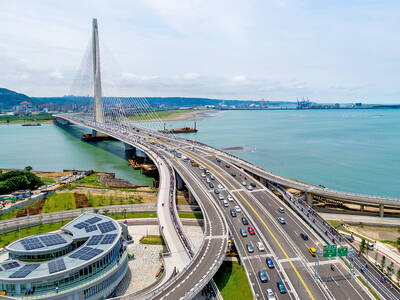
The Ministry of Transportation and Communications yesterday inaugurated the Danjiang Bridge across the Tamsui River in New Taipei City, saying that the structure would be an architectural icon and traffic artery for Taiwan. Feted as a major engineering achievement, the Danjiang Bridge is 920m long, 211m tall at the top of its pylon, and is the longest single-pylon asymmetric cable-stayed bridge in the world, the government’s Web site for the structure said. It was designed by late Iraqi-British architect Zaha Hadid. The structure, with a maximum deck of 70m, accommodates road and light rail traffic, and affords a 200m navigation channel for boats,
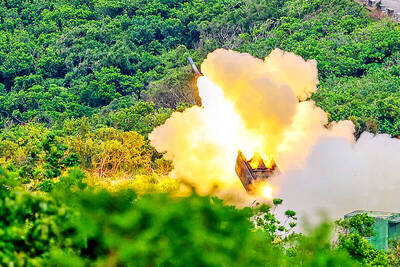
PRECISION STRIKES: The most significant reason to deploy HIMARS to outlying islands is to establish a ‘dead zone’ that the PLA would not dare enter, a source said A High Mobility Artillery Rocket System (HIMARS) would be deployed to Penghu County and Dongyin Island (東引) in Lienchiang County (Matsu) to force the Chinese military to retreat at least 100km from the coastline, a military source said yesterday. Taiwan has been procuring HIMARS and Army Tactical Missile Systems (ATACMS) from the US in batches. Once all batches have been delivered, Taiwan would possess 111 HIMARS units and 504 ATACMS, which have a range of 300km. Considering that “offense is the best defense,” the military plans to forward-deploy the systems to outlying islands such as Penghu and Dongyin so that

Taiwan Semiconductor Manufacturing Co (TSMC, 台積電), the world’s largest foundry service provider, yesterday said that global semiconductor revenue is projected to hit US$1.5 trillion in 2030, after the figure exceeds US$1 trillion this year, as artificial intelligence (AI) demand boosts consumption of token and compute power. “We are still at the beginning of the AI revolution, but we already see a significant impact across the whole semiconductor ecosystem,” TSMC deputy cochief operating officer Kevin Zhang (張曉強) said at the company’s annual technology symposium in Hsinchu City. “It is fair to say that in the past decade, smartphones and other mobile devices were

‘CLEAR MESSAGE’: The bill would set up an interagency ‘tiger team’ to review sanctions tools and other economic options to help deter any Chinese aggression toward Taiwan US Representative Young Kim has introduced a bill to deter Chinese aggression against Taiwan, calling for an interagency “tiger team” to preplan coordinated sanctions and economic measures in response to possible Chinese military or political action against Taiwan. “[Chinese President] Xi Jinping [習近平] has directed the People’s Liberation Army to be ready to invade Taiwan by 2027. China has a plan. America should have one too,” Kim said in a news release on Thursday last week. She introduced the “Deter PRC [People’s Republic of China] aggression against Taiwan act” to “ensure the US has a coordinated sanctions strategy ready should


 RSS
RSS