


US Republican and Democratic lawmakers have urged US President Donald Trump’s administration to continue with weapons sales to Taiwan after Trump on Friday said he has not made a decision on whether to move forward with an arms package for the nation.
Trump made the statement en route to Washington after a state visit to China.
He said he and Chinese President Xi Jinping (習近平) “talked a lot about Taiwan” during their meeting and confirmed Xi had brought up the weapons sale.
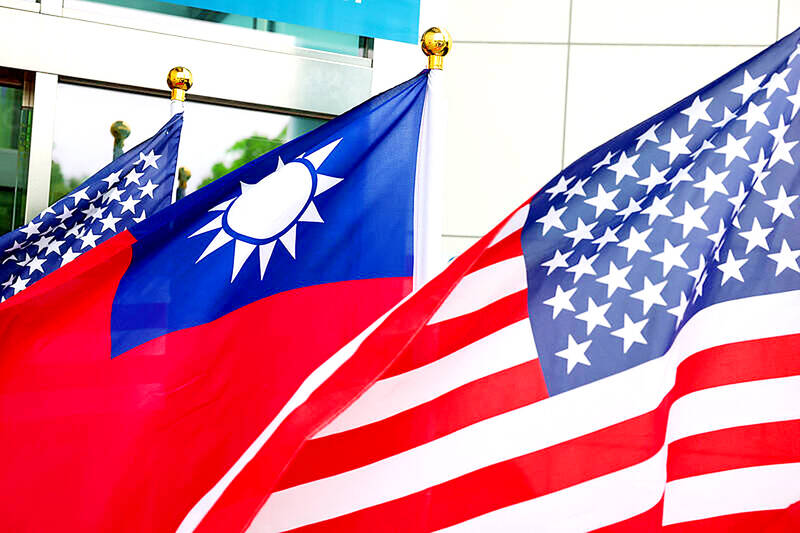
Photo: I-Hwa Cheng, AFP
Taiwan has long enjoyed strong bipartisan support in the US Congress, with lawmakers consistently pressing the Trump administration to move forward with a US$14 billion arms sale to Taiwan, which was approved by the Congress in January, but has been delayed.
US Representative Michael McCaul was quoted by CBS News as saying that the US must “arm Taiwan so they can defend themselves for deterrence against Chairman Xi.”
During the summit, Xi was “very aggressive” regarding Taiwan and “most of what [Xi] talked about was Taiwan,” McCaul was cited as saying.
US Representative Gregory Meeks also stressed the importance of US support for Taiwan’s defenses.
Meeks was among those who had urged Trump ahead of the summit to approve the delayed package before meeting with Xi, “warning that delaying Taiwan arms sales could weaken deterrence of Chinese aggression in the Taiwan Strait,” CBS News reported.
“I think it is important for us to make sure that Taiwan does have what it needs to defend itself,” it reported Meeks as saying.
Xi has “leverage over the president,” but not “over the US Congress and the American people,” Meeks said, adding that the US Congress has already acted on the package and “the president is the one that’s holding it up.”
US Representative John Moolenaar also expressed his support in a social media post, saying: “The Chinese Communist Party has never governed Taiwan yet continues to threaten force.”
The US “will stand by its commitments, support Taiwan’s defense, and oppose unilateral attempts to change the status quo,” he added.
US senators Jeanne Shaheen, Chris Coons, Chris Murphy, Tim Kaine, Jeff Merkley, Cory Booker, Brian Schatz, Chris Van Hollen, Tammy Duckworth and Jacky Rosen in a joint statement after the Trump-Xi meeting said that they were “deeply disturbed by President Trump’s refusal to defend America’s support for Taiwan during this summit, including by consulting with President Xi regarding US obligations to help provide for Taiwan’s defense.”
“We call on the administration to formally notify the US$14 billion in US arms sales that Congress pre-approved in January 2026. As established by the Taiwan Relations Act of 1979,” they said, adding that the US Congress will continue to ensure that the US supports Taiwan, including by rejecting any attempt to alter the “status quo” by force or coercion.
US Representative Zachary Nunn said the US will “stand firm” if China continues to be “belligerent” on Taiwan, while US Representative Greg Stanton said that any move on Taiwan by Xi could trigger a global recession, adding the US “must support the people of Taiwan in their self defense.”
US senator John Curtis said the special defense budget bill that Taiwan recently passed is a crucial investment in deterrence and stability across the Taiwan Strait, and it demonstrates Taiwan’s commitment to its self-defense and readiness to procure defense systems from the US.
The US$14 billion arms package to Taiwan fulfills the US’ long-standing commitment to Taiwan and would help safeguard US national and economic security, he added.
US Representative Ro Khanna, Ranking Member of the US House Select Committee on Strategic Competition between the United States and the Chinese Communist Party, told CBS News that he is “concerned about” Taiwan following Trump’s meeting with Xi.
“The Taiwan Relations Act from 1979 is clear that the United States will support Taiwan to make sure that China does not use military coercion. The reality is, as people know, that China is tightening the noose around Taiwan,” he said.
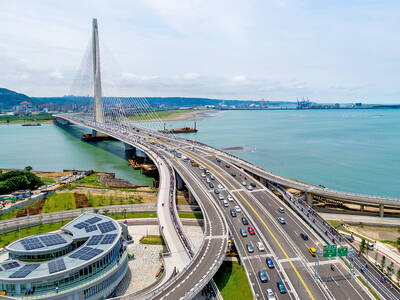
The Ministry of Transportation and Communications yesterday inaugurated the Danjiang Bridge across the Tamsui River in New Taipei City, saying that the structure would be an architectural icon and traffic artery for Taiwan. Feted as a major engineering achievement, the Danjiang Bridge is 920m long, 211m tall at the top of its pylon, and is the longest single-pylon asymmetric cable-stayed bridge in the world, the government’s Web site for the structure said. It was designed by late Iraqi-British architect Zaha Hadid. The structure, with a maximum deck of 70m, accommodates road and light rail traffic, and affords a 200m navigation channel for boats,
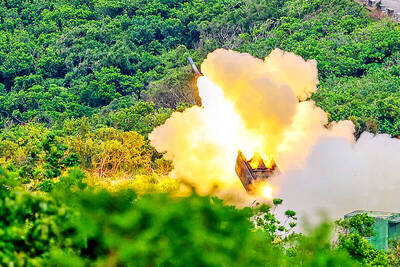
PRECISION STRIKES: The most significant reason to deploy HIMARS to outlying islands is to establish a ‘dead zone’ that the PLA would not dare enter, a source said A High Mobility Artillery Rocket System (HIMARS) would be deployed to Penghu County and Dongyin Island (東引) in Lienchiang County (Matsu) to force the Chinese military to retreat at least 100km from the coastline, a military source said yesterday. Taiwan has been procuring HIMARS and Army Tactical Missile Systems (ATACMS) from the US in batches. Once all batches have been delivered, Taiwan would possess 111 HIMARS units and 504 ATACMS, which have a range of 300km. Considering that “offense is the best defense,” the military plans to forward-deploy the systems to outlying islands such as Penghu and Dongyin so that

Taiwan Semiconductor Manufacturing Co (TSMC, 台積電), the world’s largest foundry service provider, yesterday said that global semiconductor revenue is projected to hit US$1.5 trillion in 2030, after the figure exceeds US$1 trillion this year, as artificial intelligence (AI) demand boosts consumption of token and compute power. “We are still at the beginning of the AI revolution, but we already see a significant impact across the whole semiconductor ecosystem,” TSMC deputy cochief operating officer Kevin Zhang (張曉強) said at the company’s annual technology symposium in Hsinchu City. “It is fair to say that in the past decade, smartphones and other mobile devices were
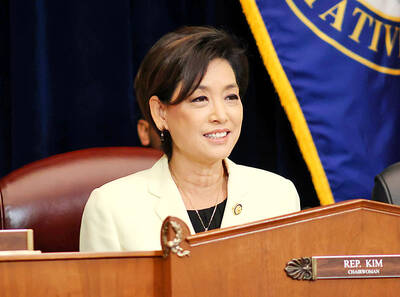
‘CLEAR MESSAGE’: The bill would set up an interagency ‘tiger team’ to review sanctions tools and other economic options to help deter any Chinese aggression toward Taiwan US Representative Young Kim has introduced a bill to deter Chinese aggression against Taiwan, calling for an interagency “tiger team” to preplan coordinated sanctions and economic measures in response to possible Chinese military or political action against Taiwan. “[Chinese President] Xi Jinping [習近平] has directed the People’s Liberation Army to be ready to invade Taiwan by 2027. China has a plan. America should have one too,” Kim said in a news release on Thursday last week. She introduced the “Deter PRC [People’s Republic of China] aggression against Taiwan act” to “ensure the US has a coordinated sanctions strategy ready should


 RSS
RSS