


President William Lai (賴清德) on May 20, his second anniversary in office, is expected to announce a comprehensive plan to address the nation’s declining birthrate, focusing on childbirth, child-rearing, education, housing and the workplace, sources said yesterday.
It is expected to expand the childcare policy to cover minors up to 18 years old, up from six, they said.
The policy provides direct allowance for caring for children at home or at childcare facilities, caps out-of-pocket fees for attending non-private kindergartens and seeks to expand the capacity of these institutions.
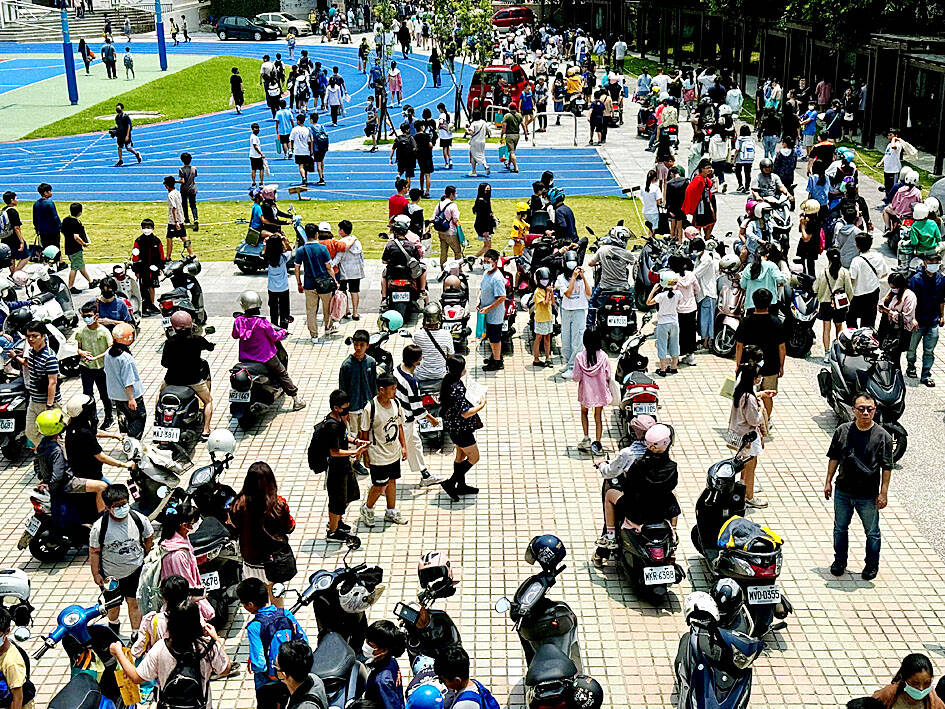
Photo: Hung Mei-hsiu, Taipei Times
The new policy would prioritize gender equality and family-friendly workplaces by enhancing paternity leave and temporary care leave, with the government evaluating subsidies to ease the burden on businesses.
The number of babies born last year was 107,812, dropping for the 10th consecutive year and hitting a new low, government data showed, making Taiwan the nation with the lowest birthrate among major global economies.
Lai has said the declining birthrate is a national security issue.
The current childcare policy — which costs about NT$120 billion (US$3.79 billion) a year — is not enough, he said, vowing to propose a more comprehensive plan.
The Presidential Office and Executive Yuan have held intensive meetings to discuss policy direction, and have listened to opinions and suggestions from Democratic Progressive Party lawmakers and other stakeholders, sources said.
Existing policies are being reviewed and new plans are being formulated, they added.
Following the announcement of the initiative, the Executive Yuan is expected to approve the policies during its weekly Cabinet meeting the next day, with full implementation expected in the second half of the year, sources said.
Minister Without Portfolio Chen Shih-chung (陳時中) yesterday said the policy’s main focus is ensuring comprehensive care and proper upbringing of children into their teenage years.
It also prioritizes gender-equal and friendly workplaces, so parents can care for their children without worry, he said.
Policy details have not yet been finalized, as it involves massive funding and final considerations must be made on how to achieve a budgetary balance, Chen added.
An anonymous Executive Yuan official said the administration considers the demographic crisis a top priority.
The new initiative is centered on five major points — childbirth, child-rearing, education, housing and the workplace — to ease the financial, time and caregiving pressures on young families, the official said.
Regarding housing improvements, a “version 2.0” of the a preferential loan program for young homebuyers would be introduced after the current scheme expires at the end of July, the official said.
Central government social housing projects are expected to lease out more than 1,000 family housing units starting this year, they said, adding that existing rent subsidies would also be maintained.
To create more family-friendly workplaces, public institutions, state-owned enterprises and government agencies would be pushed to establish infant care centers and preschools, the official said.
Private companies would also be encouraged to set up their own childcare facilities, the official added.
The government plans to provide financial support for such corporate facilities through a “quasi-public” policy framework and is reviewing regulations related to establishing them, they said.
The government earlier this year launched an expanded subsidy plan that ensures birth benefits across social insurance programs are increased to NT$100,000 per child, the official said, adding that the third version of the in vitro fertilization subsidy program now offers up to NT$150,000 for first-time applicants.
Subsidies for private university tuition, dormitory fees and scholarships for doctorate degree programs would also continue, they said.
The Ministry of Education has launched a trial program offering monthly stipends of NT$8,000 to NT$10,000 for 8,000 economically disadvantaged, but high-achieving students, they added.

A signaling system malfunction disrupted high-speed rail (HSR) services beginning at 8am today, with trains temporarily reduced to three northbound and three southbound trains per hour as authorities conduct inspections. The malfunction occurred on a section of track in Miaoli County during pre-operation checks early this morning, forcing northbound and southbound trains to use a single track, the HSR operator said. The regular schedule has been replaced with three hourly trains offering only nonreserved seating in each direction, stopping at every station, it said, adding that business class cars would still have reserved seating. Departures from terminal stations are scheduled at the top

Taiwan is still in the process of assessing the possibility of recruiting workers from Eswatini, the Ministry of Foreign Affairs said yesterday, adding that its goal is to help Eswatini upgrade its vocational training centers. If there are plans to recruit workers from Eswatini, safeguarding national security, protecting public health and ensuring the employment rights of Taiwanese would be prerequisites, Department of West Asian and African Affairs Director-General Yen Chia-liang (顏嘉良) told a news conference. Key considerations would also include filling labor shortages in specific industries, and fostering bilateral professional and technical exchanges, he said. Yen was asked about the progress of labor

VERBOSE VESSELS: A CGA cutter and a China Coast Guard exchanged verbal barbs for more than a day in Taiwanese-controlled waters before the Chinese vessel left The Taiwanese and Chinese coast guards had a standoff near the strategically located Pratas Islands (Dongsha Islands, 東沙群島) in the north of the South China Sea, the Coast Guard Administration (CGA) said yesterday. The two sides engaged in intense radio exchanges over sovereignty claims during the 33-hour standoff. China Coast Guard vessel 3501 eventually left the restricted waters, 26.6 nautical miles (49.2km) west of the Pratas Islands, at 5pm yesterday, the CGA said. Lying approximately between southern Taiwan and Hong Kong, the Taiwan-controlled Pratas are seen by some security experts as vulnerable to Chinese attack due to their distance — more than
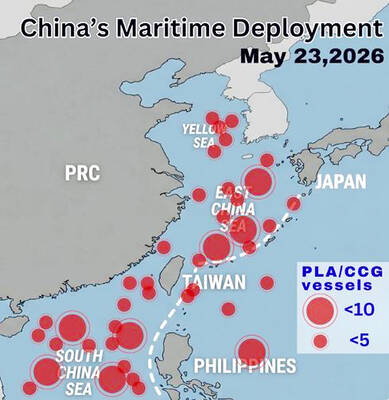
WARNING: China should stop engaging in actions that undermine regional peace and stability, as it would only build resentment among people across the Strait, the CGA said China has deployed more than 100 navy, coast guard and other vessels in waters from the Yellow Sea to the South China Sea and the western Pacific since US President Donald Trump and Chinese President Xi Jinping (習近平) met in Beijing, National Security Council Secretary-General Joseph Wu (吳釗燮) said yesterday. “In this part of the world, #China is the one & only PROBLEM wrecking the #StatusQuo & threatening regional peace & stability,” Wu wrote on X. In a separate post, he said Beijing was coercing Taiwan’s maritime domain, calling it illegal and provocative, after the Coast Guard Administration (CGA) expelled a


 RSS
RSS