


The government’s special defense budget is key to the armed forces’ plans to augment command and control, lethality, defense resilience and full-domain awareness, a top Ministry of National Defense official told a Cabinet meeting yesterday.
The military’s ability to make snap decisions, maintain situational awareness, strike with power and develop endurance depends on achieving those objectives, said Lieutenant General Huang Wen-chi, director of the Department of Strategic Planning.
To fight on the modern battlefield, the armed forces need artificial intelligence-enhanced command, control, communications, computers, cyber, intelligence, surveillance and reconnaissance systems to replace analogue technology, Huang said.
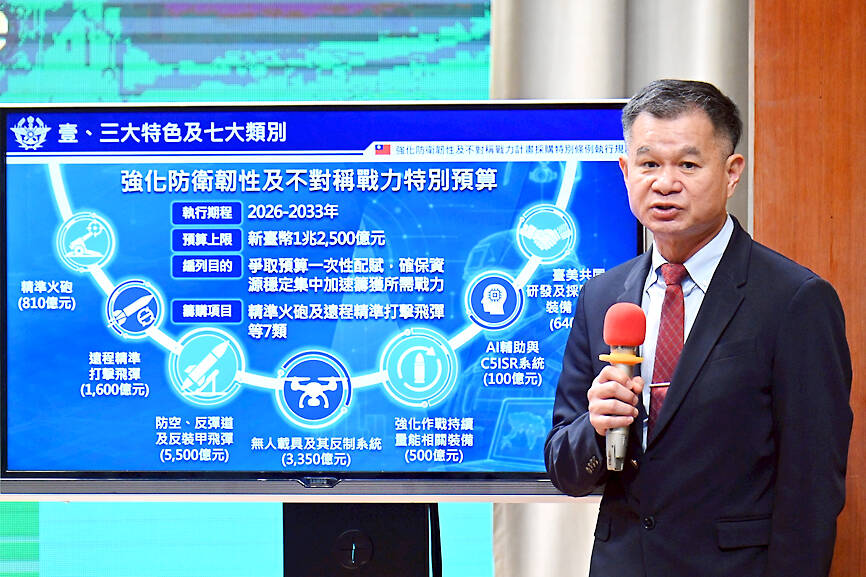
Photo courtesy of the Executive Yuan
The special budget’s provisions for Taiwan Tactical Network and Team Awareness Kit systems are designed for that purpose, he said, referring to a proposed military informational architecture using militarized mobile devices.
The ministry plans to sharpen the armed forces’ full-domain awareness by deploying a fleet of uncrewed reconnaissance assets consisting of Albatross IIs, and vertical takeoff and landing drones based on coastal platforms to be selected later, he said.
The uncrewed aerial vehicles (UAVs) would enable the military to detect Chinese landing sites and weaken their forces with precision fire, Huang said.
Taiwan has a compelling need to build up its defense industrial base and ammunition stockpiles to ensure the lethality and resilience of its military in a full-scale conflict, he said.
Taiwan’s armed forces, with less than 120 days of ammunition reserves and inadequate production volumes of military materiel, are ill-suited to endure a Chinese naval blockade, Huang said.
The nation especially needs to increase its stocks of missile defense interceptors and ammunition for counteramphibious operations, he said.
That means buying foreign-produced weapons while the nation works on a long-term project to open assembly lines for indigenous systems, he said.
The spending bill would also provide funding for single-operator drone jammers to fend off Chinese drones, he said.
Although the ministry has not settled on the make and model, multiple suppliers have developed person-portable jammers that can simultaneously engage multiple UAVs, which would give company-sized units a credible anti-UAV defense, he said.
Counterdrone capabilities are critical for the armed forces in a conflict with China, a premier manufacturer of small and medium-sized UAVs, he said.
“The drone threat is urgent and must be dealt with immediately,” he said.
Meanwhile, the Ministry of Economic Affairs touted advances in Taiwan’s UAV sector, saying that the industry is on track to establish non-Chinese supply chains for parts and whole platforms.
The nation’s drone exports were US$115 million in the first quarter, or 120 percent of the total value of all UAV exports last year, Industrial Development Administration Director-General Chiou Chyou-huey (邱求慧) said.
The government estimates that the value of UAV exports for the whole of this year would exceed US$250 million and double that in 2030, Chiuo said.
More than 267 enterprises from across Taiwan are engaged in the drone industry, producing UAV integration systems, propulsion modules, communications components and flight control software, he said.
The government is pushing to integrate central and local resources to increase supply chain efficiency, and research and development projects as part of Taiwan’s bid to cultivate a drone industry, he said.
Taiwan has signed memoranda of understanding (MOUs) on UAVs with nine countries, including the US and Japan, showing that the domestic drone industry is internationally trusted and strategically well-deployed, he said.
More than 20 Taiwanese tech companies, including Chorecronic Corp (中強光電) and Getac Technology Corp (神基), are working with Skydio, Anduril and other US-based UAV manufacturers, Chiuo said.
Taiwanese firms have also broken into the European market, with the inking of an MOU on the collaborative production of cameras, engines and airframes with Parrot, Europe’s largest drone maker, he added.
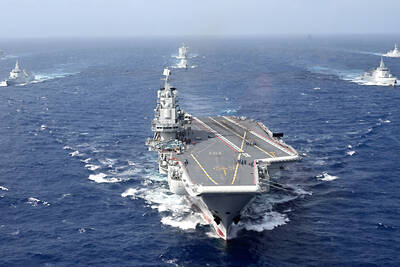
PROVOCATIVE: Chinese Deputy Ambassador to the UN Sun Lei accused Japan of sending military vessels to deliberately provoke tensions in the Taiwan Strait China denounced remarks by Japan and the EU about the South China Sea at a UN Security Council meeting on Monday, and accused Tokyo of provocative behavior in the Taiwan Strait and planning military expansion. Ayano Kunimitsu, a Japanese vice foreign minister, told the Council meeting on maritime security that Tokyo was seriously concerned about the situation in the East China and South China seas, and reiterated Japan’s opposition to any attempt to change the “status quo” by force, and obstruction of freedom of navigation and overflight. Stavros Lambrinidis, head of the EU delegation to the UN, also highlighted South China Sea
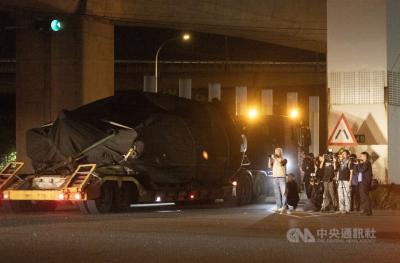
The final batch of 28 M1A2T Abrams tanks purchased from the US arrived at Taipei Port last night and were transported to the Armor Training Command in Hsinchu County’s Hukou Township (湖口), completing the military’s multi-year procurement of 108 of the tanks. Starting at 12:10am today, reporters observed more than a dozen civilian flatbed trailers departing from Taipei Port, each carrying an M1A2T tank covered with black waterproof tarps. Escorted by military vehicles, the convoy traveled via the West Coast Expressway to the Armor Training Command, with police implementing traffic control. The army operates about 1,000 tanks, including CM-11 Brave Tiger
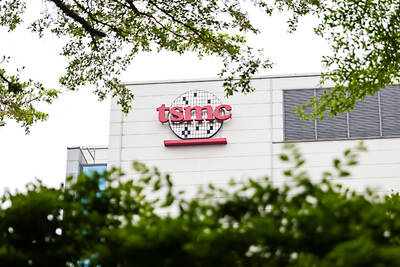
Taiwan Semiconductor Manufacturing Co (TSMC, 台積電), the world’s largest contract chipmaker, said it expects its 2-nanometer (2nm) chip capacity to grow at a compound annual rate of 70 percent from this year to 2028. The projection comes as five fabs begin volume production of 2-nanometer chips this year — two in Hsinchu and three in Kaohsiung — TSMC senior vice president and deputy cochief operating officer Cliff Hou (侯永清) said at the company’s annual technology symposium in Silicon Valley, California, last week. Output in the first year of 2-nanometer production, which began in the fourth quarter of last year, is expected to
ESWATINI TRIP: The ‘irresponsible actions’ of three African nations set a dangerous precedent and they should be held accountable, a US representative said The US Senate Foreign Relations Committee on Thursday urged Washington not to normalize Chinese pressure, while a US lawmaker called on the US government to hold countries accountable for yielding to Beijing’s pressure to block President William Lai’s (賴清德) planned trip to Eswatini. Lai had been scheduled to visit Eswatini to attend birthday events for King Mswati III of Eswatini this week, but on Tuesday, the eve of his planned departure on Wednesday, the Presidential Office said the trip was “suspended” after the Seychelles, Mauritius and Madagascar unexpectedly withdrew overflight permission. “China reportedly pressured Mauritius, Seychelles, and Madagascar to deny airspace access


 RSS
RSS