


A former Taiwan Semiconductor Manufacturing Co (TSMC, 台積電) engineer has been sentenced to 10 years in prison for his role in leaking trade secrets involving the company’s advanced 2-nanometer process, a court ruled yesterday.
The Intellectual Property and Commercial Court found Chen Li-ming (陳力銘) guilty of contraventing the National Security Act (國家安全法), and of other offenses related to the unauthorized acquisition and the use of Taiwan’s “national core key technologies.”
The ruling can be appealed.
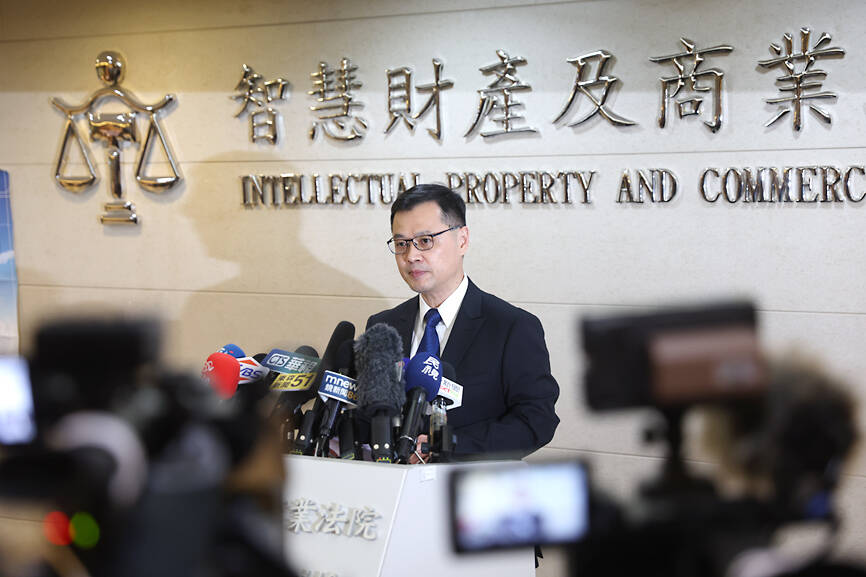
Photo: CNA
The case is the first involving a corporate entity under the National Security Act.
Two other TSMC engineers — Wu Ping-chun (吳秉駿) and Ko Yi-ping (戈一平) — were sentenced to three and two years in prison respectively, while another employee, Chen Wei-chieh (陳韋傑), received a six-year sentence.
A fourth defendant, Lu Yi-yin (盧怡尹), was given a 10-month suspended sentence and fined NT$1 million (US$31,779). She is an employee of Tokyo Electron Taiwan (東京威力), the company to which the TSMC trade secrets were leaked.
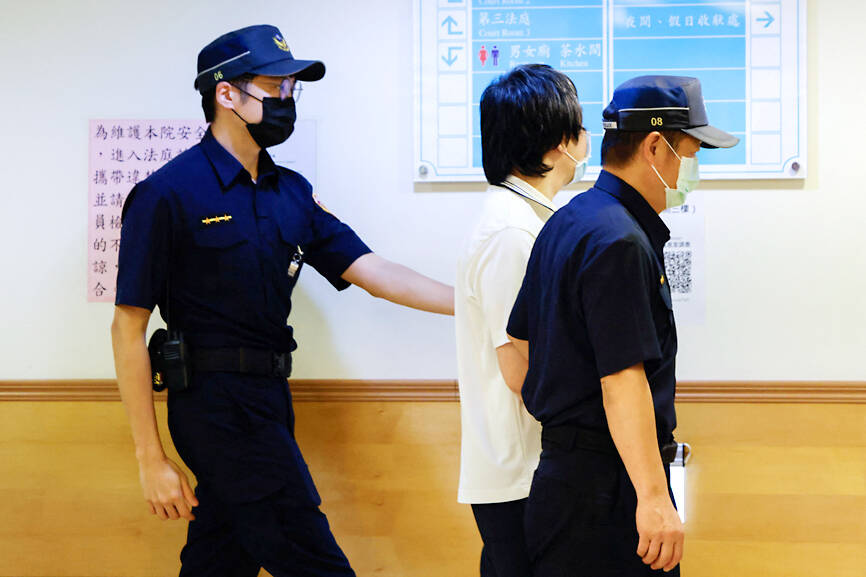
Photo: Ann Wang, Reuters
Tokyo Electron Taiwan, a TSMC equipment supplier, was fined NT$150 million, which could be suspended if it pays NT$100 million in compensation to TSMC and NT$50 million to the treasury, the ruling said.
Chen Li-ming, who previously worked in a yield engineering unit at TSMC’s Fab 12, joined Tokyo Electron Taiwan’s marketing division after leaving the chipmaker, prosecutors from the Intellectual Property Branch of the Taiwan High Prosecutors’ Office said.
Between the second half of 2023 and the first half of last year, Chen Li-ming repeatedly solicited confidential technical information from Wu and Ko, who were still employed at TSMC, in a bid to help Tokyo Electron secure more equipment supply positions for TSMC’s advanced process nodes.
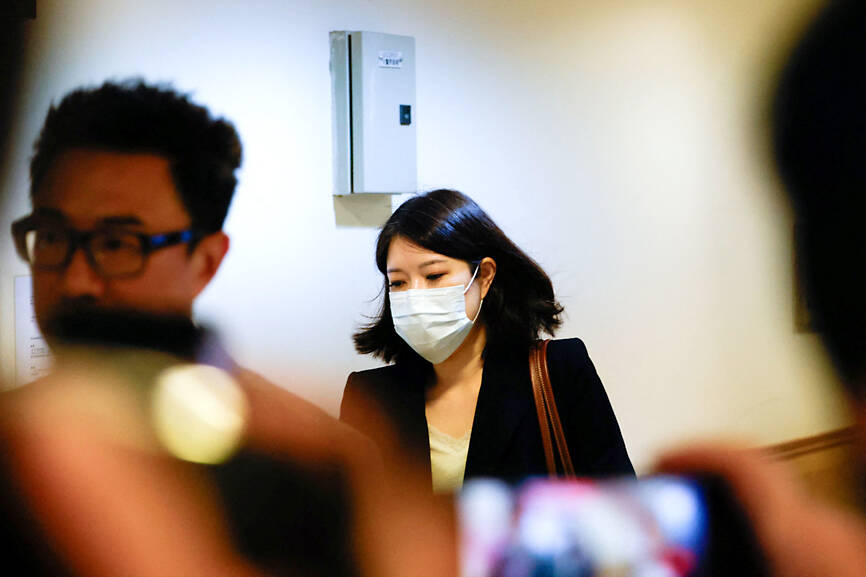
Photo: Ann Wang, Reuters
The information, including trade secrets related to etching equipment used in 2-nanometer production, was photographed and reproduced to allow Tokyo Electron to evaluate and improve its equipment performance, prosecutors said.
TSMC reported the case to authorities on July 8 last year after detecting irregularities through an internal investigation, an earlier statement said.
Prosecutors conducted an investigation between July 25 and 28 last year, and obtained court approval to detain and hold Chen Li-ming, Wu and Ko incommunicado.
The three suspects were indicted in August last year on charges including theft of trade secrets and extraterritorial use of national core technologies. Prosecutors sought prison terms of 14 years, nine years and seven years for Chen Li-ming, Wu and Ko respectively.
Prosecutors later determined that Tokyo Electron Taiwan failed to exercise adequate supervision over Chen Li-ming and did not take sufficient measures to prevent breaches of the law, and pursued corporate criminal liability under the National Security Act, seeking a fine of NT$120 million against the company.
Investigators also found that the company’s cloud storage still contained TSMC’s trade secrets, including chip manufacturing technologies below the 14-nanometer node, and related equipment and chemical processes.
Tokyo Electron, Japan’s largest semiconductor equipment maker and TSMC’s major Japanese supplier, in a statement issued after the indictments last year said that it had found no evidence that TSMC’s 2-nanometer technology had been leaked to third parties, adding that it does not tolerate contraventions of the law or ethical standards.
TSMC has said it maintains a zero-tolerance policy toward trade secret violations and pledged to strengthen internal controls to safeguard its technological advantage.
Additional charges were filed in January against Chen Li-ming, Chen Wei-chieh, Tokyo Electron Taiwan and Lu, who was accused of destroying evidence.
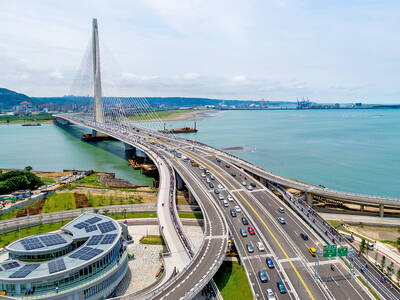
The Ministry of Transportation and Communications yesterday inaugurated the Danjiang Bridge across the Tamsui River in New Taipei City, saying that the structure would be an architectural icon and traffic artery for Taiwan. Feted as a major engineering achievement, the Danjiang Bridge is 920m long, 211m tall at the top of its pylon, and is the longest single-pylon asymmetric cable-stayed bridge in the world, the government’s Web site for the structure said. It was designed by late Iraqi-British architect Zaha Hadid. The structure, with a maximum deck of 70m, accommodates road and light rail traffic, and affords a 200m navigation channel for boats,
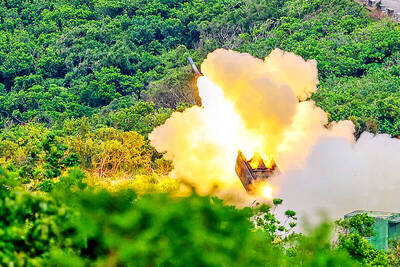
PRECISION STRIKES: The most significant reason to deploy HIMARS to outlying islands is to establish a ‘dead zone’ that the PLA would not dare enter, a source said A High Mobility Artillery Rocket System (HIMARS) would be deployed to Penghu County and Dongyin Island (東引) in Lienchiang County (Matsu) to force the Chinese military to retreat at least 100km from the coastline, a military source said yesterday. Taiwan has been procuring HIMARS and Army Tactical Missile Systems (ATACMS) from the US in batches. Once all batches have been delivered, Taiwan would possess 111 HIMARS units and 504 ATACMS, which have a range of 300km. Considering that “offense is the best defense,” the military plans to forward-deploy the systems to outlying islands such as Penghu and Dongyin so that

Taiwan Semiconductor Manufacturing Co (TSMC, 台積電), the world’s largest foundry service provider, yesterday said that global semiconductor revenue is projected to hit US$1.5 trillion in 2030, after the figure exceeds US$1 trillion this year, as artificial intelligence (AI) demand boosts consumption of token and compute power. “We are still at the beginning of the AI revolution, but we already see a significant impact across the whole semiconductor ecosystem,” TSMC deputy cochief operating officer Kevin Zhang (張曉強) said at the company’s annual technology symposium in Hsinchu City. “It is fair to say that in the past decade, smartphones and other mobile devices were

‘CLEAR MESSAGE’: The bill would set up an interagency ‘tiger team’ to review sanctions tools and other economic options to help deter any Chinese aggression toward Taiwan US Representative Young Kim has introduced a bill to deter Chinese aggression against Taiwan, calling for an interagency “tiger team” to preplan coordinated sanctions and economic measures in response to possible Chinese military or political action against Taiwan. “[Chinese President] Xi Jinping [習近平] has directed the People’s Liberation Army to be ready to invade Taiwan by 2027. China has a plan. America should have one too,” Kim said in a news release on Thursday last week. She introduced the “Deter PRC [People’s Republic of China] aggression against Taiwan act” to “ensure the US has a coordinated sanctions strategy ready should


 RSS
RSS