


International efforts to mediate between the US and Iran were in the balance yesterday, after US President Donald Trump canceled his envoys’ planned trip to Pakistan for talks.
Trump said there was no point “sitting around talking about nothing” and dismissed Tehran’s negotiating position, but added that Iran had revised its proposal within minutes of his decision.
“They gave us a paper that should have been better and — interestingly — immediately, when I canceled it, within 10 minutes, we got a new paper that was much better,” he told reporters, without elaborating.
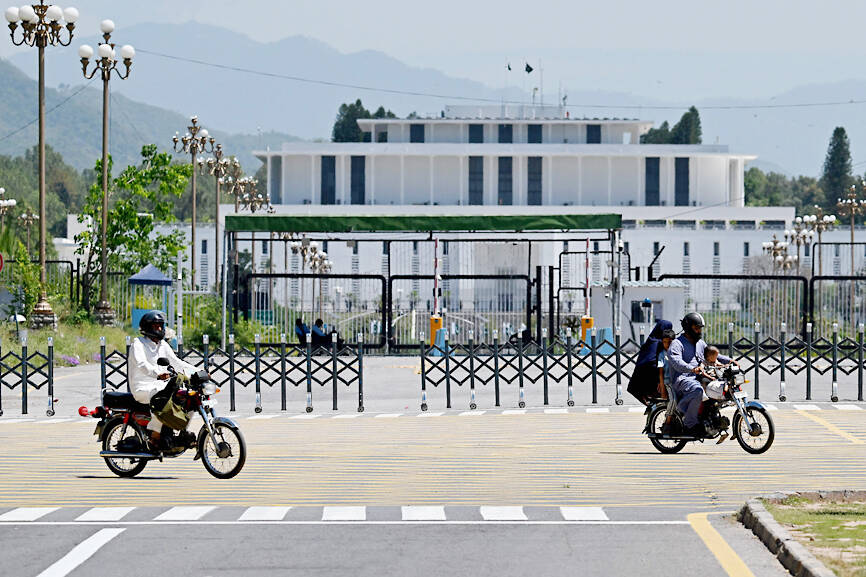
Photo: AFP
The White House had said Trump’s son-in-law, Jared Kushner, and special envoy Steve Witkoff were to set off for Pakistan on Saturday for talks with Iran aimed at moving “toward a deal,” but Trump later told Fox News he had scrapped the trip.
“We have all the cards. They can call us anytime they want, but you’re not going to be making any more 18-hour flights to sit around talking about nothing,” he said he had told his team.
Asked separately whether the cancelation meant a return to hostilities, Trump said: “No, it doesn’t mean that. We haven’t thought about it yet.”
Later, after a gunman was arrested at the White House Correspondents’ Association dinner in Washington, Trump said he did not think the incident was related to Iran, but that it would not deter him “from winning the war.”
Shortly beforehand, Iranian Foreign Minister Abbas Araghchi wrapped up a visit to Islamabad after meeting Pakistani Field Marshal Asim Munir, Prime Minister Shehbaz Sharif and Minister of Foreign Affairs Ishaq Dar.
Iran said Araghchi had left for Muscat and would return to Pakistan yesterday after meetings in Oman, before traveling on to Russia for talks on ending the war launched by the US and Israel on Feb. 28.
Araghchi described his Pakistan trip as “very fruitful,” but signaled skepticism over Washington’s intentions.
“Have yet to see if the US is truly serious about diplomacy,” he said.
Even before Trump’s move, prospects for talks were uncertain, with Iranian state television saying Araghchi had no plans to meet US officials, and that Islamabad would act as a conduit.
Sharif said he had spoken to Iranian President Masoud Pezeshkian and reiterated Islamabad’s commitment to facilitating “durable peace.”
Iranian state TV said Pezeshkian told Sharif the Islamic republic would not be coerced by Washington’s “hostile actions.”
Pressure to end the war has intensified as the Strait of Hormuz remains closed.
However, the Iranian Islamic Revolutionary Guards Corps said they had no intention of lifting their blockade, which has roiled energy markets.
On the war’s Lebanese front, Israeli Prime Minister Benjamin Netanyahu ordered strikes on Hezbollah after accusing the Iran-backed group of violating a ceasefire extended this week.
Lebanese state media reported Israeli attacks in at least four locations in the south — a pair of strikes in quick succession in a town in Bint Jbeil, another on a town in Tyre, and strikes on two more towns in Nabatieh.
The strikes in Nabatieh and Bint Jbeil killed six people, the Lebanese Ministry of Public Health said.
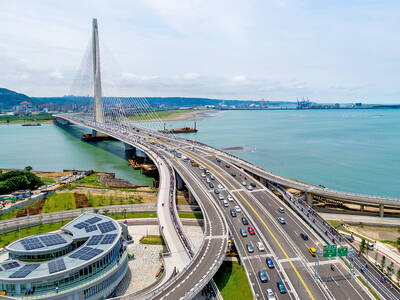
The Ministry of Transportation and Communications yesterday inaugurated the Danjiang Bridge across the Tamsui River in New Taipei City, saying that the structure would be an architectural icon and traffic artery for Taiwan. Feted as a major engineering achievement, the Danjiang Bridge is 920m long, 211m tall at the top of its pylon, and is the longest single-pylon asymmetric cable-stayed bridge in the world, the government’s Web site for the structure said. It was designed by late Iraqi-British architect Zaha Hadid. The structure, with a maximum deck of 70m, accommodates road and light rail traffic, and affords a 200m navigation channel for boats,
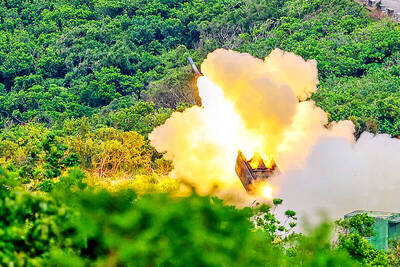
PRECISION STRIKES: The most significant reason to deploy HIMARS to outlying islands is to establish a ‘dead zone’ that the PLA would not dare enter, a source said A High Mobility Artillery Rocket System (HIMARS) would be deployed to Penghu County and Dongyin Island (東引) in Lienchiang County (Matsu) to force the Chinese military to retreat at least 100km from the coastline, a military source said yesterday. Taiwan has been procuring HIMARS and Army Tactical Missile Systems (ATACMS) from the US in batches. Once all batches have been delivered, Taiwan would possess 111 HIMARS units and 504 ATACMS, which have a range of 300km. Considering that “offense is the best defense,” the military plans to forward-deploy the systems to outlying islands such as Penghu and Dongyin so that

Taiwan Semiconductor Manufacturing Co (TSMC, 台積電), the world’s largest foundry service provider, yesterday said that global semiconductor revenue is projected to hit US$1.5 trillion in 2030, after the figure exceeds US$1 trillion this year, as artificial intelligence (AI) demand boosts consumption of token and compute power. “We are still at the beginning of the AI revolution, but we already see a significant impact across the whole semiconductor ecosystem,” TSMC deputy cochief operating officer Kevin Zhang (張曉強) said at the company’s annual technology symposium in Hsinchu City. “It is fair to say that in the past decade, smartphones and other mobile devices were

‘CLEAR MESSAGE’: The bill would set up an interagency ‘tiger team’ to review sanctions tools and other economic options to help deter any Chinese aggression toward Taiwan US Representative Young Kim has introduced a bill to deter Chinese aggression against Taiwan, calling for an interagency “tiger team” to preplan coordinated sanctions and economic measures in response to possible Chinese military or political action against Taiwan. “[Chinese President] Xi Jinping [習近平] has directed the People’s Liberation Army to be ready to invade Taiwan by 2027. China has a plan. America should have one too,” Kim said in a news release on Thursday last week. She introduced the “Deter PRC [People’s Republic of China] aggression against Taiwan act” to “ensure the US has a coordinated sanctions strategy ready should


 RSS
RSS