


Long-term care shortage looms, with the nation projected to see a sharp rise in elderly people needing care, governmental data suggested.
The National Development Council’s (NDC) in its 2024 population projections report said that according to the medium projection scenario, Taiwan’s population of people aged 85 or older is expected to rise sharply to about 1.39 million in 2045 from approximately 470,000 last year.
The projection report is scheduled to be updated in August.
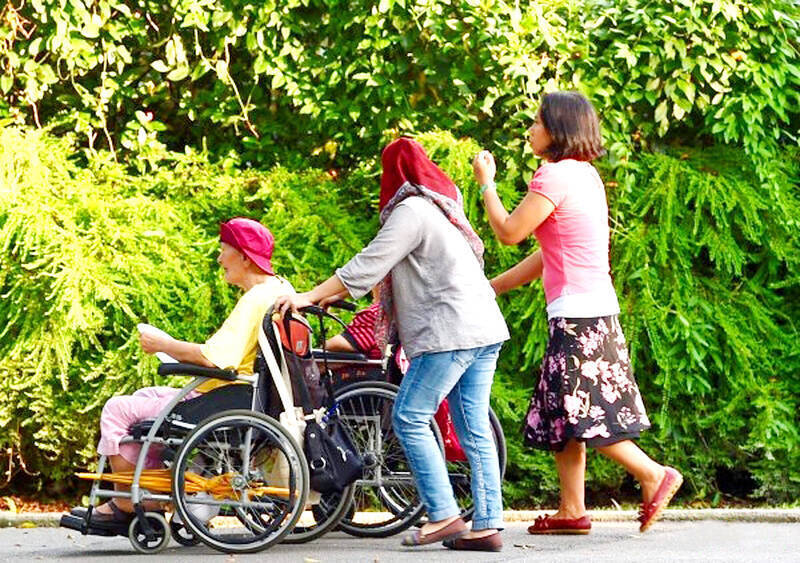
Photo: Taipei Times
Ministry of Health and Welfare data and related studies indicated that the disability rate among Taiwan’s population aged 65 or older is about 15 percent, and that after age 85, the rate increases significantly depending on gender, with an average of about 50 percent.
Experts estimate that in two decades, about 700,000 Taiwanese older than 85 would need assistance with daily activities or medical care.
There are 97,000 to 100,000 licensed local caregivers, and about 70,000 provide hourly home services — helping elderly people bathe, preparing meals or accompanying them to medical appointments — visiting homes for a few hours a day, while the other 30,000 work in elderly care centers, nursing homes or hospitals, usually on three-shift schedules or two 12-hour shifts, the Ministry of Health and Welfare’s Long-Term Care 2.0 statistics showed.
Almost no local workers take on 24-hour live-in care, leaving the bulk of this work to migrant caregivers, the data showed.
There are only 225,000 social welfare migrant workers, more than 92 percent of whom are home caregivers, the Ministry of Labor said.
Without continued expansion in recruitment, there could be a shortfall of about 500,000 workers and a “care tsunami” could sweep through many households, experts said.
Last month, Taiwan had about 225,000 migrant workers employed in social welfare, government data showed.
Indonesians make up the largest group with 186,000, followed by 20,608 from the Philippines, 18,679 from Vietnam and 231 from Thailand, and most — about 209,000 — work as home caregivers, while just 16,354 are employed in care institutions, the data showed.
The nation’s labor force structure also projected a shortfall.
The NDC’s population projections showed that the nation is entering the first wave of retirements among the baby boomers born in the 1950s and 1960s, with a second wave of retirees from “Generation X” born in the 1960s and 1970s following within the next 20 years. Together, these two waves would total 6.67 million retirees.
However, during the same period, only about 1.6 million young people would be entering the workforce, leaving a shortfall of more than 5 million workers, experts said.
The projections indicated that Taiwan’s working-age population would decline to 11.84 million in 2045 from 16.17 million in 2024 — a drop of 4.33 million over 20 years. Moreover, those aged 45 to 64 would make up about 53.3 percent of the working-age population, signaling a highly aging labor force.
Pointing to the current labor force participation rate for youth aged 15 to 29 is only about 38 percent — far below levels in Europe and the US — and that about 200,000 university graduates each year are in a “lying flat” state of neither studying nor working, experts said that in the short term, encouraging youth employment is unlikely to solve the domestic labor shortage.

‘NO SECURITY RISK’: The Railway Bureau reassured the public that the technicians’ activities were limited to technical guidance and did not involve sensitive systems The Railway Bureau yesterday said it had invited eight Chinese technicians to assist with an airport MRT construction project. The bureau issued the confirmation after an Internet user said Chinese nationals had entered the construction zone of Taiwan Taoyuan International Airport’s Terminal 3 project. They asked why “individuals from an enemy state” were allowed access to such a major national infrastructure project, which raised serious concerns over Taiwan’s industrial safety, sensitive systems and information security. The bureau’s Northern Region Engineering Branch Office said subcontractor Taiwan Handle Industrial Co (台灣手把工業) of the Taoyuan airport MRT’s “Contract No. CU05 Project A14 Station Civil, MEP &

The National Chungshan Institute of Science and Technology yesterday showcased its locally developed variants of the Vision 60 robotic patrol dog, which it plans to deploy on the nation’s outlying territories in the South China Sea. The variants were produced under the Joint Lab project — created by the institute and domestic companies — and assembled with domestically produced motors, lenses and artificial intelligence (AI) systems alongside licensed tech from the US, Missile and Rocket Systems Research Division deputy director Jen Kuo-kang (任國光) told the media event at a military base in Taipei’s Dazhi (大直) area. Taiwan has built up its strengths
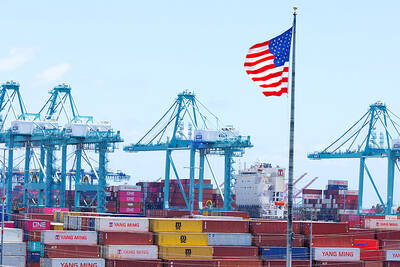
NOT IMMEDIATE: Taiwan has a chance to appeal the proposed 10 percent tariff before it starts, while other countries face a 12.5 percent tariff from the trade office Taiwan is among 60 economies determined by the US to have failed to impose or enforce a ban on the importation of goods produced with forced labor, according to a notice released on Tuesday by the Office of the US Trade Representative (USTR), which proposed imposing an additional 10 percent or more tariff on them. The USTR in a statement said that following an investigation, it had determined under Section 301 of the Trade Act of 1974 that the failure of the 60 economies to impose and effectively enforce a prohibition on the importation of goods produced with forced labor is

TIT-FOR-TAT: The US allegedly revoked the visa of a Chinese national working at Xinhua News Agency in the US in response to Beijing’s expulsion of Vivian Wang The Presidential Office yesterday condemned China for expelling a New York Times correspondent from Beijing following the newspaper’s interview with President William Lai (賴清德), saying the move highlighted Beijing’s suppression of press freedom and its threat to international news media. Taiwan has noted a series of recent incidents in which Beijing used similar tactics to “threaten and pressure international media outlets and journalists,” Presidential Office spokeswoman Karen Kuo (郭雅慧) said in a statement. “This concerns not only press freedom and freedom of expression, but also the safety of journalists, and Taiwan and relevant partners are paying close attention to the situation,” she


 RSS
RSS