


The government is building an ocean radar network to enhance monitoring capabilities in key strategic waters, including the Taiwan Shoal (台灣灘), the Luzon Strait and Pengjia Islet (彭佳嶼), the National Academy of Marine Research said yesterday.
The project was launched last year amid a rise in ocean research activities and marine incidents tied to geopolitical tensions, the academy said.
Academy president Chen Chung-ling (陳璋玲) said the nation’s marine monitoring capacity is insufficient, adding that integrating data collected by radar systems across agencies is a key hurdle, as the systems use incompatible formats.
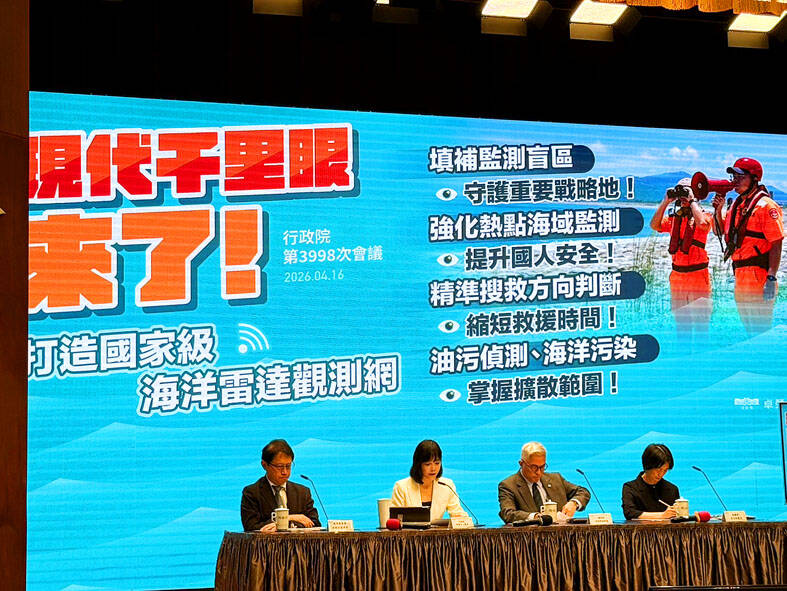
Photo: Chung Li-hua, Taipei Times
That might affect navigation safety, and compromise capabilities to monitor marine pollution and prevent natural disasters, Chen said.
Premier Cho Jung-tai (卓榮泰) told a Cabinet meeting that the first and foremost task should be to integrate 57 marine radar systems across agencies, Executive Yuan spokeswoman Michelle Lee (李慧芝) said.
“With its enhanced resilience, the national radar network would cover blind spots in key strategic waters,” Lee quoted Cho as saying. “In addition to covering waters around Taiwan proper, as well as Penghu, Kinmen and Lienchiang (Matsu) counties, the network would also cover Pengjia Islet [50km northeast of Taiwan proper’s northernmost point] and other strategic posts, providing continuous, all-weather updates on marine environmental dynamics.”
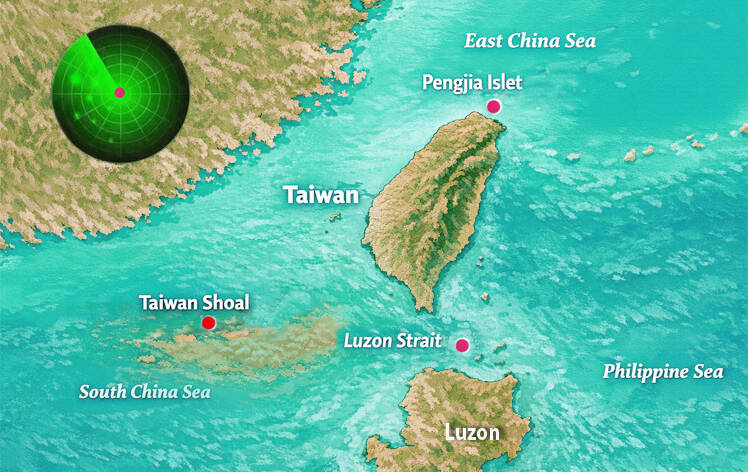
Image generated by ChatGPT, edited by Angela Chen, Taipei Times
The government would also build an offshore oil and gas risk information platform to step up monitoring of environmental conditions in oil and gas hotspots, and provide clear, easy to understand marine safety information to the public, while improving decisionmaking support for disaster prevention and response, Cho said.
The academy said in a statement that the radar network would be collectively constructed by the Ocean Affairs Council, the Ministry of Transportation and Communications, the National Science and Technology Council and the Ministry of National Defense.
With the deployment of ocean remote-sensing radar stations at key points along Taiwan’s coast, the network would enable continuous, all-weather monitoring of sea surface currents, waves and wind conditions, the academy said.
Compared with observations from buoys and ships, remote sensing radar offers a wider coverage areas and continuous marine weather data in high resolution, it said.
The network would expand the observation range to include blind spots in key strategic waters, with those near the Taiwan Shoal southwest of Penghu County, the Luzon Strait between Taiwan and the Philippines and Pengjia Islet being the priority, it said.
It would be used to monitor waters that are recreational hot spots as well, it added.
The goal is to expand the area of surface currents monitored by the radar network to 210,000km2 from 155,000km2 by 2028, enabling all-weather coverage of key waters around Taiwan, Penghu, Kinmen and Lienchiang, the academy said.
Meanwhile, the government would also use artificial intelligence (AI) to expedite the assessment efficiency of incidents in which people fall out of boats and enhance maritime rescue operation precision, it said.
AI would help officials better respond to oil spills, enabling them to instantly estimate the range of affected waters, the academy said.
AI would also help improve rip current detection and public warnings in recreational areas, support small-target detection and enable radar-based tracking of sea surface pollution trends, it said.
The Ministry of Transportation and Communications yesterday inaugurated the Danjiang Bridge across the Tamsui River in New Taipei City, saying that the structure would be an architectural icon and traffic artery for Taiwan. Feted as a major engineering achievement, the Danjiang Bridge is 920m long, 211m tall at the top of its pylon, and is the longest single-pylon asymmetric cable-stayed bridge in the world, the government’s Web site for the structure said. It was designed by late Iraqi-British architect Zaha Hadid. The structure, with a maximum deck of 70m, accommodates road and light rail traffic, and affords a 200m navigation channel for boats,
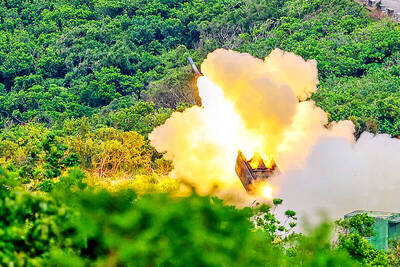
PRECISION STRIKES: The most significant reason to deploy HIMARS to outlying islands is to establish a ‘dead zone’ that the PLA would not dare enter, a source said A High Mobility Artillery Rocket System (HIMARS) would be deployed to Penghu County and Dongyin Island (東引) in Lienchiang County (Matsu) to force the Chinese military to retreat at least 100km from the coastline, a military source said yesterday. Taiwan has been procuring HIMARS and Army Tactical Missile Systems (ATACMS) from the US in batches. Once all batches have been delivered, Taiwan would possess 111 HIMARS units and 504 ATACMS, which have a range of 300km. Considering that “offense is the best defense,” the military plans to forward-deploy the systems to outlying islands such as Penghu and Dongyin so that

Taiwan Semiconductor Manufacturing Co (TSMC, 台積電), the world’s largest foundry service provider, yesterday said that global semiconductor revenue is projected to hit US$1.5 trillion in 2030, after the figure exceeds US$1 trillion this year, as artificial intelligence (AI) demand boosts consumption of token and compute power. “We are still at the beginning of the AI revolution, but we already see a significant impact across the whole semiconductor ecosystem,” TSMC deputy cochief operating officer Kevin Zhang (張曉強) said at the company’s annual technology symposium in Hsinchu City. “It is fair to say that in the past decade, smartphones and other mobile devices were

‘CLEAR MESSAGE’: The bill would set up an interagency ‘tiger team’ to review sanctions tools and other economic options to help deter any Chinese aggression toward Taiwan US Representative Young Kim has introduced a bill to deter Chinese aggression against Taiwan, calling for an interagency “tiger team” to preplan coordinated sanctions and economic measures in response to possible Chinese military or political action against Taiwan. “[Chinese President] Xi Jinping [習近平] has directed the People’s Liberation Army to be ready to invade Taiwan by 2027. China has a plan. America should have one too,” Kim said in a news release on Thursday last week. She introduced the “Deter PRC [People’s Republic of China] aggression against Taiwan act” to “ensure the US has a coordinated sanctions strategy ready should


 RSS
RSS