


The Chinese Nationalist Party (KMT) today confirmed that the party had applied for subsidies from the Taiwan Foundation for Democracy, which is mainly funded by the Ministry of Foreign Affairs, to cover party Chairwoman Cheng Li-wun’s (鄭麗文) “journey of peace” to China, where she met with Chinese President Xi Jinping (習近平).
KMT Culture and Communication Committee deputy director Yin Nai-ching (尹乃菁) confirmed a report by Mirror Media that the party had applied for subsidies from the foundation to cover NT$4.8 million (US$152,101) in travel expenses for Cheng’s trip.
The KMT had legally applied to the foundation for funding to conduct party-to-party exchanges, she said.
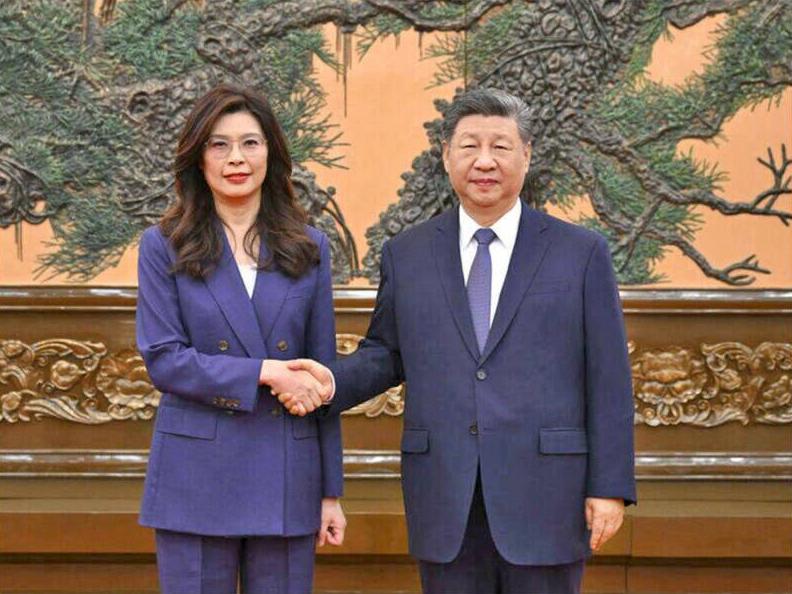
Photo: AP
The foundation, which is chaired by Legislative Speaker Han Kuo-yu (韓國瑜), was established in 2003 with the primary goal of “establishing a cooperative relationship and aligning with international democratic forces.”
In August 2022, the foundation was listed by China’s Taiwan Affairs Office as “an organization associated with Taiwanese separatists,” and was sanctioned by Chinese authorities.
It has been prohibited from exchanges with Chinese organizations, enterprises or individuals, while its members are not allowed to travel to China.
The foundation was established to promote exchanges between Taiwanese political parties, think tanks and counterparts in Asia and around the world, to advocate Taiwan’s values of democracy, freedom and human rights, Yin said.
If the Democratic Progressive Party (DPP) was willing to return to the “1992 consensus” and abandon its support for Taiwanese independence, it could also apply for subsidies from the foundation to engage in exchanges with the Chinese Communist Party (CCP), she said.
The so-called “1992 consensus,” a term former Mainland Affairs Council chairman Su Chi (蘇起) in 2006 admitted making up, refers to a tacit understanding between the KMT and CCP that both sides of the Strait acknowledge there is “one China,” with each side having its own interpretation of what “China” means.
Visits such as Cheng’s trip demonstrate Taiwan’s democratic and free political system, in which ruling and opposition parties alternate in power and can engage in normal exchanges with China, Yin said.
In response, Presidential Office spokesperson Karen Kuo (郭雅慧) asked if the KMT had discussed anything related to democracy with the CCP during the trip.
Executive Yuan spokeswoman Michelle Lee (李慧芝) expressed surprise at the news, saying that the public would inevitably question whether such expenditures align with the foundation’s original mission.
Now that the trip has ended, the KMT should stop delaying the defense budget, as the public is concerned with substantive actions regarding national security, she said.
Having sufficient defense capabilities is essential to ensuring that Taiwanese can maintain their democratic and free way of life, she added.
DPP caucus secretary-general Fan Yun (范雲), who also serves as a foundation board member, urged Cheng to withdraw the application, saying that public funds should not be used for exchanges in China that lack democratic and human rights elements.
The KMT’s trip to China and Cheng’s meeting with Xi were subsidized by an organization sanctioned by the CCP, DPP Legislator Rosalia Wu (吳思瑤) said, calling Cheng very “brave.”
If there are concerns, they should be addressed through the appropriate legislative bodies, KMT Legislator Lo Ming-tsai (羅明才) said.
The practice has been in place for years and should not be politicized, Lo added.
The foundation said in a statement today that it processes applications in accordance with its party subsidy guidelines and procedures.
The KMT’s proposal stated that through site visits and participation in events, it would promote Taiwan’s democratic and free values in China, foster peaceful cross-strait development and safeguard stability and prosperity in the Taiwan Strait, the statement said.
The foundation encourages domestic political parties to promote activities related to democracy and human rights, as well as cooperation between Taiwan and international non-governmental organizations, with the aim of enhancing the quality of Taiwan’s democracy and its international standing, it said.
The foundation’s charter says that up to one-third of its annual budget, as approved by the legislature, can be allocated for subsidies to political parties that receive more than 5 percent of the vote in legislative elections, including overseas ballots, for activities related to democracy and human rights.
Each party can receive up to NT$30 million, with allocations proportionate to legislative seat share, the charter says.
It also stipulates that the foundation must not fund activities related to unification or independence, support foreign political groups in breaching local laws or lobby foreign entities to act in ways that contravene the Constitution.
In 2024, the KMT received NT$9,984,797 in subsidies from the foundation, while the DPP received NT$13,860,995 and the Taiwan People’s Party received NT$2,327,327, Ministry of the Interior data showed.
The KMT received NT$10,180,119 in subsidies from the foundation in 2023 and NT$11,640,922 in 2022, the party’s financial reports showed.
From 2022 to 2024, the KMT received an average of more than NT$10.6 million in annual subsidies from the foundation, the reports showed.
The foundation said that it has allocated a total budget of NT$30 million this year to subsidize party diplomacy and exchanges aimed at deepening democracy.
It hopes that by supporting major domestic political parties in conducting parliamentary diplomacy and international democratic exchanges, Taiwan’s democratization experience can be promoted globally and the nation’s international visibility can be enhanced, the foundation added.
Additional reporting by Chen Yun, Lo Kuo-chia and CNA

‘NO SECURITY RISK’: The Railway Bureau reassured the public that the technicians’ activities were limited to technical guidance and did not involve sensitive systems The Railway Bureau yesterday said it had invited eight Chinese technicians to assist with an airport MRT construction project. The bureau issued the confirmation after an Internet user said Chinese nationals had entered the construction zone of Taiwan Taoyuan International Airport’s Terminal 3 project. They asked why “individuals from an enemy state” were allowed access to such a major national infrastructure project, which raised serious concerns over Taiwan’s industrial safety, sensitive systems and information security. The bureau’s Northern Region Engineering Branch Office said subcontractor Taiwan Handle Industrial Co (台灣手把工業) of the Taoyuan airport MRT’s “Contract No. CU05 Project A14 Station Civil, MEP &

The National Chungshan Institute of Science and Technology yesterday showcased its locally developed variants of the Vision 60 robotic patrol dog, which it plans to deploy on the nation’s outlying territories in the South China Sea. The variants were produced under the Joint Lab project — created by the institute and domestic companies — and assembled with domestically produced motors, lenses and artificial intelligence (AI) systems alongside licensed tech from the US, Missile and Rocket Systems Research Division deputy director Jen Kuo-kang (任國光) told the media event at a military base in Taipei’s Dazhi (大直) area. Taiwan has built up its strengths
NOT IMMEDIATE: Taiwan has a chance to appeal the proposed 10 percent tariff before it starts, while other countries face a 12.5 percent tariff from the trade office Taiwan is among 60 economies determined by the US to have failed to impose or enforce a ban on the importation of goods produced with forced labor, according to a notice released on Tuesday by the Office of the US Trade Representative (USTR), which proposed imposing an additional 10 percent or more tariff on them. The USTR in a statement said that following an investigation, it had determined under Section 301 of the Trade Act of 1974 that the failure of the 60 economies to impose and effectively enforce a prohibition on the importation of goods produced with forced labor is
TIT-FOR-TAT: The US allegedly revoked the visa of a Chinese national working at Xinhua News Agency in the US in response to Beijing’s expulsion of Vivian Wang The Presidential Office yesterday condemned China for expelling a New York Times correspondent from Beijing following the newspaper’s interview with President William Lai (賴清德), saying the move highlighted Beijing’s suppression of press freedom and its threat to international news media. Taiwan has noted a series of recent incidents in which Beijing used similar tactics to “threaten and pressure international media outlets and journalists,” Presidential Office spokeswoman Karen Kuo (郭雅慧) said in a statement. “This concerns not only press freedom and freedom of expression, but also the safety of journalists, and Taiwan and relevant partners are paying close attention to the situation,” she


 RSS
RSS