


China yesterday accused the US of “dangerous and irresponsible” behavior over its blockade of Iranian ports, with Chinese President Xi Jinping (習近平) vowing Beijing would play a “constructive role” in promoting peace in the Middle East.
US President Donald Trump has threatened to sink ships entering or leaving Iranian ports and coastal areas after peace talks between Washington and Tehran failed over the weekend.
The blockade came into force at 2pm GMT on Monday, despite the US and Iran agreeing to a fragile two-week ceasefire days earlier.
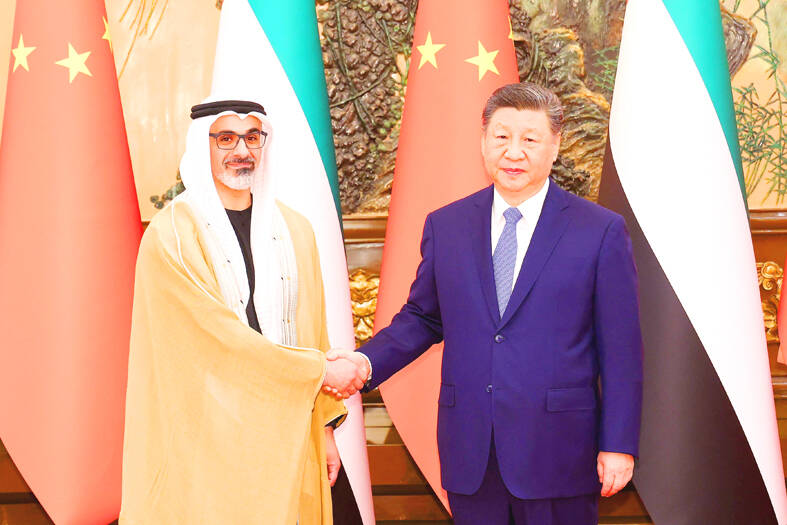
Photo: Reuters
“The US increased military deployments and took a targeted blockade action, which will only exacerbate tensions and undermine the already fragile ceasefire agreement and further jeopardize safety of passage through the Strait [of Hormuz],” Chinese Ministry of Foreign Affairs spokesman Guo Jiakun (郭嘉昆) told a news conference.
“This is dangerous and irresponsible behavior,” he added.
Iran has effectively closed the Strait of Hormuz, allowing only vessels serving nations it deems friendly — such as China — to cross.
Speaking publicly about the war for the first time, Xi echoed those warnings, calling for the national sovereignty of nations in the Middle East and the Gulf to be “respected.”
Xi spoke as he met with Abu Dhabi Prince Sheikh Khaled bin Mohamed bin Zayed Al Nahyan in Beijing. He vowed China would continue to play a “constructive role” in promoting peace talks.
China also took a firm stance against Trump’s threats to impose new tariffs on Chinese products entering the US following reports Beijing was supplying or intends to supply weapons to Iran.
Trump — who is scheduled to visit Beijing next month for talks with Xi — on Sunday said that he would hit China’s goods with a 50 percent tariff if it provided military assistance to Tehran.
Guo said those reports were “completely fabricated.”
“If the US insists on using this as an excuse to impose additional tariffs on China, China will definitely take resolute countermeasures,” he said.
China is welcoming a string of leaders from nations impacted by the Middle East conflict in Beijing this week.
Vietnamese President To Lam and Russian Minister of Foreign Affairs Sergei Lavrov also touched down in the Chinese capital yesterday, hoping to boost cooperation on the conflict, as well as bilateral issues.
Spanish Prime Minister Pedro Sanchez is also visiting Beijing this week for a trip largely focused on bilateral trade ties.
Sanchez told reporters yesterday that China can play an “important role” in the Middle East, while Xi warned against a return to the “law of the jungle” in international relations, state media reported.
“Both China and Spain are principled countries that stand for justice. They should strengthen communication, consolidate mutual trust and cooperate closely to oppose the world’s regression to the law of the jungle,” Xi said during their meeting at Beijing’s Great Hall of the People.

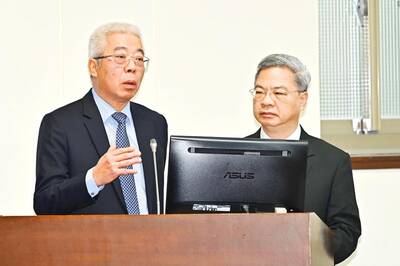
Taiwan has arranged for about 8 million barrels of crude oil, or about one-third of its monthly needs, to be shipped from the Red Sea this month to bypass the Strait of Hormuz and ease domestic supply pressures, CPC Corp, Taiwan (CPC, 台灣中油) said yesterday. The state-run oil company has worked with Middle Eastern suppliers to secure routes other than the Strait of Hormuz, through which about 20 percent of the world’s oil and liquefied natural gas typically passes, CPC chairman Fang Jeng-zen (方振仁) said at a meeting of the legislature’s Economics Committee in Taipei. Suppliers in Saudi Arabia have indicated they
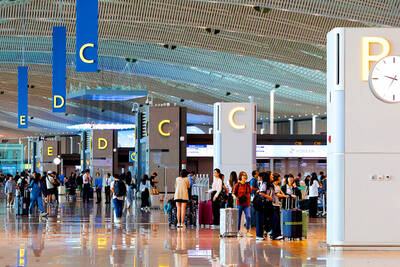
South Korea has adjusted its electronic arrival card system to no longer list Taiwan as a part of China, a move that the Ministry of Foreign Affairs said would help facilitate exchanges between the two sides. South Korea previously listed “Taiwan” as “Taiwan (China)” in the drop-down menus of its online arrival card system, where people had to fill out where they came from and their next destination. The ministry had requested South Korea make a revision and said it would change South Korea’s name on Taiwan’s online immigration system from “Republic of Korea” to “Korea (South),” should the issue not be

Tainan, Taipei and New Taipei City recorded the highest fines nationwide for illegal accommodations in the first quarter of this year, with fines issued in the three cities each exceeding NT$7 million (US$220,639), Tourism Administration data showed. Among them, Taipei had the highest number of illegal short-term rental units, with 410. There were 3,280 legally registered hotels nationwide in the first quarter, down by 14 properties, or 0.43 percent, from a year earlier, likely indicating operators exiting the market, the agency said. However, the number of unregistered properties rose to 1,174, including 314 illegal hotels and 860 illegal short-term rental
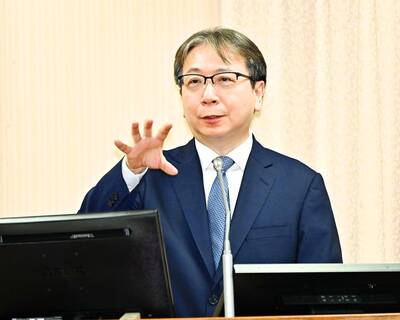
AIR ALERT: China’s reservation of airspace over the Yellow Sea and East China Sea could be an attempt to test the US’ response ahead of a Trump-Xi meeting, the NSB head said China’s attempts to infiltrate Taiwan are systematic, planned and targeted, with activity shifting from recruiting mid-level military officers to rank-and-file enlisted personnel, National Security Bureau (NSB) Director-General Tsai Ming-yen (蔡明彥) said yesterday. The Chinese Communist Party’s (CCP) integrates national security, intelligence operations and “united front” efforts into a dense network to conduct intelligence gathering and espionage in Taiwan, Tsai said at a meeting of the legislature’s Foreign Affairs and National Defense Committee. It uses specific networks to screen targets through exchange activities and recruiting local collaborators to establish intelligence-gathering organizations, he said. China is also shifting who it targets to lower-ranking military personnel,


 RSS
RSS