


President William Lai (賴清德) yesterday urged service members to test the military’s strengths to the utmost in this year’s Han Kuang No. 41 virtual exercise, while urging lawmakers to pass the administration’s special defense budget without any cuts.
Lai visited the joint command headquarters hosting two weeks of computer-assisted tabletop simulations as part of this year’s iteration of the annual large-scale military drills, which started on Saturday.
The drills are billed as high-intensity, open-ended war games testing every level of command and type of formation in a simulated defense against an invasion by the Chinese People’s Liberation Army.
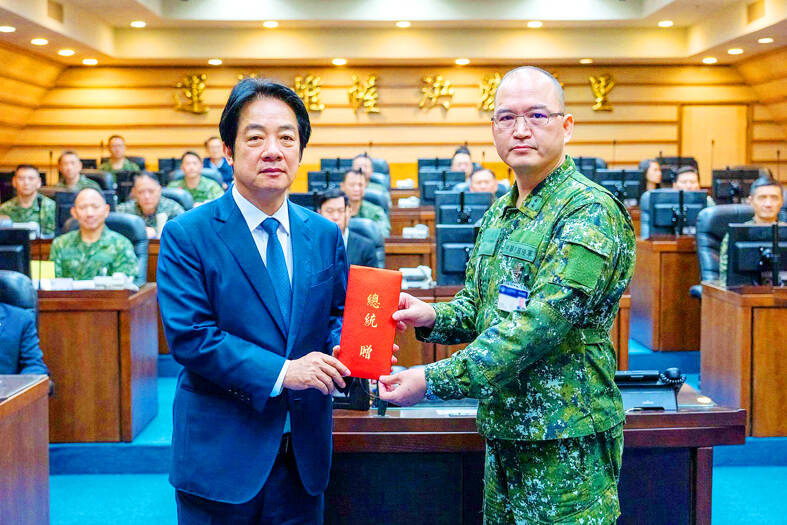
Photo: screen grab from William Lai’s Facebook
Lai on Facebook exhorted commanders to conduct the tabletop simulation “with their unreserved skill and strength as if fighting real battles,” so that the weaknesses and shortcomings of the military could be rectified.
The simulations must come as close to the extreme and complex conditions of warfare as possible to prepare Taiwanese forces for a real conflict, he said.
The exercise this year features a further incorporation of civilian capabilities into the war effort to implement the whole-of-society resilience concept, and an emphasis on testing new training, doctrine, equipment and technology, Lai said.
These concepts must be implemented into the armed forces for the nation to shore up its asymmetric warfare capabilities and deterrence, he said.
“All Taiwanese desire peace, yet peace is obtained not by agreements on sheets of paper, but our own strength,” he said. “It is my sincere hope that the lawmakers of the Legislative Yuan can put aside party differences to support the government’s well-thought-out plans, so that the special defense budget can be passed in its entirety with all haste.”
Polling indicates that 70 percent of Taiwanese support the defense budget, which is crucial for the proposed “T-Dome” air defense system that would defend the nation’s troops, critical infrastructure and civilians against Chinese ballistic and cruise missiles, he said.
Meanwhile, National Security Bureau (NSB) Director-General Tsai Ming-yen (蔡明彥) on the sidelines of a legislative hearing on Monday told reporters that the bureau would directly support the armed forces in the field during this year’s Han Kuang exercises.
While it is not unprecedented for NSB personnel to be attached to the Ministry of National Defense in support of training exercises, this year’s drills would see institutionalization of the practice, he said.
The NSB and the military have long conducted joint operations and established regular channels of communications to facilitate such missions, Tsai said.
A military spokesperson said that this year’s exercises would for the first time allow NSB officers to directly support military combat operations.
The armed forces are testing a model of military-intelligence cooperation based on the US Defense Intelligence Agency’s approach to intelligence gathering in support of military operations, said Su Tzu-yun (蘇紫雲), director of the Institute for National Defense and Security Research’s Defense Strategy and Resource Research Institute.
The NSB would likely directly deploy officers to support the headquarters of specific combat units, with no intermediaries in the chain of command to preserve secrecy, he said.
In related news, Legislative Speaker Han Kuo-yu (韓國瑜) yesterday put discussion of the government’s general budget — including the Ministry of National Defense annual budget — on the legislative agenda for today.
The announcement came following a day of negotiations between party caucuses, and rumors of increasingly vocal misgivings from KMT lawmakers about continuing the budget fight.
Democratic Progressive Party Legislator Chen Kuan-ting (陳冠廷) said that Han has also indicated that he is to convene the party caucuses in another round of negotiations on the special defense budget act, after KMT lawmakers boycotted talks originally scheduled for Thursday last week.
Additional reporting by Huang Ching-hsuan and Lin Hsin-han
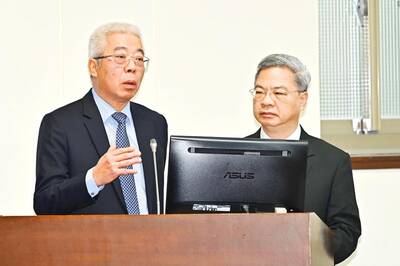
Taiwan has arranged for about 8 million barrels of crude oil, or about one-third of its monthly needs, to be shipped from the Red Sea this month to bypass the Strait of Hormuz and ease domestic supply pressures, CPC Corp, Taiwan (CPC, 台灣中油) said yesterday. The state-run oil company has worked with Middle Eastern suppliers to secure routes other than the Strait of Hormuz, through which about 20 percent of the world’s oil and liquefied natural gas typically passes, CPC chairman Fang Jeng-zen (方振仁) said at a meeting of the legislature’s Economics Committee in Taipei. Suppliers in Saudi Arabia have indicated they
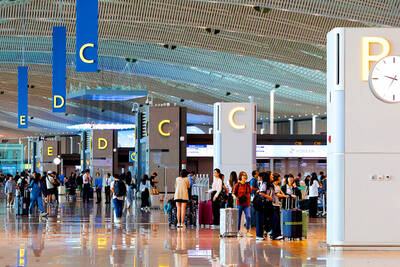
South Korea has adjusted its electronic arrival card system to no longer list Taiwan as a part of China, a move that the Ministry of Foreign Affairs said would help facilitate exchanges between the two sides. South Korea previously listed “Taiwan” as “Taiwan (China)” in the drop-down menus of its online arrival card system, where people had to fill out where they came from and their next destination. The ministry had requested South Korea make a revision and said it would change South Korea’s name on Taiwan’s online immigration system from “Republic of Korea” to “Korea (South),” should the issue not be
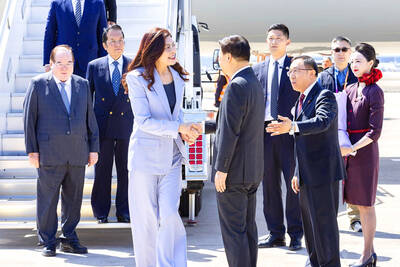
CCP ‘PAWN’? Beijing could use the KMT chairwoman’s visit to signal to the world that many people in Taiwan support the ‘one China’ principle, an academic said Chinese Nationalist Party (KMT) Chairwoman Cheng Li-wun (鄭麗文) yesterday arrived in China for a “peace” mission and potential meeting with Chinese President Xi Jinping (習近平), while a Taiwanese minister detailed the number of Chinese warships currently deployed around the nation. Cheng is visiting at a time of increased Chinese military pressure on Taiwan, as the opposition-dominated Legislative Yuan stalls a government plan for US$40 billion in extra defense spending. Speaking to reporters before going to the airport, Cheng said she was going on a “historic journey for peace,” but added that some people felt uneasy about her trip. “If you truly love Taiwan,

Tainan, Taipei and New Taipei City recorded the highest fines nationwide for illegal accommodations in the first quarter of this year, with fines issued in the three cities each exceeding NT$7 million (US$220,639), Tourism Administration data showed. Among them, Taipei had the highest number of illegal short-term rental units, with 410. There were 3,280 legally registered hotels nationwide in the first quarter, down by 14 properties, or 0.43 percent, from a year earlier, likely indicating operators exiting the market, the agency said. However, the number of unregistered properties rose to 1,174, including 314 illegal hotels and 860 illegal short-term rental


 RSS
RSS