


The Taiwan People’s Party (TPP) Central Evaluation Committee yesterday voted to expel party member Li Zhenxiu (李貞秀), effective immediately, following a series of controversies. The decision also resulted in Li’s loss of her legislator-at-large seat.
Li, who took office in February as a legislator-at-large for the TPP, is the first China-born spouse of a Taiwanese to serve as a lawmaker in Taiwan. She has since been embroiled in disputes over her nationality and eligibility.
Amid an ongoing debate over her citizenship status, Li sparked further controversy on a livestream by saying that Hsinchu Mayor Ann Kao (高虹安) had given former TPP chairman Ko Wen-je (柯文哲) NT$7 million (US$220,230). Kao swiftly denied the claim and Li issued a public apology, but the incident continued to escalate.
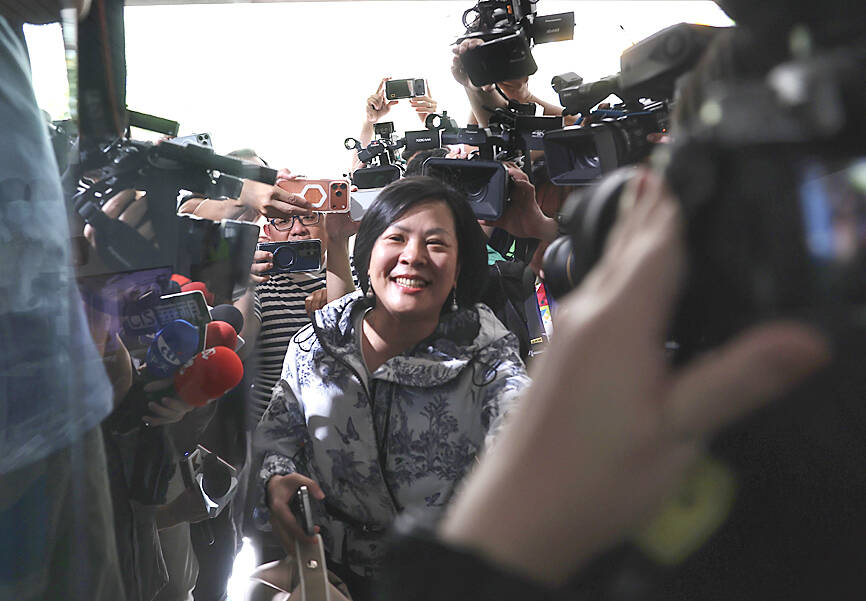
Photo: CNA
Li was later accused of having reported Kao over alleged misuse of assistant funds, prompting several party officials to call on her to step down. She was subsequently referred to the committee for disciplinary action.
TPP Chairman Huang Kuo-chang (黃國昌), in an interview yesterday morning, said that legislators-at-large should meet supporters’ expectations and fulfill their commitments to voters, rather than pursue personal interests. Asked whether Li met that standard, Huang said: “No.”
Li arrived at TPP headquarters at about 2:30pm to address the committee. After about three-and-a-half hours of deliberation, it announced her expulsion, resulting in the loss of her legislative seat.
The TPP said the decision was based on multiple complaints filed by party members, along with evidence submitted by caucus whip Jacky Chen (陳清龍). The committee found Li’s statements and actions had seriously damaged the party’s reputation and internal cohesion, and that she had engaged in repeated misconduct.
It also said that Li had disregarded the responsibilities of public office and the trust of supporters, citing a meeting on Tuesday last week at which she proposed resigning her seat in exchange for financial compensation, an act the party said undermined ethics. Despite being advised otherwise, she continued to insist on receiving money as a condition for resigning, which the party said constituted a serious breach of party discipline and political ethics.
Based on its findings, the committee said Li’s conduct had severely damaged the party’s image and undermined public trust. It added that public office must not be treated as a bargaining tool, and that Li’s actions eroded the integrity of party politics.
The party said the decision was made in accordance with Articles 32 and 36 of its Disciplinary Review and Adjudication Guidelines (紀律評議裁決準則), with the Central Evaluation Committee unanimously voting to expel Li, effective immediately.
In response to media queries after the meeting, committee deputy head Chen Yu-cheng (陳宥丞) said that Li explicitly treated stepping down as an legislator-at-large as a bargaining chip, seeking a specific amount of compensation in return.
“This seriously violates public office ethics and damages the party’s reputation; the committee has approved Li’s expulsion,” he said.
Later yesterday, the Central Election Commission said that it had been notified by the TPP of Li’s expulsion.
The comission said that in accordance with standard procedures and the Public Officials Election and Recall Act (公職人員選罷法), it would ask the Legislative Yuan to revoke Li’s status as a legislator-at-large.
Li last night on Facebook accused party headquarters and the TPP caucus of working together to pressure her into resigning through improper channels.
She said that she did not want money or a position.
“I cannot bear to harm the Taiwan People’s Party, nor do I wish for this incident to affect all Chinese spouses living and working hard in Taiwan. At the same time, I also do not want to harm former chairman Ko Wen-je, who has supported and given me opportunities along the way,” she said. “In consideration of the overall situation, I accept the Central Evaluation Committee’s decision to expel me and I will not pursue any legal action or arbitration.”
Additional reporting by Chen Chih-cheng

PROVOCATIVE: Chinese Deputy Ambassador to the UN Sun Lei accused Japan of sending military vessels to deliberately provoke tensions in the Taiwan Strait China denounced remarks by Japan and the EU about the South China Sea at a UN Security Council meeting on Monday, and accused Tokyo of provocative behavior in the Taiwan Strait and planning military expansion. Ayano Kunimitsu, a Japanese vice foreign minister, told the Council meeting on maritime security that Tokyo was seriously concerned about the situation in the East China and South China seas, and reiterated Japan’s opposition to any attempt to change the “status quo” by force, and obstruction of freedom of navigation and overflight. Stavros Lambrinidis, head of the EU delegation to the UN, also highlighted South China Sea

SILENCING CRITICS: In addition to blocking Taiwan, China aimed to prevent rights activists from speaking out against authoritarian states, a Cabinet department said The Ministry of Foreign Affairs (MOFA) yesterday condemned transnational repression by Beijing after RightsCon, a major digital human rights conference scheduled to be held in Zambia this week, was abruptly canceled due to Chinese pressure over Taiwanese participation. This year’s RightsCon, the world’s largest conference discussing issues “at the intersection of human rights and technology,” was scheduled to take place from tomorrow to Friday in Lusaka, and expected to draw 2,600 in-person attendees from 150 countries, along with 1,100 online participants. However, organizers were forced to cancel the event due to behind-the-scenes pressure from China, the ministry said, expressing its “strongest condemnation”
Taiwan Semiconductor Manufacturing Co (TSMC, 台積電), the world’s largest contract chipmaker, said it expects its 2-nanometer (2nm) chip capacity to grow at a compound annual rate of 70 percent from this year to 2028. The projection comes as five fabs begin volume production of 2-nanometer chips this year — two in Hsinchu and three in Kaohsiung — TSMC senior vice president and deputy cochief operating officer Cliff Hou (侯永清) said at the company’s annual technology symposium in Silicon Valley, California, last week. Output in the first year of 2-nanometer production, which began in the fourth quarter of last year, is expected to
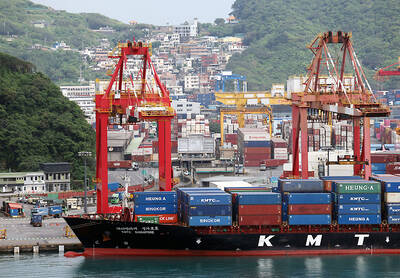
Taiwan’s economy grew far faster than expected in the first quarter, as booming demand for artificial intelligence (AI) applications drove a surge in exports, spilling over into investment and consumption, the Directorate-General of Budget, Accounting and Statistics (DGBAS) said yesterday. GDP growth was 13.69 percent year-on-year during the January-to-March period, beating the DGBAS’ February forecast by 2.23 percentage points and marking the most robust growth in nearly four decades, DGBAS senior official Chiang Hsin-yi (江心怡) told a news conference in Taipei. The result was powered by exports, which remain the backbone of Taiwan’s economy, Chiang said. Outbound shipments jumped 51.12 percent year-on-year to


 RSS
RSS