


President William Lai (賴清德) is to visit Taiwan’s sole African ally, the Kingdom of Eswatini, later this month, in what would be his second official overseas trip since taking office in May 2024, the Presidential Office said yesterday.
Eswatini is one of 12 UN member nations worldwide that have formal diplomatic ties with Taiwan along with non-UN member Somaliland.
Presidential Office spokeswoman Karen Kuo (郭雅慧) yesterday told a news conference that Eswatini would hold a series of celebrations from Friday next week to April 26 to mark the 40th anniversary of King Mswati III’s accession to the throne and his 58th birthday.
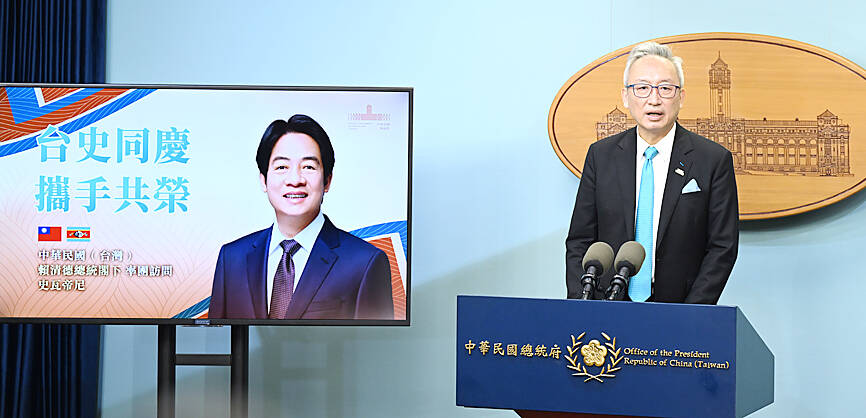
Photo: Liao Chen-huei, Taipei Times
The king visited Taiwan in May 2024 at Lai’s invitation to attend the president’s inauguration, and earlier this year sent a personally signed letter inviting Lai to the celebrations in Eswatini, Kuo said.
In response to King Mswati III’s “warm invitation,” Lai is to lead a delegation to Eswatini later this month, demonstrating the importance of the diplomatic relations between the two nations and Taiwan’s commitment to deepening the bilateral partnership, she said.
An itinerary released by the Presidential Office said that Lai and his delegation are to leave Taiwan on Wednesday next week and return on April 27.
During the visit, Lai is to meet with King Mswati III and sign a joint communique, the itinerary shows.
Apart from attending the anniversary and birthday celebrations, Lai and his delegation are also scheduled to visit the site of a planned Taiwanese industrial innovation park.
Deputy Minister of Foreign Affairs Francois Wu (吳志中) said at the news conference that Lai and his delegation would travel to Eswatini on a non-stop flight, which would not pass over the Middle East, where the security situation remains tense due to the ongoing conflict.
The visit to Eswatini, which has maintained diplomatic ties for 58 years, would be Lai’s second official overseas trip since he took office in May 2024.
His first trip, from Nov. 30 to Dec. 6, 2024, included visits to Pacific allies the Marshall Islands, Tuvalu and Palau, as well as transit stops in Hawaii and the US territory of Guam.
An official, who declined to be named, said separately yesterday that Lai’s trip to Eswatini highlights the value of the “Taiwan model” of diplomacy in contrast to China’s hegemonic expansion, and would amplify Taiwan’s diplomatic significance in the global south.
Lai’s visit “demonstrates the long-standing, stable diplomatic friendship between Taiwan and Eswatini,” the official said.
It also signifies to the international community that despite continuous pressure from China, the Taiwan-Eswatini relationship is strong and enduring, they said.
Beijing has expanded its influence in Africa through the Belt and Road Initiative and the Forum on China-Africa Cooperation, while pressuring Eswatini as Taiwan’s last remaining diplomatic ally on the continent.
However, China’s model of diplomacy has come under scrutiny, as data from the World Bank showed sub-Saharan African nations which are in or at high risk of debt distress rose from eight in 2014 to 23 last year, reflecting the risks they face under external financing and debt, the official said.
In contrast to China, Taiwan does not tie its loans to politics, but focuses on cooperating in public health, education, agriculture, women’s empowerment, infrastructure and talent cultivation, they said.
Eswatini is part of the Southern African Customs Union and the African Continental Free Trade Area, giving it regional connectivity, the official said.
The president’s trip is not only about strengthening diplomatic ties, but also demonstrating the concrete contributions Taiwan offers its allies, enhancing the nation’s visibility and credibility in Africa, they said.
For Taiwan, this is not just a diplomatic visit, but a demonstration to the international community of the kind of partner Taiwan can be, they added.

DRONE CENTRAL: Taiwan aims to become Asia’s democratic hub for drones, with most exports focused on high-quality military-grade models, an official said Taiwan’s drone industry is expected to expand significantly by 2030, producing 100,000 units per month and exporting half of them, the Ministry of Economic Affairs said yesterday. Current drone production capacity is about 15,000 units per month, but the industry can quickly scale up as demand increases, Industrial Development Administration Director-General Chiou Chyou-huey (邱求慧) told a news conference in Taipei. Taiwan’s drone output grew 2.5-fold last year to NT$12.9 billion (US$408.3 million) under a government program to develop the uncrewed vehicle sector, he said. The Executive Yuan in October last year approved plans to invest NT$44.2 billion into domestic production of uncrewed aerial
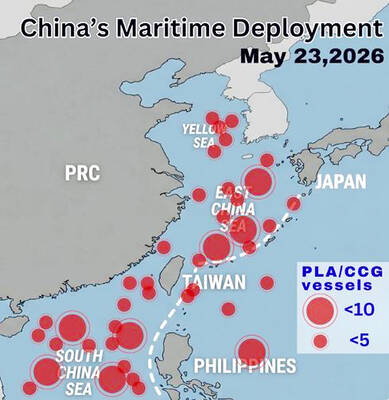
WARNING: China should stop engaging in actions that undermine regional peace and stability, as it would only build resentment among people across the Strait, the CGA said China has deployed more than 100 navy, coast guard and other vessels in waters from the Yellow Sea to the South China Sea and the western Pacific since US President Donald Trump and Chinese President Xi Jinping (習近平) met in Beijing, National Security Council Secretary-General Joseph Wu (吳釗燮) said yesterday. “In this part of the world, #China is the one & only PROBLEM wrecking the #StatusQuo & threatening regional peace & stability,” Wu wrote on X. In a separate post, he said Beijing was coercing Taiwan’s maritime domain, calling it illegal and provocative, after the Coast Guard Administration (CGA) expelled a

VERBOSE VESSELS: A CGA cutter and a China Coast Guard exchanged verbal barbs for more than a day in Taiwanese-controlled waters before the Chinese vessel left The Taiwanese and Chinese coast guards had a standoff near the strategically located Pratas Islands (Dongsha Islands, 東沙群島) in the north of the South China Sea, the Coast Guard Administration (CGA) said yesterday. The two sides engaged in intense radio exchanges over sovereignty claims during the 33-hour standoff. China Coast Guard vessel 3501 eventually left the restricted waters, 26.6 nautical miles (49.2km) west of the Pratas Islands, at 5pm yesterday, the CGA said. Lying approximately between southern Taiwan and Hong Kong, the Taiwan-controlled Pratas are seen by some security experts as vulnerable to Chinese attack due to their distance — more than
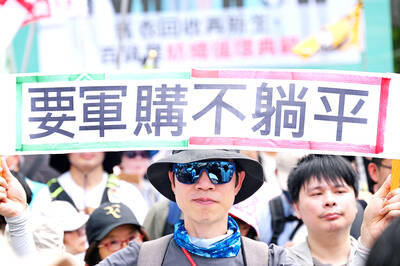
More than 8,000 people took part in a rally in Taipei yesterday to express support for more defense spending, after the opposition slashed the Cabinet’s proposed NT$1.25 trillion (US$39.6 billion) special defense budget and capped it at NT$780 billion. The demonstrators urged the Cabinet to propose another bill. Taiwan Economic Democracy Union convener Lai Chung-chiang (賴中強) said the main problem of the passed budget plan is the removal of funding for critical items, not just that the total amount is smaller. Critical budget items included purchasing or developing uncrewed vehicles, Strong Bow (強弓) missile systems, additional ammunition, artificial intelligence-powered combat systems and Taiwan-US


 RSS
RSS