


US President Donald Trump yesterday ordered a US naval blockade of the Strait of Hormuz in response to Iran’s “unyielding” refusal to give up its nuclear ambitions during peace talks in Islamabad.
While acknowledging that the marathon negotiations in Pakistan had gone “well” and “most points were agreed to,” Trump said Tehran had refused to concede on the issue of its nuclear program.
“Effective immediately, the United States Navy, the Finest in the World, will begin the process of BLOCKADING any and all Ships trying to enter, or leave, the Strait of Hormuz,” Trump said on his Truth Social platform. “Any Iranian who fires at us, or at peaceful vessels, will be BLOWN TO HELL!”
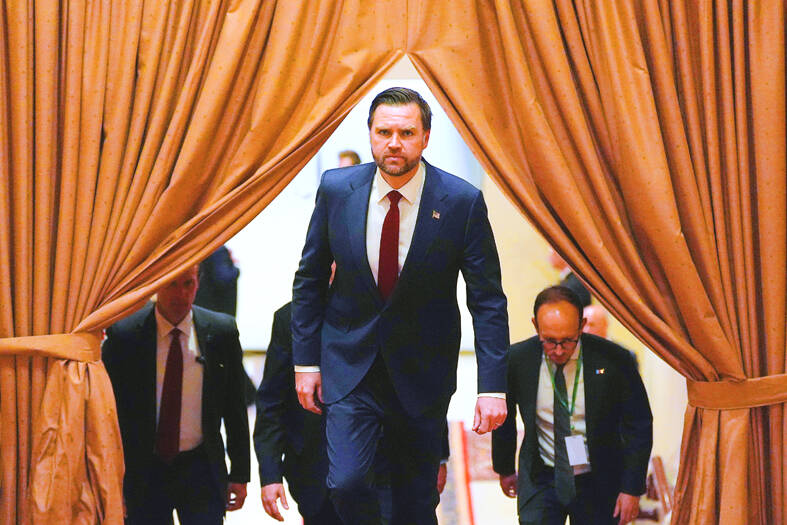
Photo: AP
The US and Iran yesterday failed to strike a deal to end the war in the Middle East.
US Vice President J.D. Vance left Pakistan after the talks — the highest-level meeting between the two sides since the 1979 Islamic revolution — and said that Washington had made Tehran its “final and best offer” for a deal.
“We leave here with a very simple proposal,” he said. “We’ll see if the Iranians accept it.”
Iranian Parliamentary Speaker Mohammad Bagher Ghalibaf said his negotiating team “put forward constructive initiatives, but ultimately the other side was unable to gain the trust of the Iranian delegation in this round of negotiations.”
The failure of the talks would raise concerns that a return to fighting could drive world energy prices higher, and further damage shipping and oil and gas facilities in the Gulf. However Saudi Arabian Minister of Energy Prince Abdulaziz bin Salman yesterday said its key east-west oil pipeline was back in service after it was damaged in earlier strikes, and the Qatari Ministry of Transport said it was lifting some restrictions on Gulf shipping.
Pakistan, which hosted the talks and whose leadership had ushered the rival sides to the table, said it would keep facilitating dialogue and urged both countries to continue respecting the temporary truce.
“It is imperative that the parties continue to uphold their commitment to ceasefire,” Pakistani Minister of Foreign Affairs Ishaq Dar said.
US news Web site Axios quoted an unnamed source briefed on the negotiations as saying that disagreements included “Iran’s demand to control the Strait of Hormuz and refusal to give up on its enriched uranium stockpile.”
British Secretary of State for Health and Social Care Wes Streeting, speaking for the British government, told Sky News that the failure of the talks was disappointing, but “that doesn’t mean there isn’t merit in continuing to try.”
The US and Israel attacked Iran on Feb. 28, sparking retaliation from Tehran that has plunged the Middle East into conflict and shaken the global economy.

A signaling system malfunction disrupted high-speed rail (HSR) services beginning at 8am today, with trains temporarily reduced to three northbound and three southbound trains per hour as authorities conduct inspections. The malfunction occurred on a section of track in Miaoli County during pre-operation checks early this morning, forcing northbound and southbound trains to use a single track, the HSR operator said. The regular schedule has been replaced with three hourly trains offering only nonreserved seating in each direction, stopping at every station, it said, adding that business class cars would still have reserved seating. Departures from terminal stations are scheduled at the top

DRONE CENTRAL: Taiwan aims to become Asia’s democratic hub for drones, with most exports focused on high-quality military-grade models, an official said Taiwan’s drone industry is expected to expand significantly by 2030, producing 100,000 units per month and exporting half of them, the Ministry of Economic Affairs said yesterday. Current drone production capacity is about 15,000 units per month, but the industry can quickly scale up as demand increases, Industrial Development Administration Director-General Chiou Chyou-huey (邱求慧) told a news conference in Taipei. Taiwan’s drone output grew 2.5-fold last year to NT$12.9 billion (US$408.3 million) under a government program to develop the uncrewed vehicle sector, he said. The Executive Yuan in October last year approved plans to invest NT$44.2 billion into domestic production of uncrewed aerial

Taiwan is still in the process of assessing the possibility of recruiting workers from Eswatini, the Ministry of Foreign Affairs said yesterday, adding that its goal is to help Eswatini upgrade its vocational training centers. If there are plans to recruit workers from Eswatini, safeguarding national security, protecting public health and ensuring the employment rights of Taiwanese would be prerequisites, Department of West Asian and African Affairs Director-General Yen Chia-liang (顏嘉良) told a news conference. Key considerations would also include filling labor shortages in specific industries, and fostering bilateral professional and technical exchanges, he said. Yen was asked about the progress of labor

VERBOSE VESSELS: A CGA cutter and a China Coast Guard exchanged verbal barbs for more than a day in Taiwanese-controlled waters before the Chinese vessel left The Taiwanese and Chinese coast guards had a standoff near the strategically located Pratas Islands (Dongsha Islands, 東沙群島) in the north of the South China Sea, the Coast Guard Administration (CGA) said yesterday. The two sides engaged in intense radio exchanges over sovereignty claims during the 33-hour standoff. China Coast Guard vessel 3501 eventually left the restricted waters, 26.6 nautical miles (49.2km) west of the Pratas Islands, at 5pm yesterday, the CGA said. Lying approximately between southern Taiwan and Hong Kong, the Taiwan-controlled Pratas are seen by some security experts as vulnerable to Chinese attack due to their distance — more than


 RSS
RSS