


The government is encouraging telecoms to install more resilient undersea cables, buried deeper and reinforced with steel jacketing, to reduce their vulnerability to sabotage, Minister of Digital Affairs Lin Yi-jing (林宜敬) said yesterday.
The Ministry of Digital Affairs (MODA) this week released its first comprehensive assessment of undersea cable damage, identifying anchor-related incidents as the primary cause of disruptions in coastal areas. While largely accidental, the incidents have heightened concern over the security of critical communications infrastructure.
Speaking at a meeting of the legislature’s Transportation Committee, Lin said Taiwan’s broader digital strategy — including the “five trusted industry sectors” and the “10 major artificial intelligence infrastructure projects” — aims to reinforce systemic resilience across key sectors.
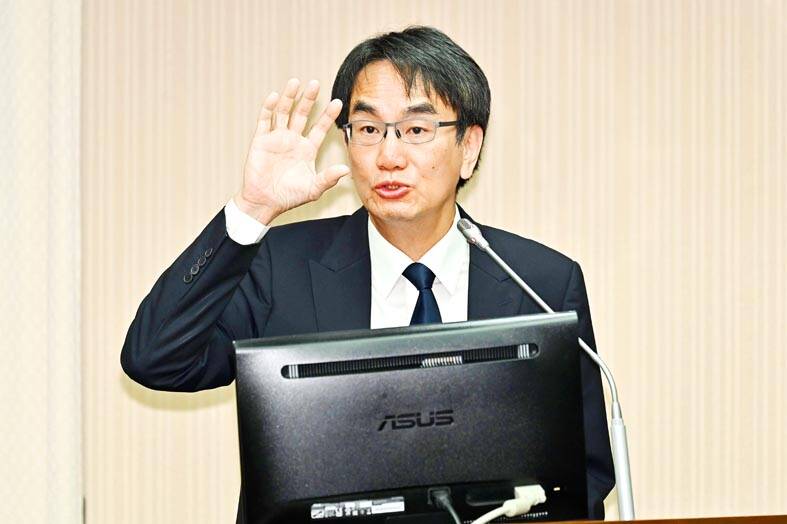
Photo: Tu Chien-jung, Taipei Times
The ministry has coordinated with the National Communications Commission to amend Article 72 of the Telecommunications Management Act (電信管理法), authorizing the confiscation of vessels or equipment, should it be proven that undersea cables were severed as part of sabotage, he said.
The amendment was promulgated on Jan. 5.
Infrastructure expansion is also under way as the government has urged domestic operators to participate in regional systems such as the Southeast Asia-Japan 2 and Apricot submarine cables, Lin said.
Domestic cable projects — such as the Taiwan-Matsu No. 4, Taiwan-Penghu No. 4 and Penghu-Kinmen No. 4 cables — are expected to be finished this year, he said.
Government subsidies for the development of backup systems, including microwave links, as well as additional support this year for early-warning systems and accelerated repair capabilities, would help maintain connectivity in the event of cable damage, he added.
MODA would step up monitoring capabilities to improve response times and strengthen attribution in suspected sabotage cases, Lin said.
The government is coordinating with private-sector partners to strengthen protections at cable landing points — areas particularly exposed to accidental damage and targeted interference, he said.
Subsidy programs launched last year would be expanded to support the efforts, reflecting a broader shift toward layered resilience in Taiwan’s communications infrastructure, he added.
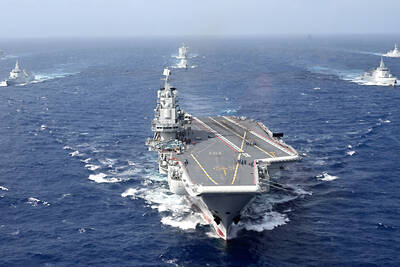
PROVOCATIVE: Chinese Deputy Ambassador to the UN Sun Lei accused Japan of sending military vessels to deliberately provoke tensions in the Taiwan Strait China denounced remarks by Japan and the EU about the South China Sea at a UN Security Council meeting on Monday, and accused Tokyo of provocative behavior in the Taiwan Strait and planning military expansion. Ayano Kunimitsu, a Japanese vice foreign minister, told the Council meeting on maritime security that Tokyo was seriously concerned about the situation in the East China and South China seas, and reiterated Japan’s opposition to any attempt to change the “status quo” by force, and obstruction of freedom of navigation and overflight. Stavros Lambrinidis, head of the EU delegation to the UN, also highlighted South China Sea
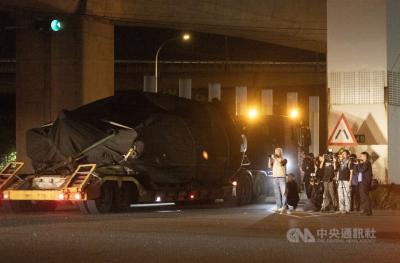
The final batch of 28 M1A2T Abrams tanks purchased from the US arrived at Taipei Port last night and were transported to the Armor Training Command in Hsinchu County’s Hukou Township (湖口), completing the military’s multi-year procurement of 108 of the tanks. Starting at 12:10am today, reporters observed more than a dozen civilian flatbed trailers departing from Taipei Port, each carrying an M1A2T tank covered with black waterproof tarps. Escorted by military vehicles, the convoy traveled via the West Coast Expressway to the Armor Training Command, with police implementing traffic control. The army operates about 1,000 tanks, including CM-11 Brave Tiger
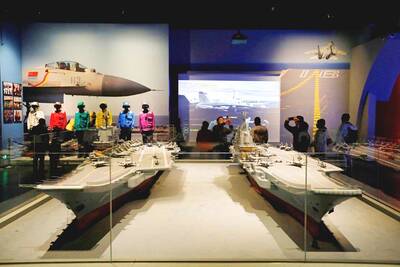
China on Wednesday teased in a video an aircraft carrier that could be its fourth, and the first using nuclear power, while making an allusion to Taiwan and vowing to further build up its islands, as it looks to boost maritime power, secure resources and bolster territorial claims. The video, issued on the eve of the 77th founding anniversary of the Chinese People’s Liberation Army Navy, featured fictional officers with names that are homophones of three commissioned aircraft carriers, the Liaoning (遼寧), Shandong (山東) and Fujian (福建). Titled Into the Deep, it showed a 19-year-old named “Hejian” (何劍) joining the group, sparking
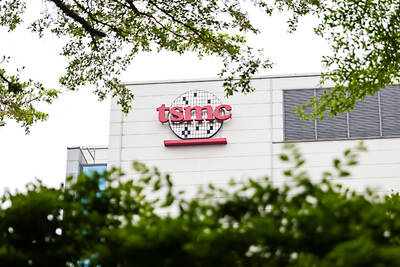
Taiwan Semiconductor Manufacturing Co (TSMC, 台積電), the world’s largest contract chipmaker, said it expects its 2-nanometer (2nm) chip capacity to grow at a compound annual rate of 70 percent from this year to 2028. The projection comes as five fabs begin volume production of 2-nanometer chips this year — two in Hsinchu and three in Kaohsiung — TSMC senior vice president and deputy cochief operating officer Cliff Hou (侯永清) said at the company’s annual technology symposium in Silicon Valley, California, last week. Output in the first year of 2-nanometer production, which began in the fourth quarter of last year, is expected to


 RSS
RSS