


Iran yesterday hit an oil tanker off the coast of Qatar, as well as Kuwait’s airport, while airstrikes battered Tehran — hours after US President Donald Trump said that he was nearly ready to wind down the war.
Trump, who was scheduled to address the US after press time last night, said that he could walk away from the war in two to three weeks once he felt confident Iran would not be able to build a nuclear weapon — even if Tehran does not agree to a ceasefire.
Trump said that the US “will not have anything to do with” what happens next in Strait of Hormuz, which has been closed by Iran.
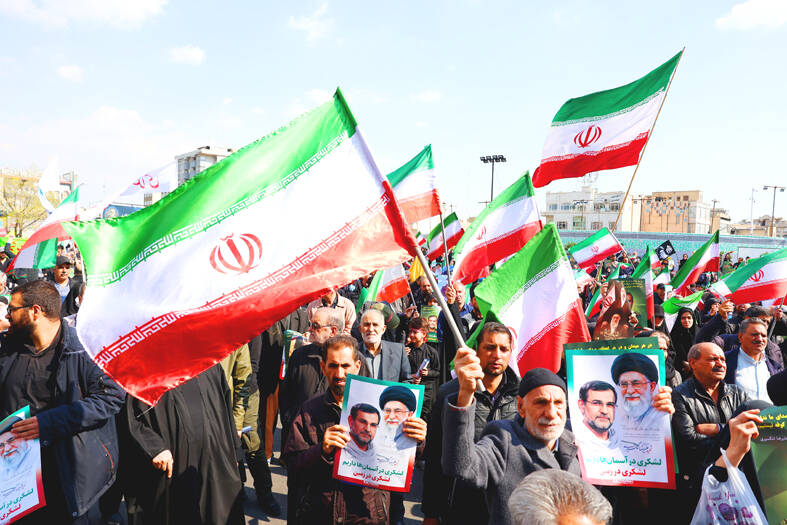
Photo: EPA
Instead, the responsibility for keeping the strait open would rest with countries that rely on it, he said.
Gulf states rely on the waterway for exports and imports, including food, and 20 percent of the world’s oil supply flows through it.
It was not clear what Israel, which began bombing Iran alongside the US on Feb. 28, would do if Washington pulls out without a deal.
Meanwhile, Iranian Minister of Foreign Affairs Abbas Araghchi signaled Tehran’s willingness to keep fighting.
“You cannot speak to the people of Iran in the language of threats and deadlines,” Araghchi told al-Jazeera. “We do not set any deadline for defending ourselves.”
Amid the war, oil prices have skyrocketed, pushing up the cost of gasoline, food and other goods. The spot price of Brent crude, the international standard, was up more than 40 percent since the start of the war, trading at more than US$103 a barrel yesterday.
The US has presented Iran with a 15-point plan aimed at bringing about a ceasefire, including a demand for the Strait of Hormuz to be reopened and for Tehran’s nuclear program to be rolled back.
Iran insists its nuclear program is peaceful. Its own five-point response includes retaining sovereignty over the strait.
In the interview with al-Jazeera, Araghchi said that direct messages from US envoy Steve Witkoff had been received.
However, there were no direct negotiations, he said, adding that Iran has no faith that talks with the US could yield any results, saying: “The trust level is at zero.”
He warned against any US attempt to launch a ground offensive, saying: “We are waiting for them.”
Meanwhile, a cruise missile slammed into an oil tanker off Qatar’s coast, the Qatari Ministry of Defense said.
The 21-member crew of the tanker, contracted by state-owned QatarEnergy, was evacuated and no casualties were reported.
In the United Arab Emirates, a person was killed when he was hit by debris from an intercepted drone in Fujairah, one of the country’s seven emirates.
Bahrain sounded two alerts for incoming missiles, while Kuwait’s state-run news agency, KUNA, said a drone hit a fuel tank at Kuwait International Airport, sparking a large fire.
Two drones were also intercepted in Saudi Arabia, and air raid sirens sounded in Israel, although there were no immediate reports of damage or casualties.
An airstrike on Tehran appeared to have hit the former US embassy compound, which has been controlled by Iran’s Revolutionary Guard since US diplomats were held hostage there in 1979.
Witnesses said buildings outside the massive compound had their windows blown out and that it appears the strike happened inside the walled facility.
Israel also said it hit a plant in Iran producing fentanyl, a synthetic opioid.
Israel and the US have alleged in recent years that Iran was experimenting with using fentanyl in chemical weapons.
In Lebanon, at least five people were killed in an Israeli strike on a Beirut neighborhood.
Israel invaded southern Lebanon after the Iran-linked Hezbollah militant group began launching missiles into northern Israel days after the outbreak of the war.
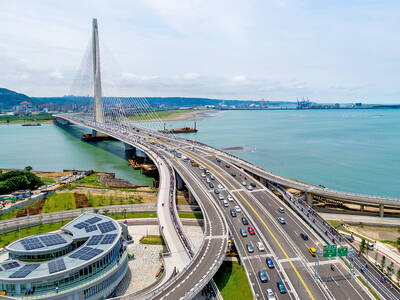
The Ministry of Transportation and Communications yesterday inaugurated the Danjiang Bridge across the Tamsui River in New Taipei City, saying that the structure would be an architectural icon and traffic artery for Taiwan. Feted as a major engineering achievement, the Danjiang Bridge is 920m long, 211m tall at the top of its pylon, and is the longest single-pylon asymmetric cable-stayed bridge in the world, the government’s Web site for the structure said. It was designed by late Iraqi-British architect Zaha Hadid. The structure, with a maximum deck of 70m, accommodates road and light rail traffic, and affords a 200m navigation channel for boats,
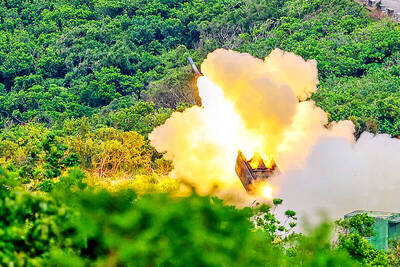
PRECISION STRIKES: The most significant reason to deploy HIMARS to outlying islands is to establish a ‘dead zone’ that the PLA would not dare enter, a source said A High Mobility Artillery Rocket System (HIMARS) would be deployed to Penghu County and Dongyin Island (東引) in Lienchiang County (Matsu) to force the Chinese military to retreat at least 100km from the coastline, a military source said yesterday. Taiwan has been procuring HIMARS and Army Tactical Missile Systems (ATACMS) from the US in batches. Once all batches have been delivered, Taiwan would possess 111 HIMARS units and 504 ATACMS, which have a range of 300km. Considering that “offense is the best defense,” the military plans to forward-deploy the systems to outlying islands such as Penghu and Dongyin so that

Taiwan Semiconductor Manufacturing Co (TSMC, 台積電), the world’s largest foundry service provider, yesterday said that global semiconductor revenue is projected to hit US$1.5 trillion in 2030, after the figure exceeds US$1 trillion this year, as artificial intelligence (AI) demand boosts consumption of token and compute power. “We are still at the beginning of the AI revolution, but we already see a significant impact across the whole semiconductor ecosystem,” TSMC deputy cochief operating officer Kevin Zhang (張曉強) said at the company’s annual technology symposium in Hsinchu City. “It is fair to say that in the past decade, smartphones and other mobile devices were
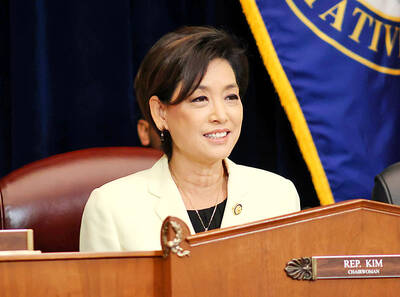
‘CLEAR MESSAGE’: The bill would set up an interagency ‘tiger team’ to review sanctions tools and other economic options to help deter any Chinese aggression toward Taiwan US Representative Young Kim has introduced a bill to deter Chinese aggression against Taiwan, calling for an interagency “tiger team” to preplan coordinated sanctions and economic measures in response to possible Chinese military or political action against Taiwan. “[Chinese President] Xi Jinping [習近平] has directed the People’s Liberation Army to be ready to invade Taiwan by 2027. China has a plan. America should have one too,” Kim said in a news release on Thursday last week. She introduced the “Deter PRC [People’s Republic of China] aggression against Taiwan act” to “ensure the US has a coordinated sanctions strategy ready should


 RSS
RSS