


Legislative committee members yesterday failed to reach a consensus on most articles of the three versions of the special defense budget bill.
Over the past two days, a joint session of the Foreign Affairs and National Defense Committee and Finance Committee conducted article-by-article deliberations on the three versions.
They were the Cabinet’s NT$1.25 trillion (US$39.18 billion) version, the Chinese Nationalist Party’s (KMT) NT$380 billion proposal and the Taiwan People’s Party’s (TPP) NT$400 billion bill.
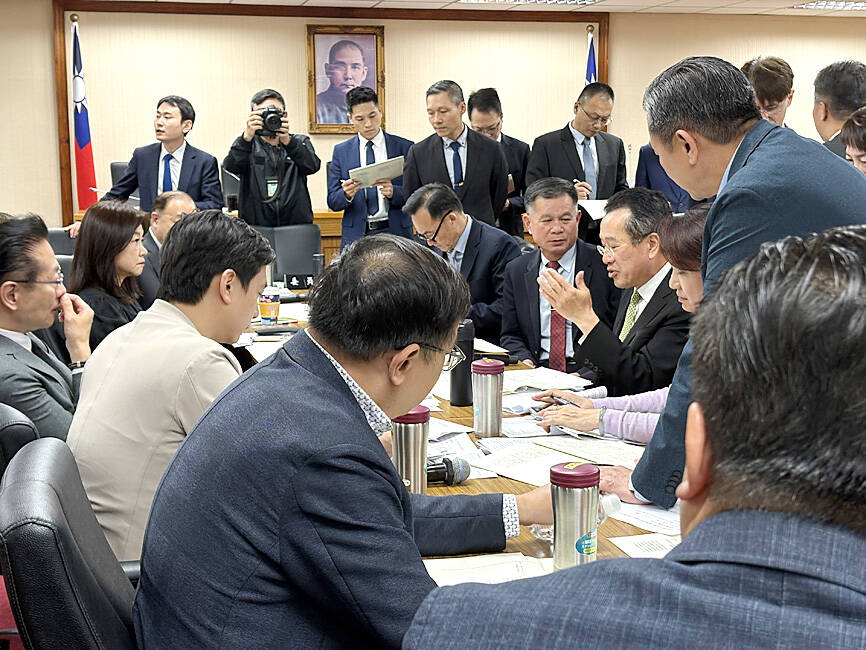
Photo: Huang Ching-hsuan, Taipei Times
Only two provisions were passed, while the rest were set aside for cross-party negotiations.
The two articles passed were Article 2, which stipulates that the Ministry of National Defense is the competent authority, and Article 3 of the KMT’s version requiring procurement to follow the Government Procurement Act (政府採購法).
Before adjourning, the joint committee passed a supplementary resolution proposed by KMT lawmakers requiring the government to discuss individual procurement cases with the US and to report to the legislature.
“We will continue to make efforts,” Minister of National Defense Wellington Koo (顧立雄) told reporters after the session.
As the delay has raised fears Taiwan might miss deadlines to purchase US equipment, Koo said the government is talking to Washington about possibly deferring payment or reducing the initial payment, given that he could not predict when the legislature would approve the funds.
Regarding proposed auditing mechanisms, Koo agreed to the KMT caucus’ proposal that the Ministry of National Defense submit a special report to the Legislative Yuan each session detailing the execution progress and performance of the special budget.
Koo also agreed to a TPP proposal that the competent authority compile a report on the implementation results by the end of May in the year following the act’s expiration, which would then be submitted to the legislature.
However, Koo said that he does not want lower-level personnel to bear undeserved pressure, adding that blame should not be placed on officials who are merely executing their duties.
Meanwhile, the defense minister said the next arms sale package from the US is on track, after the government received a letter of guarantee from Washington.
A major US arms package for Taiwan worth about US$14 billion that includes advanced interceptor missiles is ready for US President Donald Trump’s approval and could be signed after his upcoming trip to China, Reuters reported earlier this month.
Asked by reporters whether the upcoming meeting between Trump and Chinese President Xi Jinping (習近平) would affect US arms sales, Koo said the government had already received a letter of guarantee indicating the US is willing to authorize the next deal.
“We have also been in close communication with the US Department of Defense’s Defense Security Cooperation Agency regarding its willingness to provide and sell the arms to us, including guidance concerning the items, the amount and the transaction,” he added, without offering details.
The package is still undergoing review in the US and Taiwan has not received any notification about delays, Koo said.
Additional reporting by CNA

A signaling system malfunction disrupted high-speed rail (HSR) services beginning at 8am today, with trains temporarily reduced to three northbound and three southbound trains per hour as authorities conduct inspections. The malfunction occurred on a section of track in Miaoli County during pre-operation checks early this morning, forcing northbound and southbound trains to use a single track, the HSR operator said. The regular schedule has been replaced with three hourly trains offering only nonreserved seating in each direction, stopping at every station, it said, adding that business class cars would still have reserved seating. Departures from terminal stations are scheduled at the top
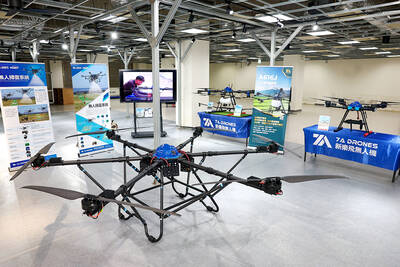
DRONE CENTRAL: Taiwan aims to become Asia’s democratic hub for drones, with most exports focused on high-quality military-grade models, an official said Taiwan’s drone industry is expected to expand significantly by 2030, producing 100,000 units per month and exporting half of them, the Ministry of Economic Affairs said yesterday. Current drone production capacity is about 15,000 units per month, but the industry can quickly scale up as demand increases, Industrial Development Administration Director-General Chiou Chyou-huey (邱求慧) told a news conference in Taipei. Taiwan’s drone output grew 2.5-fold last year to NT$12.9 billion (US$408.3 million) under a government program to develop the uncrewed vehicle sector, he said. The Executive Yuan in October last year approved plans to invest NT$44.2 billion into domestic production of uncrewed aerial

Taiwan is still in the process of assessing the possibility of recruiting workers from Eswatini, the Ministry of Foreign Affairs said yesterday, adding that its goal is to help Eswatini upgrade its vocational training centers. If there are plans to recruit workers from Eswatini, safeguarding national security, protecting public health and ensuring the employment rights of Taiwanese would be prerequisites, Department of West Asian and African Affairs Director-General Yen Chia-liang (顏嘉良) told a news conference. Key considerations would also include filling labor shortages in specific industries, and fostering bilateral professional and technical exchanges, he said. Yen was asked about the progress of labor

VERBOSE VESSELS: A CGA cutter and a China Coast Guard exchanged verbal barbs for more than a day in Taiwanese-controlled waters before the Chinese vessel left The Taiwanese and Chinese coast guards had a standoff near the strategically located Pratas Islands (Dongsha Islands, 東沙群島) in the north of the South China Sea, the Coast Guard Administration (CGA) said yesterday. The two sides engaged in intense radio exchanges over sovereignty claims during the 33-hour standoff. China Coast Guard vessel 3501 eventually left the restricted waters, 26.6 nautical miles (49.2km) west of the Pratas Islands, at 5pm yesterday, the CGA said. Lying approximately between southern Taiwan and Hong Kong, the Taiwan-controlled Pratas are seen by some security experts as vulnerable to Chinese attack due to their distance — more than


 RSS
RSS