


Taiwan’s manufacturing strengths, in combination with the US’ technological expertise, could bolster the nations’ trade resilience by enhancing supply chain resilience and tapping into emerging markets, American Institute in Taiwan (AIT) Director Raymond Greene said yesterday.
Industrial development should prioritize security, resilience and trust, highlighting Taiwan’s growing importance in global supply chains, Greene said at the Taiwan International Machine Tool Show.
As digitalization and artificial intelligence (AI) reshape product design and manufacturing, Taiwan’s expanding industrial base and deepening trade ties have elevated its global role, he said.
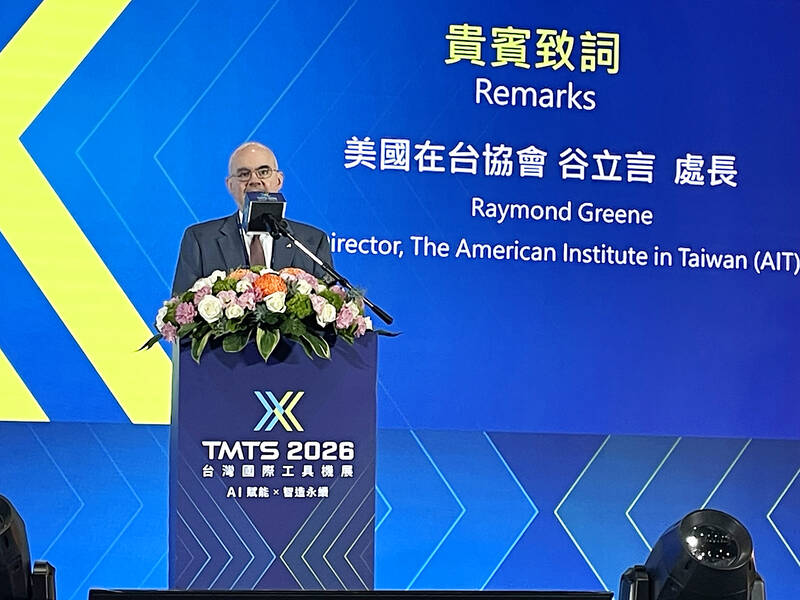
Photo: CNA
Taiwan has become the US’ fourth-largest trading partner, with future cooperation focusing on advanced manufacturing, AI, robotics, defense supply chains, aerospace engineering and broader regional collaboration, Greene said.
He urged Taiwanese companies to invest in AI, drones and other emerging technologies in the US market.
Separately, Taiwan is taking decisive action against China’s military, information and economic pressure, and hopes to work with like-minded partners to promote global AI infrastructure, and protect global prosperity and freedom through advanced technology, Vice President Hsiao Bi-khim (蕭美琴) said in a prerecorded video played at the Hill and Valley Forum in Washington.
Energy, information and communications resilience are considered vital pillars of national defense under President William Lai’s (賴清德) Whole-of-Society Defense Resilience concept, she said.
Private innovation and the localization of the production of national defense equipment would ensure that the policy is implemented rather than remaining a vision, Hsiao said.
Taiwan-US collaboration on drones was a game changer for bilateral relations, turning a buyer-seller relationship into a national defense industrial partnership, she said.
The Industrial Technology Research Institute has become the first non-US institute to join the Green UAS defense logistics program under the US Association for Uncrewed Vehicle Systems International, showing that Taiwan’s industrial sector is ready, she said.
Private corporations in Taiwan have issued the first set of information security standards — SEMI E187 — for machinery used to manufacture semiconductors, Hsiao added.
Through initiatives such as the “Ten Major AI Infrastructure Projects,” Taiwan aims to expand AI applications beyond data centers into deployable systems and enhance integration with US-led supply chains, she said.
Taiwan and the US are not competitors, but partners in the global innovation ecosystem, working together to drive the next wave of technological development, and ensure global prosperity and freedom, she said.
Additional reporting by CNA
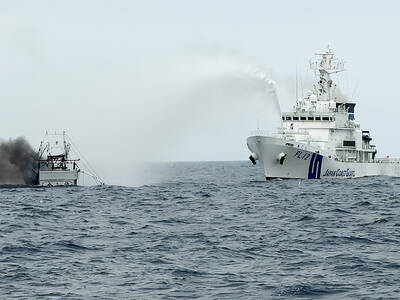
CREDIT-GRABBER: China said its coast guard rescued the crew of a fishing vessel that caught fire, who were actually rescued by a nearby Taiwanese boat and the CGA Maritime search and rescue operations do not have borders, and China should not use a shipwreck to infringe upon Taiwanese sovereignty, the Coast Guard Administration (CGA) said yesterday. The coast guard made the statement in response to the China Coast Guard (CCG) saying it saved a Taiwanese fishing boat. The Chuan Yu No. 6 (全漁6號), a fishing vessel registered in Keelung, on Thursday caught fire and sank in waters northeast of Diaoyutai Islands (釣魚台). The vessel left Keelung’s Badouzih Fishing Harbor (八斗子漁港) at 3:35pm on Sunday last week, with seven people on board — a 62-year-old Taiwanese captain surnamed Chang (張) and six
RISKY BUSINESS: The ‘incentives’ include initiatives that get suspended for no reason, creating uncertainty and resulting in considerable losses for Taiwanese, the MAC said China’s “incentives” failed to sway sentiment in Taiwan, as willingness to work in China hit a record low of 1.6 percent, a Ministry of Labor survey showed. The Directorate-General of Budget, Accounting and Statistics (DGBAS) also reported that the number of Taiwanese workers in China has nearly halved from a peak of 430,000 in 2012 to an estimated 231,000 in 2024. That marked a new low in the proportion of Taiwanese going abroad to work. The ministry’s annual survey on “Labor Life and Employment Status” includes questions respondents’ willingness to seek employment overseas. Willingness to work in China has steadily declined from

The Legislative Yuan’s Finance Committee yesterday approved proposed amendments to the Amusement Tax Act (娛樂稅法) that would abolish taxes on films, cultural activities and competitive sporting events, retaining the fee only for dance halls and golf courses. The proposed changes would set the maximum tax rate for dance halls and golf courses at 50 and 20 percent respectively, with local governments authorized to suspend the levies. Article 2 of the act says that “amusement tax shall be levied on tickets sold or fees charged by amusement places, facilities or activities” in six categories: “Cinema; professional singing, story-telling, dancing, circus, magic show, acrobatics
INFLATION UP? The IMF said CPI would increase to 1.5 percent this year, while the DGBAS projected it would rise to 1.68 percent, with GDP per capita of US$44,181 The IMF projected Taiwan’s real GDP would grow 5.2 percent this year, up from its 2.1 percent outlook in January, despite fears of global economic disruptions sparked by the US-Iran conflict. Taiwan’s consumer price index (CPI) is projected to increase to 1.5 percent, while unemployment would be 3.4 percent, roughly in line with estimates for Asia as a whole, the international body wrote in its Global Economic Outlook Report published in the US on Monday. The figures are comparatively better than the IMF outlook for the rest of the world, which pegged real GDP growth at 3.1 percent, down from 3.3 percent


 RSS
RSS