


The Control Yuan yesterday urged the judiciary to impose stricter punishments on military personnel convicted of contravening national security regulations after being lured to spy for China.
The government watchdog investigated two cases involving military personnel: one, a sergeant surnamed Tsai (蔡) from the army’s Penghu Defense Command who was recruited by Chinese intelligence operatives after searching for online loans, and two, Chinese intelligence agents using temple affiliates to recruit active and retired military personnel to gather classified information.
The Control Yuan’s Foreign Affairs and National Defense Committee and Judiciary and Prison Administration Committee jointly approved the investigation report and released it to the public on Thursday last week.
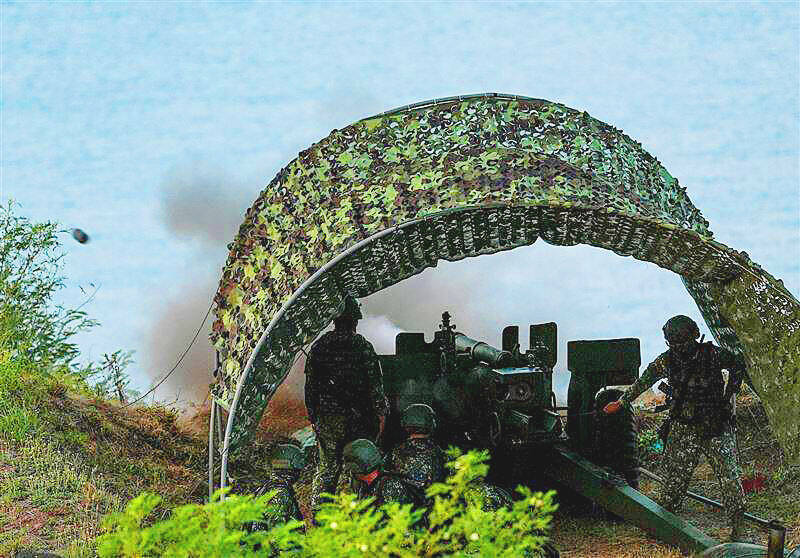
Photo courtesy of Military News Agency
The committees also passed a motion censuring six military agencies: Penghu Defense Command, Infantry Training Command, Guandu Area Command, 586th Armored Brigade, Chiayi Reserve Command and the Armaments Bureau’s Production and Manufacturing Center, Plant No. 401.
Tsai’s case was a typical example of Chinese intelligence agencies using social networks to attract military personnel having financial difficulties and paying them in exchange for collecting classified military information in Taiwan, Control Yuan members Lai Chen-chang (賴振昌) and Lai Ting-ming (賴鼎銘) said in a statement.
“The army’s Penghu Defense Command was aware that Tsai had mismanaged his finances. Other than punishing and reassigning him to a different position, it did not follow up on his case or offer him further assistance, which led to the spying incident,” they said.
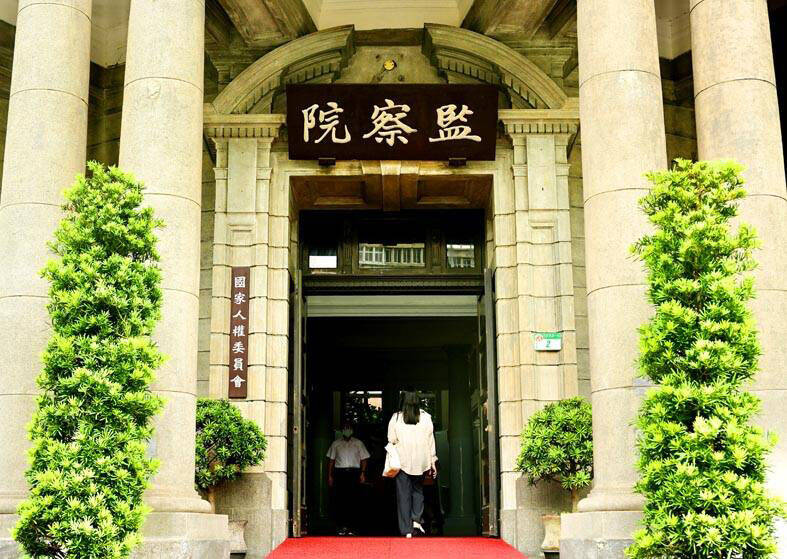
Photo: Lo Pei-de, Taipei Times
The Penghu Defense Command failed to scrutinize the use of personal mobile phones in the military base and did not detect loopholes in the base’s access control system, nor did it thoroughly enforce the “zero trust” cybersecurity policy, they said.
In the second case, Chinese intelligence agencies used temple managers to recruit Taiwanese military personnel for espionage activities through fortune-telling and other means, they said.
The manager of a temple in New Taipei City’s Wugu District (五股), surnamed Liu (劉), knew intelligence agents from China and recruited more than 10 Taiwanese service members from the Infantry Training Command, Guandu Area Command, 586th Armored Brigade, the Chiayi Reserve Command and the Armaments Bureau’s Plant No. 401.
“These military units also have other issues, including careless management of classified information, failure to thoroughly enforce the cybersecurity protection policy and subpar security awareness among military personnel. Meanwhile, access controls and checkpoints were effectively meaningless. Failure to address these problems would surely compromise national security and combat capabilities,” the two Control Yuan members said.
Data from the Judicial Yuan showed that from 2017 to last year the average prison sentences meted out in cases involving national security and military personnel were: 12.8 months for district courts, 18.1 months for the High Court and 27.8 months for the Supreme Court, they said.
Ministry of Justice data also showed that, as of last year, the average prison sentence for national security breaches was 31.4 months, they said.
As of 2024, people convicted of contravening the Classified National Security Information Protection Act (國家機密保護法) were sentenced to an average of 24.3 months in prison, which is 12.7 times shorter than those in other democratic countries, they said.
The punishment is also relatively lighter than that for officials convicted of bribery or people found guilty of trafficking in category 1 or 2 drugs, they added.
“This highlights a clear tendency of courts to impose relatively light sentences in national security cases, failing to effectively deter potential offenders,” they said.
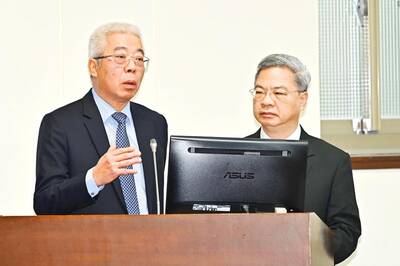
Taiwan has arranged for about 8 million barrels of crude oil, or about one-third of its monthly needs, to be shipped from the Red Sea this month to bypass the Strait of Hormuz and ease domestic supply pressures, CPC Corp, Taiwan (CPC, 台灣中油) said yesterday. The state-run oil company has worked with Middle Eastern suppliers to secure routes other than the Strait of Hormuz, through which about 20 percent of the world’s oil and liquefied natural gas typically passes, CPC chairman Fang Jeng-zen (方振仁) said at a meeting of the legislature’s Economics Committee in Taipei. Suppliers in Saudi Arabia have indicated they
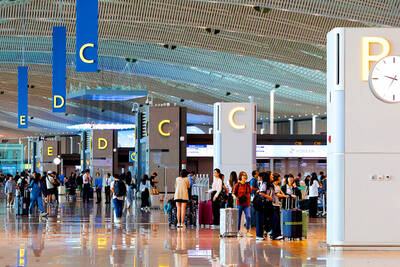
South Korea has adjusted its electronic arrival card system to no longer list Taiwan as a part of China, a move that the Ministry of Foreign Affairs said would help facilitate exchanges between the two sides. South Korea previously listed “Taiwan” as “Taiwan (China)” in the drop-down menus of its online arrival card system, where people had to fill out where they came from and their next destination. The ministry had requested South Korea make a revision and said it would change South Korea’s name on Taiwan’s online immigration system from “Republic of Korea” to “Korea (South),” should the issue not be

CCP ‘PAWN’? Beijing could use the KMT chairwoman’s visit to signal to the world that many people in Taiwan support the ‘one China’ principle, an academic said Chinese Nationalist Party (KMT) Chairwoman Cheng Li-wun (鄭麗文) yesterday arrived in China for a “peace” mission and potential meeting with Chinese President Xi Jinping (習近平), while a Taiwanese minister detailed the number of Chinese warships currently deployed around the nation. Cheng is visiting at a time of increased Chinese military pressure on Taiwan, as the opposition-dominated Legislative Yuan stalls a government plan for US$40 billion in extra defense spending. Speaking to reporters before going to the airport, Cheng said she was going on a “historic journey for peace,” but added that some people felt uneasy about her trip. “If you truly love Taiwan,
A global survey showed that 60 percent of Taiwanese had attained higher education, second only to Canada, the Ministry of the Interior said. Taiwan easily surpassed the global average of 43 percent and ranked ahead of major economies, including Japan, South Korea and the US, data from the Organisation for Economic Co-operation and Development (OECD) for 2024 showed. Taiwan has a high literacy rate, data released by the ministry showed. As of the end of last year, Taiwan had 20.617 million people aged 15 or older, accounting for 88.5 percent of the total population, with a literacy rate of 99.4 percent, the data


 RSS
RSS