


US President Donald Trump and Iran threatened to escalate their war by attacking energy facilities in the Gulf, a potential widening of hostilities that could deepen a regional crisis and add to concerns in global markets.
Air raid sirens sounded across Israel from the early hours yesterday morning, warning of incoming missiles from Iran, after scores of people were hurt overnight in two separate attacks in the southern Israeli towns of Arad and Dimona.
The Israeli military said hours later that it was striking Tehran in response.
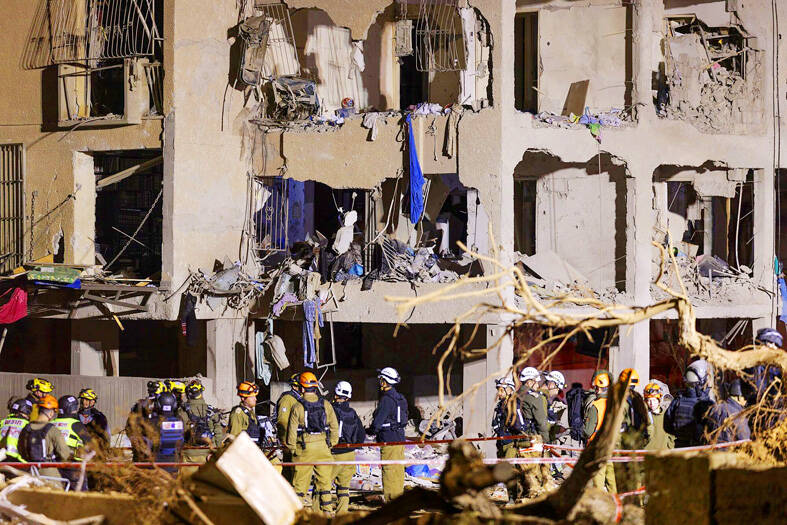
Photo: Bloomberg
Trump on Saturday threatened to “obliterate” Iran’s power plants if Tehran did not fully reopen the Strait of Hormuz within 48 hours, suggesting a significant escalation barely a day after he talked about “winding down” the war.
Iran yesterday said it would attack US infrastructure, including energy facilities in the Gulf, if Trump carried out his threat.
Iranian Islamic Consultative Assemply Speaker Mohammad Baqer Qalibaf wrote on X that critical infrastructure and energy facilities in the Middle East could be “irreversibly destroyed” should Iranian power plants be attacked.
More than 2,000 people have been killed during the war the US and Israel launched on Feb. 28, which has upended markets, spiked fuel costs, fueled global inflation fears and convulsed the post-World War II Western alliance.
Iranian attacks have effectively closed the Strait of Hormuz, a narrow choke point that carries about one-fifth of global oil and liquefied natural gas supplies, causing the worst oil crisis since the 1970s. Its near-closure sent European gas prices surging as much as 35 percent last week.
The Strait of Hormuz remains open to all shipping except vessels linked to “Iran’s enemies,” the country’s representative to the International Maritime Organization Ali Mousavi was quoted as saying in Iranian media reports.
Passage through the waterway was possible by coordinating security and safety arrangements with Tehran, he added.
Ship-tracking data has shown some vessels, such as Indian-flagged ships and a Pakistani oil tanker, have negotiated safe passage through the Strait.
Iran’s Khatam al-Anbiya military command headquarters said that if the US hit Iran’s fuel and energy infrastructure, Tehran would launch attacks on all US energy, information technology and desalination infrastructure in the region.
The Islamic Republic’s power grid is deeply intertwined with its energy sector. Striking major plants could trigger blackouts, crippling everything from pumps and refineries to export terminals and military command centers.
Tehran fired long-range missiles for the first time on Saturday, expanding the risk of attacks beyond the Middle East, while an Iranian strike landed near Israel’s secretive nuclear reactor about 13km southeast of the city of Dimona.
Iran fired two ballistic missiles with a range of 4,000km at the US-British Indian Ocean military base at Diego Garcia, Israeli Chief of the General Staff Eyal Zamir said.
Pope Leo appealed for an end to the conflict
“The death and suffering caused by this war are a scandal to the whole human family,” he said.
A Reuters/Ipsos poll last week found that 59 percent of Americans disapprove of US military strikes against Iran, with 37 percent approving.
South Korea has adjusted its electronic arrival card system to no longer list Taiwan as a part of China, a move that the Ministry of Foreign Affairs said would help facilitate exchanges between the two sides. South Korea previously listed “Taiwan” as “Taiwan (China)” in the drop-down menus of its online arrival card system, where people had to fill out where they came from and their next destination. The ministry had requested South Korea make a revision and said it would change South Korea’s name on Taiwan’s online immigration system from “Republic of Korea” to “Korea (South),” should the issue not be

Tainan, Taipei and New Taipei City recorded the highest fines nationwide for illegal accommodations in the first quarter of this year, with fines issued in the three cities each exceeding NT$7 million (US$220,639), Tourism Administration data showed. Among them, Taipei had the highest number of illegal short-term rental units, with 410. There were 3,280 legally registered hotels nationwide in the first quarter, down by 14 properties, or 0.43 percent, from a year earlier, likely indicating operators exiting the market, the agency said. However, the number of unregistered properties rose to 1,174, including 314 illegal hotels and 860 illegal short-term rental

Both sides of the Taiwan Strait share a political foundation based on the “1992 consensus” and opposition to Taiwanese independence, Chinese Nationalist Party (KMT) Chairwoman Cheng Li-wun (鄭麗文) today said during her meeting with Chinese President Xi Jinping (習近平). Both sides of the Strait should plan and build institutionalized and sustainable mechanisms for dialogue and cooperation based on that foundation to make peaceful development across the Strait irreversible, she said. Peace is a shared moral value across the Strait, and both sides should move beyond political confrontation to seek institutionalized solutions to prevent war, she said. Mutually beneficial cross-strait relations are what the

ECONOMIC COERCION: Such actions are often inconsistently applied, sometimes resumed, and sometimes just halted, the Presidential Office spokeswoman said The government backs healthy and orderly cross-strait exchanges, but such arrangements should not be made with political conditions attached and never be used as leverage for political maneuvering or partisan agendas, Presidential Office spokeswoman Karen Kuo (郭雅慧) said yesterday. Kuo made the remarks after China earlier in the day announced 10 new “incentive measures” for Taiwan, following a landmark meeting between Chinese President Xi Jinping (習近平) and Chinese Nationalist Party (KMT) Chairwoman Cheng Li-wun (鄭麗文) in Beijing on Friday. The measures, unveiled by China’s Xinhua news agency, include plans to resume individual travel by residents of Shanghai and China’s Fujian


 RSS
RSS