


Supporting Taiwan’s meaningful participation in international organizations remains a key part of the US Mission to the UN, US Representative to the UN Mike Waltz said on Friday.
He also reiterated the US’ opposition to China’s distortion of UN General Assembly Resolution 2758, saying it was an attempt to isolate Taiwan from the international community.
Waltz made the remarks at a hearing titled “Oversight Field Hearing — Accountability and Reform at the UN,” held by the US House of Representatives’ Subcommittee on National Security, Department of State and Related Programs.
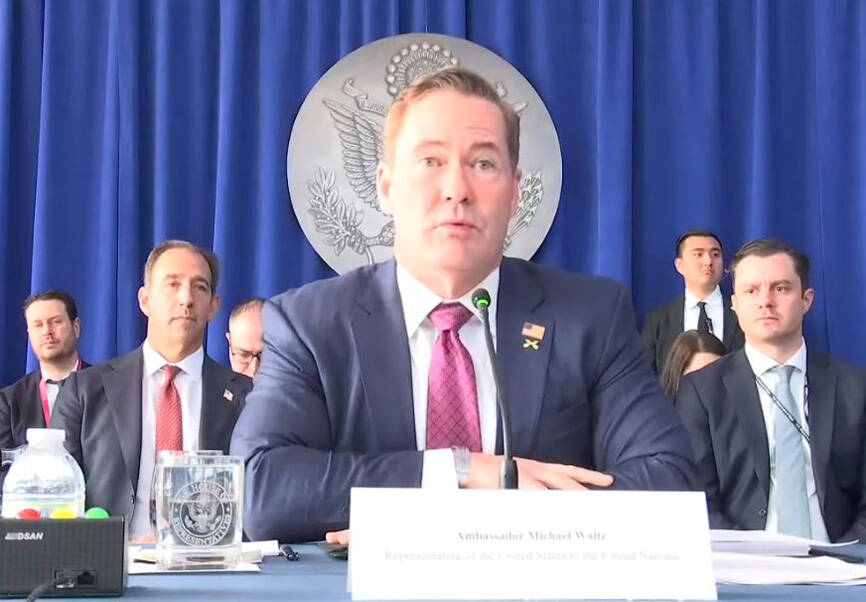
Photo: Screen grab from the US House Appropriations Committee’s YouTube channel
During the hearing, US Representative John Moolenaar said the People’s Republic of China (PRC) is using multiple means, including financial contributions and placing PRC officials at key roles in the UN, to expand its influence throughout the group’s system.
He asked Waltz to share how the US, and its allies and partners are working to maintain transparency and integrity of UN institutions and prevent countries such as China, North Korea, Iran and Russia for using the organization for their geopolitical agendas.
“The continual support of Taiwan’s meaningful participation in international organizations is a key part of our charge here,” Waltz said.
“The world benefits from Taiwan’s expertise and resources, addressing some of the most critical challenges, particularly with the technology that they bring,” he said. “The US will not advocate for partners that don’t also share this view.”
“The US opposes China’s intentional misuse and mischaracterization of a resolution that was passed by the [UN] General Assembly here, 2758, that is part of China’s broader efforts to isolate Taiwan from the international community,” Waltz said, adding that the US has forcefully pushed back on China’s effort.
The Ministry of Foreign Affairs yesterday said Minister of Foreign Affairs Lin Chia-lung (林佳龍) thanked Waltz for his support.
“The US’ strong support for Taiwan highlights that Taiwan is a responsible, capable and important partner in the international community, and that the international community cannot tolerate any country’s use of political distortion to exclude a democratic partner that is capable of contributing to the world,” the minister said.
The US firmly maintains that Taiwan has the right to connect with the world, he said, adding that it underscores the nation’s expertise in healthcare, disease prevention, digital technology and supply chain resilience, as well as its ability to utilize its expertise and experience to benefit the world.
Only by allowing Taiwan’s meaningful participation in the world could the world benefit from Taiwan — this is widely recognized and highly anticipated by many democratic countries, Lin said.
UN Resolution 2758 only addressed China’s representation in the UN, not Taiwan’s sovereignty, and it made no mention of Taiwan throughout its entire text, so no country should use the resolution to exclude Taiwan’s participation in the UN system and other international organizations, he said.
The ministry called on the international community to continue taking concrete actions to counter China’s distortion of UN Resolution 2758 and its improper application of the “one China” principle.
The international community should also counter China’s attempts to treat the Taiwan issue as a domestic affair, and prevent Beijing from using the resolution as a legal basis for taking military action against Taiwan.

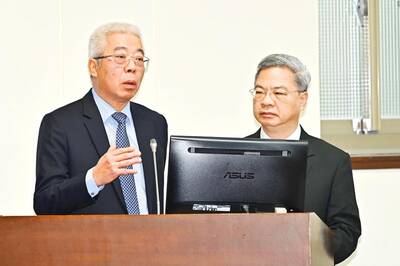
Taiwan has arranged for about 8 million barrels of crude oil, or about one-third of its monthly needs, to be shipped from the Red Sea this month to bypass the Strait of Hormuz and ease domestic supply pressures, CPC Corp, Taiwan (CPC, 台灣中油) said yesterday. The state-run oil company has worked with Middle Eastern suppliers to secure routes other than the Strait of Hormuz, through which about 20 percent of the world’s oil and liquefied natural gas typically passes, CPC chairman Fang Jeng-zen (方振仁) said at a meeting of the legislature’s Economics Committee in Taipei. Suppliers in Saudi Arabia have indicated they

South Korea has adjusted its electronic arrival card system to no longer list Taiwan as a part of China, a move that the Ministry of Foreign Affairs said would help facilitate exchanges between the two sides. South Korea previously listed “Taiwan” as “Taiwan (China)” in the drop-down menus of its online arrival card system, where people had to fill out where they came from and their next destination. The ministry had requested South Korea make a revision and said it would change South Korea’s name on Taiwan’s online immigration system from “Republic of Korea” to “Korea (South),” should the issue not be

Tainan, Taipei and New Taipei City recorded the highest fines nationwide for illegal accommodations in the first quarter of this year, with fines issued in the three cities each exceeding NT$7 million (US$220,639), Tourism Administration data showed. Among them, Taipei had the highest number of illegal short-term rental units, with 410. There were 3,280 legally registered hotels nationwide in the first quarter, down by 14 properties, or 0.43 percent, from a year earlier, likely indicating operators exiting the market, the agency said. However, the number of unregistered properties rose to 1,174, including 314 illegal hotels and 860 illegal short-term rental
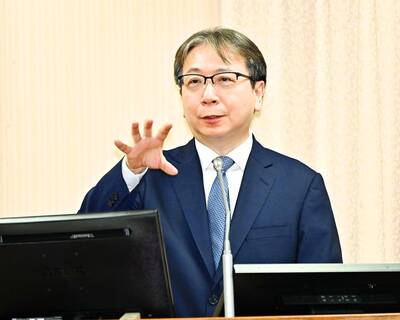
AIR ALERT: China’s reservation of airspace over the Yellow Sea and East China Sea could be an attempt to test the US’ response ahead of a Trump-Xi meeting, the NSB head said China’s attempts to infiltrate Taiwan are systematic, planned and targeted, with activity shifting from recruiting mid-level military officers to rank-and-file enlisted personnel, National Security Bureau (NSB) Director-General Tsai Ming-yen (蔡明彥) said yesterday. The Chinese Communist Party’s (CCP) integrates national security, intelligence operations and “united front” efforts into a dense network to conduct intelligence gathering and espionage in Taiwan, Tsai said at a meeting of the legislature’s Foreign Affairs and National Defense Committee. It uses specific networks to screen targets through exchange activities and recruiting local collaborators to establish intelligence-gathering organizations, he said. China is also shifting who it targets to lower-ranking military personnel,


 RSS
RSS