


The central government would invest NT$6.25 billion (US$195.6 million) this year and next year to expand services for elderly people living alone, helping to ensure that they can receive timely assistance during emergencies, the Ministry of Health and Welfare said yesterday.
Due to Taiwan’s status as a super-aged society, as well as changing family structures and social values, an increasing number of older people are living alone, the ministry told an Executive Yuan briefing.
Responding to the demographic shift, the government would invest NT$6.25 billion from its special resilience budget so that local governments can expand support for older people living alone, it said, adding it would supervise the funding.
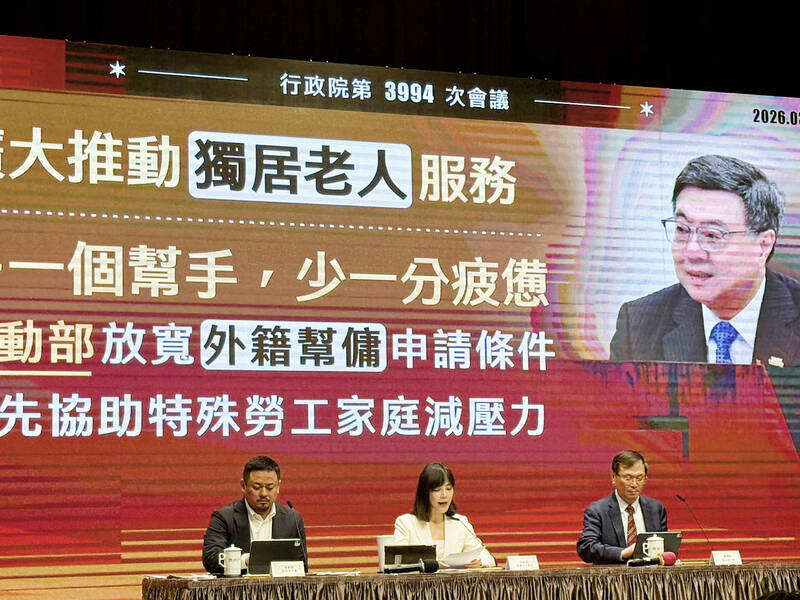
Photo: Chung Li-hua, Taipei Times
Starting this year, local governments would interview people in such situations to better understand their living conditions and requirements, while providing care, meals, emergency rescue assistance and other services as needed, the ministry said.
About 700,000 people would be interviewed over the next two years and about 350,000 are expected to require support, it added.
Using a digital governance model, data from home visits would be integrated with data from the National Health Insurance and other social welfare systems to monitor their health and living conditions, it said.
The ministry would develop an early warning system to provide real-time care and essential services before a crisis occurs, it said.
It would also expand subsidies for emergency rescue devices for 70,000 older people living alone, providing 24-hour protection so that they can receive immediate assistance in case of emergencies, the ministry said.
To improve community support, the ministry is also encouraging local governments to work with 5,000 community centers and grassroots organizations nationwide to provide care visits and meals, it said.
By combining technology with community support, it hopes to provide timely services to every older person in need, it added.
At a Cabinet meeting yesterday, Premier Cho Jung-tai (卓榮泰) also approved an expansion of eligibility to hire migrant domestic helpers, with employers required to pay monthly fees of NT$2,000 to NT$10,000 to fund Ministry of Labor measures aimed at mitigating potential effects on Taiwanese workers.
Under the new regulations, families with at least one child younger than 12 can apply to hire a foreign domestic helper.
Previously, families were required to have three or more children younger than six to be eligible to hire domestic helpers.
In addition to a worker’s salary, families that hire migrant domestic helpers must pay a monthly “employment stabilization” fee of NT$5,000, which would be NT$2,000 for families with special needs, including those with one child younger than six and another younger than 12; those with three children younger than 12; and those with a disabled family member and a child younger than 12.
They also include single-parent families with a child younger than 12; families with a child younger than 12 who has been diagnosed with a rare disease or a disability; and those with a child younger than six with developmental delays.
Foreign employers must have household registration in Taiwan and would be required to pay NT$10,000 per month in employment stabilization fees, the Workforce Development Agency said.
Agency official Chuang Kuo-liang (莊國良) said that the fee for foreign families with special care needs is still being determined and would be announced before applications open on April 13.
Minister of Labor Hung Sun-han (洪申翰) said that his ministry and the Ministry of Health and Welfare would cooperate to provide job-matching services to Taiwanese workers affected by the new rules.
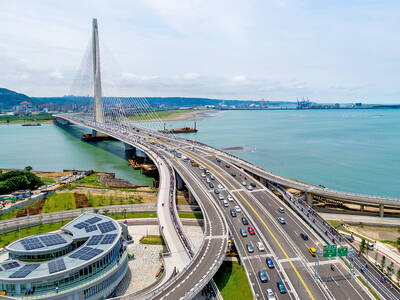
The Ministry of Transportation and Communications yesterday inaugurated the Danjiang Bridge across the Tamsui River in New Taipei City, saying that the structure would be an architectural icon and traffic artery for Taiwan. Feted as a major engineering achievement, the Danjiang Bridge is 920m long, 211m tall at the top of its pylon, and is the longest single-pylon asymmetric cable-stayed bridge in the world, the government’s Web site for the structure said. It was designed by late Iraqi-British architect Zaha Hadid. The structure, with a maximum deck of 70m, accommodates road and light rail traffic, and affords a 200m navigation channel for boats,
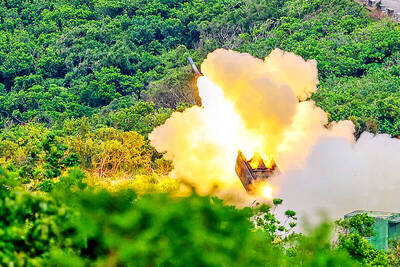
PRECISION STRIKES: The most significant reason to deploy HIMARS to outlying islands is to establish a ‘dead zone’ that the PLA would not dare enter, a source said A High Mobility Artillery Rocket System (HIMARS) would be deployed to Penghu County and Dongyin Island (東引) in Lienchiang County (Matsu) to force the Chinese military to retreat at least 100km from the coastline, a military source said yesterday. Taiwan has been procuring HIMARS and Army Tactical Missile Systems (ATACMS) from the US in batches. Once all batches have been delivered, Taiwan would possess 111 HIMARS units and 504 ATACMS, which have a range of 300km. Considering that “offense is the best defense,” the military plans to forward-deploy the systems to outlying islands such as Penghu and Dongyin so that

Taiwan Semiconductor Manufacturing Co (TSMC, 台積電), the world’s largest foundry service provider, yesterday said that global semiconductor revenue is projected to hit US$1.5 trillion in 2030, after the figure exceeds US$1 trillion this year, as artificial intelligence (AI) demand boosts consumption of token and compute power. “We are still at the beginning of the AI revolution, but we already see a significant impact across the whole semiconductor ecosystem,” TSMC deputy cochief operating officer Kevin Zhang (張曉強) said at the company’s annual technology symposium in Hsinchu City. “It is fair to say that in the past decade, smartphones and other mobile devices were
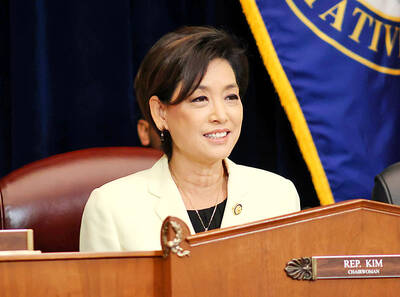
‘CLEAR MESSAGE’: The bill would set up an interagency ‘tiger team’ to review sanctions tools and other economic options to help deter any Chinese aggression toward Taiwan US Representative Young Kim has introduced a bill to deter Chinese aggression against Taiwan, calling for an interagency “tiger team” to preplan coordinated sanctions and economic measures in response to possible Chinese military or political action against Taiwan. “[Chinese President] Xi Jinping [習近平] has directed the People’s Liberation Army to be ready to invade Taiwan by 2027. China has a plan. America should have one too,” Kim said in a news release on Thursday last week. She introduced the “Deter PRC [People’s Republic of China] aggression against Taiwan act” to “ensure the US has a coordinated sanctions strategy ready should


 RSS
RSS