


The Urban Resilience Exercises this year are expected to last five months through August — overlapping with the Han Kuang exercises and raising the number of days that regions would be affected to two — with drone trials scheduled for Chiayi and Pingtung counties, National Security Council Deputy Secretary-General Lin Fei-fan (林飛帆) told the Presidential Office’s Whole-of-Society Defense Resilience Committee yesterday.
The Urban Resilience Exercises would be more systematic and science-based, while they would be conducted without pre-scripted scenarios, Lin said.
The urban resilience drills conducted next month would coincide with the computer-assisted phase of the Han Kuang exercises, he said.
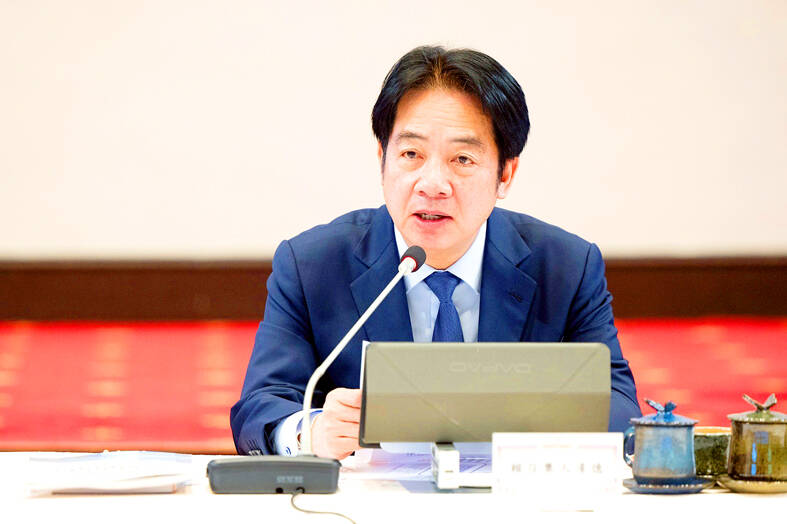
Photo courtesy of the Presidential Office
The Urban Resilience Exercises, which are coordinated by the Central Joint Emergency Operations Center, are to cover preventive civilian evacuations, relocation of hospitals and medical facilities, and joint transportation management, he said.
From next month to July, seven regions — Changhua, Chiayi, Hsinchu, Miaoli, Nantou and Yunlin counties, as well as Taoyuan — would participate at different times, with the areas involved for two days each, he said.
Drills in the four months would be conducted to boost information security, wartime psychological defense and cross-zone evacuation capabilities, as well as to improve integration of reservice and other civilian groups, such as the Taiwan Community Emergency Response Team, Lin said.
One of the highlights would be the use of uncrewed aerial vehicles to assist with transportation and logistics in Chiayi and Pingtung counties, he said, adding that it would be the first time for such drills to be conducted in Taiwan.
The Urban Resilience Exercises on Aug. 6 and 7 would be held alongside the live-fire Han Kuang exercises in Pingtung County and Kaohsiung, Lin said.
On Aug 12 and 13, drills of preventive and emergency evacuations of members of the public and medical workers would be conducted in New Taipei City and Yilan County, with transportation and logistics to be under a joint command, he said.
Air raid drills are scheduled in southern Taiwan at 10am on Aug. 7, while they are to be at 1:10pm in central Taiwan on Aug. 10, outlying regions on Aug. 11, eastern Taiwan on Aug. 12 and northern Taiwan on Aug. 13, he added.
President William Lai (賴清德) said at the meeting that geopolitical tensions have shifted dramatically over the past month, with conflicts spreading, affecting global energy and economic markets.
This year’s Urban Resilience Exercises would place greater emphasis on conflict scenarios to help the public understand how military and civilian efforts are coordinated, Lai said.
When threats arise, everyone in Taiwan should have a role to play in providing support and assistance, he said.
Lai issued three directives.
The first is to improve all exercises, ensuring that capabilities are practical, precise and effective; the second is to enhance coordination between central and local governments in defense resilience; and the third is to establish regional disaster-relief corridors, reinforcing international cooperation and a whole-of-society defense network.
Additional reporting by CNA

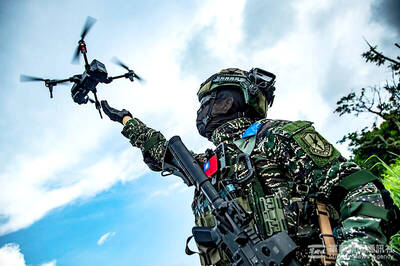
RESILIENCE: Taiwan plays a key role in semiconductors, energy, information infrastructure and advanced manufacturing, AIT Director Raymond Greene said Taiwan’s continued investment in deterrence and resilience remains vital, especially in uncrewed systems and other emerging technologies, American Institute in Taiwan (AIT) Director Raymond Greene said yesterday. Greene made the remarks at the annual National Strategic Summit on Supply Chain Resilience held by the Research Institute for Democracy, Society and Emerging Technology (DSET), a government-backed think tank. As Taiwan last year became the US’ fourth-largest trading partner and supply chain security is becoming more important, cooperation in emerging technologies continues to deepen between the two countries, he said. The US is committed to accelerating innovation, building key infrastructure, strengthening cooperation

The National Chungshan Institute of Science and Technology yesterday showcased its locally developed variants of the Vision 60 robotic patrol dog, which it plans to deploy on the nation’s outlying territories in the South China Sea. The variants were produced under the Joint Lab project — created by the institute and domestic companies — and assembled with domestically produced motors, lenses and artificial intelligence (AI) systems alongside licensed tech from the US, Missile and Rocket Systems Research Division deputy director Jen Kuo-kang (任國光) told the media event at a military base in Taipei’s Dazhi (大直) area. Taiwan has built up its strengths

RIGHT DIRECTION: Taiwan’s efforts to prevent forced labor include a proposal to ‘fully prohibit’ employers from withholding workers’ documents, an official said Taiwan is to establish a mechanism to restrict imports of goods linked to forced labor, the Executive Yuan said yesterday, after the US proposed imposing additional tariffs on Taiwanese goods over labor concerns. “The Ministry of Labor and the Ministry of Economic Affairs are to establish an interministerial review procedure,” Executive Yuan spokesperson Michelle Lee (李慧芝) said at a news briefing in Taipei. “The government is to use the Foreign Trade Act [貿易法] as the legal basis to restrict imports of goods produced with forced labor” and bring its supply chain governance more in line with international standards on human rights, resilience

NOT IMMEDIATE: Taiwan has a chance to appeal the proposed 10 percent tariff before it starts, while other countries face a 12.5 percent tariff from the trade office Taiwan is among 60 economies determined by the US to have failed to impose or enforce a ban on the importation of goods produced with forced labor, according to a notice released on Tuesday by the Office of the US Trade Representative (USTR), which proposed imposing an additional 10 percent or more tariff on them. The USTR in a statement said that following an investigation, it had determined under Section 301 of the Trade Act of 1974 that the failure of the 60 economies to impose and effectively enforce a prohibition on the importation of goods produced with forced labor is


 RSS
RSS