


The military has found and retrieved the flight data recorder of an F-16V jet that disappeared off eastern Taiwan in January and is to send it to its manufacturer in the US to decode the data.
Air Force Command Headquarters in a statement yesterday said that the salvage company responsible for the mission successfully retrieved the flight data recorder, better known as the black box, in waters off Taiwan on Monday.
The air force did not disclose the exact location where the black box was found, but it said the device had been moved ashore and would be sent for decoding to determine the cause of the plane’s disappearance.
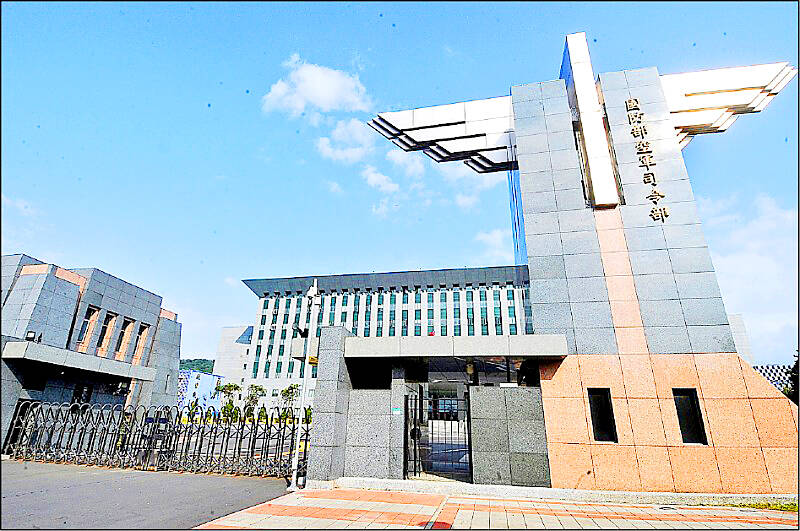
Photo: Taipei Times
The single-seat fighter jet, tail number 6700, piloted by Captain Hsin Po-yi (辛柏毅), went missing on Jan. 6 after taking off from Hualien Air Base at 6:17pm on a nighttime training mission and heading south.
Hsin soon reported that the aircraft was losing altitude, the air force said.
Hsin at 7:28pm reported that he was about to eject from the aircraft. Eight seconds later, the jet’s signal disappeared from radar while it was flying off the coast of Fengbin (豐濱) in Hualien County, the air force said.
The air force subsequently set up an emergency response center, and launched a search-and-rescue operation, but it has not been able to find Hsin.
It has since speculated that there might have been a malfunction in the aircraft’s main onboard computer, but an investigation to pinpoint the cause continues.
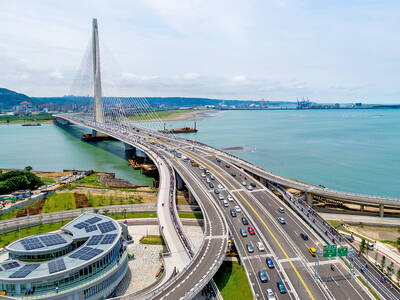
The Ministry of Transportation and Communications yesterday inaugurated the Danjiang Bridge across the Tamsui River in New Taipei City, saying that the structure would be an architectural icon and traffic artery for Taiwan. Feted as a major engineering achievement, the Danjiang Bridge is 920m long, 211m tall at the top of its pylon, and is the longest single-pylon asymmetric cable-stayed bridge in the world, the government’s Web site for the structure said. It was designed by late Iraqi-British architect Zaha Hadid. The structure, with a maximum deck of 70m, accommodates road and light rail traffic, and affords a 200m navigation channel for boats,
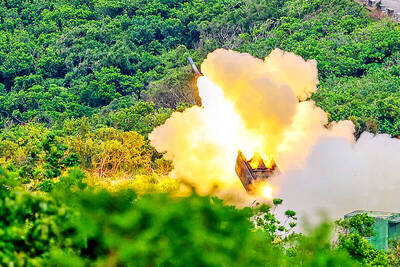
PRECISION STRIKES: The most significant reason to deploy HIMARS to outlying islands is to establish a ‘dead zone’ that the PLA would not dare enter, a source said A High Mobility Artillery Rocket System (HIMARS) would be deployed to Penghu County and Dongyin Island (東引) in Lienchiang County (Matsu) to force the Chinese military to retreat at least 100km from the coastline, a military source said yesterday. Taiwan has been procuring HIMARS and Army Tactical Missile Systems (ATACMS) from the US in batches. Once all batches have been delivered, Taiwan would possess 111 HIMARS units and 504 ATACMS, which have a range of 300km. Considering that “offense is the best defense,” the military plans to forward-deploy the systems to outlying islands such as Penghu and Dongyin so that

Taiwan Semiconductor Manufacturing Co (TSMC, 台積電), the world’s largest foundry service provider, yesterday said that global semiconductor revenue is projected to hit US$1.5 trillion in 2030, after the figure exceeds US$1 trillion this year, as artificial intelligence (AI) demand boosts consumption of token and compute power. “We are still at the beginning of the AI revolution, but we already see a significant impact across the whole semiconductor ecosystem,” TSMC deputy cochief operating officer Kevin Zhang (張曉強) said at the company’s annual technology symposium in Hsinchu City. “It is fair to say that in the past decade, smartphones and other mobile devices were

‘CLEAR MESSAGE’: The bill would set up an interagency ‘tiger team’ to review sanctions tools and other economic options to help deter any Chinese aggression toward Taiwan US Representative Young Kim has introduced a bill to deter Chinese aggression against Taiwan, calling for an interagency “tiger team” to preplan coordinated sanctions and economic measures in response to possible Chinese military or political action against Taiwan. “[Chinese President] Xi Jinping [習近平] has directed the People’s Liberation Army to be ready to invade Taiwan by 2027. China has a plan. America should have one too,” Kim said in a news release on Thursday last week. She introduced the “Deter PRC [People’s Republic of China] aggression against Taiwan act” to “ensure the US has a coordinated sanctions strategy ready should


 RSS
RSS