


US President Donald Trump might delay his China trip due to the Iran war, but US Secretary of the Treasury Scott Bessent yesterday said that it is not to pressure Beijing on the Strait of Hormuz.
Bessent said any delay to Trump’s trip to Beijing would not be because of disagreements over the Iran war or efforts to reopen the Strait of Hormuz.
“If the meeting for some reason was rescheduled, it would be rescheduled because of logistics,” he said. “The president wants to remain in [Washington] DC to coordinate the war and traveling abroad at a time like this may not be optimal.”

Photo: AFP
Trump has suggested he might delay the much-anticipated visit to China at the end of the month as he seeks to ramp up the pressure on Beijing to help reopen the Strait of Hormuz and calm oil prices that have soared during the Iran war.
In an interview on Sunday with the Financial Times, Trump said that China’s reliance on oil from the Middle East means it ought to help with a new coalition he is trying to put together to get oil tanker traffic moving through the strait after Iran’s threats have throttled global flows of oil.
The US president said that “we’d like to know” before the trip whether Beijing would help.
“We may delay,” he said in the interview.
The uncertainty underscores just how much the US-Israeli strikes on Iran have reshaped global politics in the past two weeks. Calling off the face-to-face visit with Chinese President Xi Jinping (習近平) could have its own major economic consequences: Relations between Washington and Beijing have been fraught as both sides have threatened the other with steep tariffs over the past year.
The White House did not immediately respond to requests for comment.
In Beijing, a Chinese Ministry of Foreign Affairs spokesperson said only that China and the US have maintained communication on Trump’s visit.
“Head-of-state diplomacy plays an irreplaceable strategic guiding role in China-US relations,” Lin Jian (林劍) said at a daily briefing.
Bessent made his comments in Paris, where he was meeting with Chinese Vice Premier He Lifeng (何立峰) for a new round of trade talks that were meant to pave the way for Trump’s Beijing trip.
The US and China have declared a truce that has prevented both sides from levying dueling tariffs, but the stakes remain high.
“We had a very good two days here,” Bessent said, adding that a statement “reaffirming the stability” between the two nations would be issued “in the next few days.”
In the early days of the Iran conflict, Trump had said US Navy vessels would escort oil tankers through the strait and downplayed the threat posed by Iran, but as oil prices soared, he and his administration have been forced to consider new options — including the idea, broached at the weekend, for other nations to join the push with their own warships. So far, none has yet formally heeded the call.
Trump told reporters aboard Air Force One as he returned to Washington from a weekend in Florida that the US had spoken to “about seven” nations about offering military support.
He would not say which ones, though, and demurred when he was asked directly about China — although he subsequently suggested that he had made such an offer to Beijing.
“China’s an interesting case study,” he said, noting its reliance on Gulf oil. “So I said: ‘Would you like to come in’ and we’ll find out. Maybe they will, maybe they won’t.”
The war in Iran has sent the price of oil skyrocketing, which has raised the price Americans pay at the pump, just as the midterm election season begins to heat up.
China has faced its own economic pressures and lowered its growth target for this year to 4.5 percent to 5 percent, its slowest projected growth since 1991 — meaning prolonged disruptions in the strait could have long-term impacts for Beijing as well.
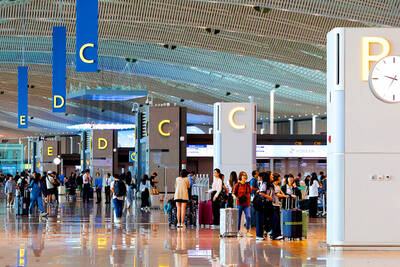
South Korea has adjusted its electronic arrival card system to no longer list Taiwan as a part of China, a move that the Ministry of Foreign Affairs said would help facilitate exchanges between the two sides. South Korea previously listed “Taiwan” as “Taiwan (China)” in the drop-down menus of its online arrival card system, where people had to fill out where they came from and their next destination. The ministry had requested South Korea make a revision and said it would change South Korea’s name on Taiwan’s online immigration system from “Republic of Korea” to “Korea (South),” should the issue not be

Tainan, Taipei and New Taipei City recorded the highest fines nationwide for illegal accommodations in the first quarter of this year, with fines issued in the three cities each exceeding NT$7 million (US$220,639), Tourism Administration data showed. Among them, Taipei had the highest number of illegal short-term rental units, with 410. There were 3,280 legally registered hotels nationwide in the first quarter, down by 14 properties, or 0.43 percent, from a year earlier, likely indicating operators exiting the market, the agency said. However, the number of unregistered properties rose to 1,174, including 314 illegal hotels and 860 illegal short-term rental
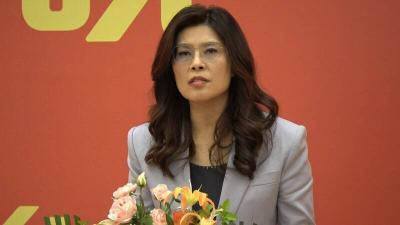
Both sides of the Taiwan Strait share a political foundation based on the “1992 consensus” and opposition to Taiwanese independence, Chinese Nationalist Party (KMT) Chairwoman Cheng Li-wun (鄭麗文) today said during her meeting with Chinese President Xi Jinping (習近平). Both sides of the Strait should plan and build institutionalized and sustainable mechanisms for dialogue and cooperation based on that foundation to make peaceful development across the Strait irreversible, she said. Peace is a shared moral value across the Strait, and both sides should move beyond political confrontation to seek institutionalized solutions to prevent war, she said. Mutually beneficial cross-strait relations are what the
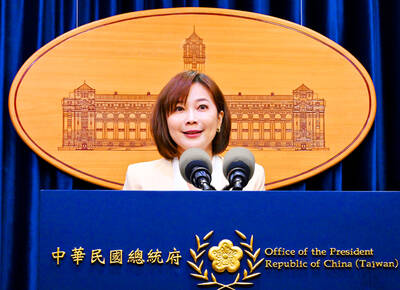
ECONOMIC COERCION: Such actions are often inconsistently applied, sometimes resumed, and sometimes just halted, the Presidential Office spokeswoman said The government backs healthy and orderly cross-strait exchanges, but such arrangements should not be made with political conditions attached and never be used as leverage for political maneuvering or partisan agendas, Presidential Office spokeswoman Karen Kuo (郭雅慧) said yesterday. Kuo made the remarks after China earlier in the day announced 10 new “incentive measures” for Taiwan, following a landmark meeting between Chinese President Xi Jinping (習近平) and Chinese Nationalist Party (KMT) Chairwoman Cheng Li-wun (鄭麗文) in Beijing on Friday. The measures, unveiled by China’s Xinhua news agency, include plans to resume individual travel by residents of Shanghai and China’s Fujian


 RSS
RSS