


The Executive Yuan would prioritize pushing forward 13 national security bills during this legislative session, a government official familiar with the matter said yesterday, adding that these measures are crucial to Taiwan’s security and should receive cross-party support.
In December last year, the Executive Yuan passed draft amendments to several national security related laws, including the National Security Act (國家安全法), the Criminal Code of the Armed Forces (陸海空軍刑法), the Act of Military Service for Officers and Non-commissioned Officers of the Armed Forces (陸海空軍軍官士官服役條例), the Veterans Assistance Act (國軍退除役官兵輔導條例), and the Act Governing Relations Between the People of the Taiwan Area and the Mainland Area (臺灣地區與大陸地區人民關係條例), which are awaiting review by the Legislative Yuan.
Regarding the National Security Act, the draft amendments include new provisions defining illicit organizational activities and introducing administrative penalties for speech advocating war.
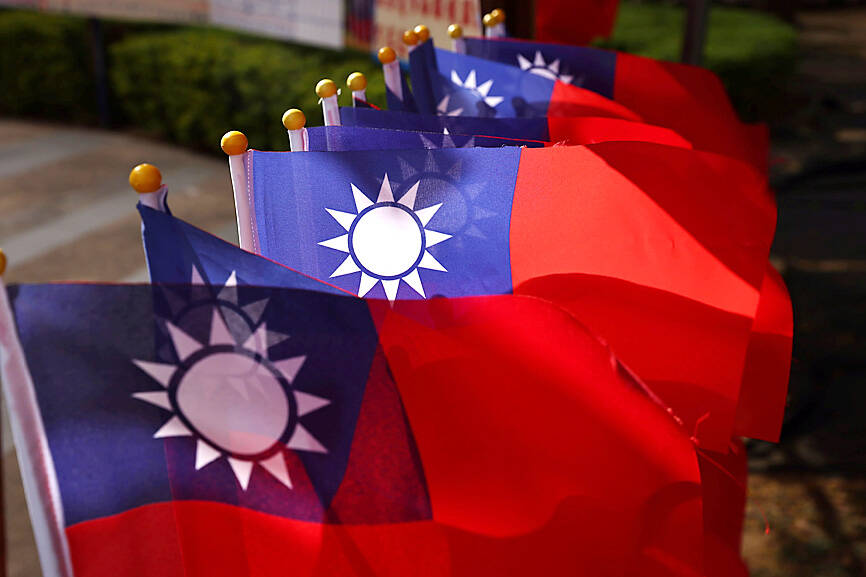
Photo: Ann Wang, Reuters
Those who publicly advocate, promote or support the initiation of war against the Republic of China (ROC), or the use of non-peaceful means by foreign countries, Mainland China, Hong Kong, Macau or other hostile external forces to eliminate ROC sovereignty, shall face an administrative fine between NT$100,000 and NT$1 million (US$3,133 and US$31,330), the draft amendments say.
Currently, if military personnel, civil servants, teachers or retired military officers are involved in national security crimes, their retirement pension can be revoked once a final guilty verdict is delivered.
The draft amendments propose that when such personnel are sentenced to imprisonment, retirement pension revocation can take effect after the first ruling, and that active-duty military personnel or civil servants who intentionally contravene the National Security Act would have their sentences increased by half.
The draft amendment to Article 24 of the Criminal Code of the Armed Forces suggests that active-duty service members who express loyalty to the enemy through speech or other means face imprisonment for one to seven years.
The proposed penalty for those who surrender to the enemy by failing to fulfill their duties were increased to imprisonment for three to 10 years, while provisions for punishing those involved in preparations or conspiracies for such offenses have also been added.
Draft amendments to the Veterans Assistance Act added a new provision that if retired military personnel have their retirement benefits “suspended” based on other laws, benefits and rights provided under the Veterans Assistance Act should be “simultaneously suspended.”
They also added a provision requiring civil servants at Rank 10 or below and without access to classified information to obtain permission from their agencies before traveling to China.
Legislators and personnel, who through their duties have knowledge of, possess or manage state secrets, must obtain approval from the Ministry of the Interior’s joint review committee before visiting China, they say.
A new draft provision also requires elected public officials to publicly disclose information regarding any contact with the Chinese Communist Party (CCP), the Chinese government or military entities while in China.
Due to the lack of regulations governing retired field-grade officers who cooperate with the CCP’s “united front” tactics, the draft amendment proposes expanding the scope to include personnel who previously held specific positions.
Under the draft amendments, such personnel would be prohibited from attending CCP, Chinese government or military celebrations and activities involving acts that are detrimental to Taiwan’s national dignity.
A proposed new provision also has been added to prohibit them from attending activities hosted by Chinese authorities that “advocate for the elimination or belittlement of our [Taiwan’s] national sovereignty.”
To prevent public officials, retired military personnel and political party members from going to China and aligning with the CCP’s narrative, some Democratic Progressive Party lawmakers have also proposed amendments to the cross-strait act, the Legislators’ Conduct Act (立法委員行為法), and the Act Governing Relations with Hong Kong and Macau (香港澳門關係條例), the official said, adding that the opposition has blocked those changes in the legislature 850 times.
The proposed amendments, as well as the passage of a special budget for US arms purchases, are intended to protect Taiwan’s national security, and safeguard its democracy and self-defense mechanisms, which are all matters of great urgency, the official said.
“They are of paramount importance to Taiwan’s security and should receive cross-party support for their passage,” they added.

South Korea has adjusted its electronic arrival card system to no longer list Taiwan as a part of China, a move that the Ministry of Foreign Affairs said would help facilitate exchanges between the two sides. South Korea previously listed “Taiwan” as “Taiwan (China)” in the drop-down menus of its online arrival card system, where people had to fill out where they came from and their next destination. The ministry had requested South Korea make a revision and said it would change South Korea’s name on Taiwan’s online immigration system from “Republic of Korea” to “Korea (South),” should the issue not be

Tainan, Taipei and New Taipei City recorded the highest fines nationwide for illegal accommodations in the first quarter of this year, with fines issued in the three cities each exceeding NT$7 million (US$220,639), Tourism Administration data showed. Among them, Taipei had the highest number of illegal short-term rental units, with 410. There were 3,280 legally registered hotels nationwide in the first quarter, down by 14 properties, or 0.43 percent, from a year earlier, likely indicating operators exiting the market, the agency said. However, the number of unregistered properties rose to 1,174, including 314 illegal hotels and 860 illegal short-term rental

Both sides of the Taiwan Strait share a political foundation based on the “1992 consensus” and opposition to Taiwanese independence, Chinese Nationalist Party (KMT) Chairwoman Cheng Li-wun (鄭麗文) today said during her meeting with Chinese President Xi Jinping (習近平). Both sides of the Strait should plan and build institutionalized and sustainable mechanisms for dialogue and cooperation based on that foundation to make peaceful development across the Strait irreversible, she said. Peace is a shared moral value across the Strait, and both sides should move beyond political confrontation to seek institutionalized solutions to prevent war, she said. Mutually beneficial cross-strait relations are what the

ECONOMIC COERCION: Such actions are often inconsistently applied, sometimes resumed, and sometimes just halted, the Presidential Office spokeswoman said The government backs healthy and orderly cross-strait exchanges, but such arrangements should not be made with political conditions attached and never be used as leverage for political maneuvering or partisan agendas, Presidential Office spokeswoman Karen Kuo (郭雅慧) said yesterday. Kuo made the remarks after China earlier in the day announced 10 new “incentive measures” for Taiwan, following a landmark meeting between Chinese President Xi Jinping (習近平) and Chinese Nationalist Party (KMT) Chairwoman Cheng Li-wun (鄭麗文) in Beijing on Friday. The measures, unveiled by China’s Xinhua news agency, include plans to resume individual travel by residents of Shanghai and China’s Fujian


 RSS
RSS