


US Representative Pat Harrigan yesterday introduced the Taiwan Energy Security and Anti-Embargo Act of 2026, saying it would ensure “Taiwan isn’t left vulnerable to supply shocks, coercion by the Chinese Communist Party [CCP], or external geopolitical turmoil.”
“Energy is leverage,” Harrigan, a Republican, was quoted as saying in a statement from his office. “Beijing knows exactly where Taiwan is weakest — and global events today, from strikes in the Middle East to threats at chokepoints like the Strait of Hormuz, underscore that energy vulnerability is national security vulnerability.”
The bill would authorize the creation of a joint Taiwan-US energy security center to facilitate academic collaboration on energy security and mandate that the National Academy of Sciences report to the US Congress on ways to increase liquefied natural gas (LNG) exports to Taiwan.
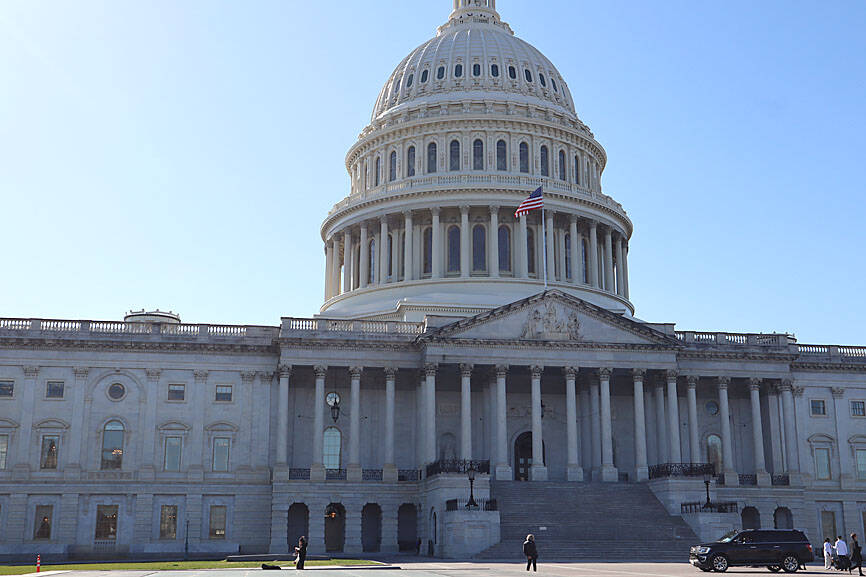
Photo: CNA
It would also authorize the US departments of commerce, defense, energy and state to promote US energy exports to Taiwan, and help Taiwan diversify and protect its energy infrastructure and supply.
The bill would “harden a critical weak point in the Indo-Pacific balance of power: Taiwan’s energy dependence,” the statement said.
Prioritizing US LNG exports to Taiwan would reduce hostile powers’ leverage over Taiwan’s energy supply, it said.
Enhancing Taiwan-US cooperation on energy security would also help protect Taiwan’s energy grids and storage systems from different forms of attack, it added.
The bill further calls for bilateral efforts to develop advanced nuclear technologies, such as small modular reactors, to provide “reliable baseload power less susceptible to external disruptions,” the statement said.
The bill would expand the US Maritime Administration’s authority to ensure that vessels “transporting critical energy and vital goods to Taiwan” remain available if commercial operators withdraw from the market due to foreign military threats.
It would have to pass the US House of Representatives and the US Senate, and be signed into law by the US president.
Minister of Economic Affairs Kung Ming-hsin (龔明鑫) on Monday said that LNG supplies for this month and next month would require the equivalent of 22 shipments.
The ministry has secured 20 ships willing to make the trips and is searching for two more, Kung said, adding that LNG supplies for the two months are guaranteed.
Rumors that LNG supplies might be inadequate are “impossible,” Kung said, adding that Taiwan sources LNG from diverse suppliers, with about one-third coming from Qatar, while the remaining 60 to 70 percent comes from other countries.

The Tourism Administration yesterday announced that it would reward repeat international visitors with incentives of up to NT$8,000 to boost inbound tourism. The incentives are available to all international tourists, it said, adding that repeat visitors would be rewarded with NT$5,000 and would receive an additional NT$3,000 if they bring travel companions. The nation received 2,990,657 inbound visitors during the first quarter, marking a 3.8 percent increase from the same period last year, agency data showed. Japanese nationals are among groups visiting Taiwan the most. About 1.48 million Japanese tourists arrived last year, a year-on-year increase of more than 12
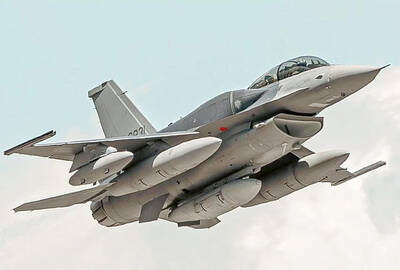
66 FIGHTER JETS: The aircraft is likely undergoing preparations for its transfer to Taiwan — a significant step forward in the nation’s modernization program, a lawmaker said The first of Taiwan’s order of F-16V Block 70 aircraft has been sighted in Texas ahead of delivery, Democratic Progressive Party (DPP) Legislator Wang Ting-yu (王定宇) said. Taiwan’s first F-16V Block 70 two-seat aircraft, tail number 6831, was seen flying from Lockheed Martin’s production facility in Greenville, South Carolina, to Naval Air Station Joint Reserve Base Fort Worth in Texas, Wang wrote on Facebook yesterday. The plane is likely undergoing preparations for its transfer to Taiwan, marking a significant step forward in the Republic of China Air Force’s modernization program, Wang said, citing military analysts. The F-16V Block 70 is a new-build version
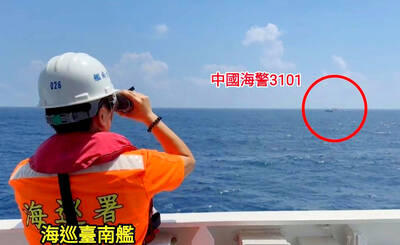
‘BRAZEN’: The holiday did not stop China from activities that infringe on Taiwan’s maritime jurisdiction, but the CGA is ready to defend the nation, Kuan Bi-ling said Beijing is intensifying maritime pressure on Taiwan, but the nation will never yield, Ocean Affairs Council Deputy Minister Sung Chen-en (宋承恩) said. The Coast Guard Administration (CGA) has adopted a “shadowing and monitoring” approach to avoid falling into a Chinese trap to escalate tensions and deepen the conflict, Sung said in an interview published yesterday in the Chinese-language Liberty Times (the Taipei Times’ sister newspaper). China Coast Guard formations patrolling waters east of Taiwan, as well as official Chinese vessels entering areas around Itu Aba Island (Taiping Island, 太平島) and Pratas Islands (Dongsha Islands, 東沙群島) show Beijing’s attempts to significantly step up
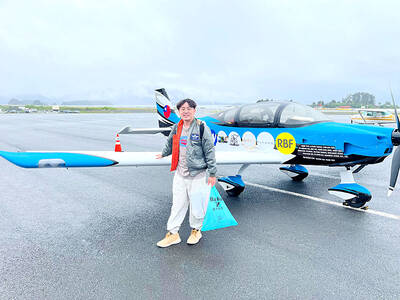
Taiwanese aviator Roger Lin (林睿哲) returned to Taiwan on Saturday after completing a nine-day round-the-world journey in a single-engine aircraft, becoming the first Taiwanese pilot to achieve the feat. Lin departed on June 5 from Los Angeles, California, and continued through Alaska, Japan, Taiwan, the Philippines, Indonesia, Malaysia, Thailand, Nepal, Jordan, Norway, Iceland and Canada before landing at the Taipei International Airport (Songshan) via Los Angeles and Japan. Lin shared numerous photos and videos of his journey on a Facebook page titled “Pilot Roger’s Around the World Flight,” including a video showing his aircraft flying over the Danjiang Bridge and


 RSS
RSS