


Taiwan’s state-run defense research group is mulling developing autonomous “loyal wingman” drones to support fighter jets in a potential collaboration with a US-based manufacturer, a source said.
Speaking on condition of anonymity, a defense official said the National Chungshan Institute of Science and Technology (NCIST) has reached out to Kratos Defense in a bid to collaborate in building combat aircraft utilizing technologies featured in the latter’s XQ-58A Valkyrie.
The NCIST is optimistic that the project would go forward, as Kratos has shared valuable technologies, the official said.
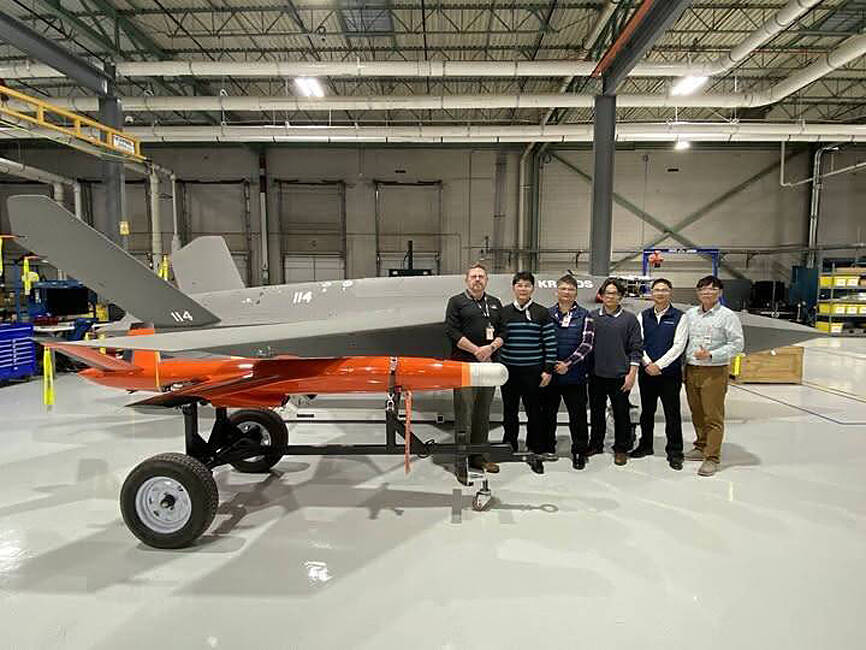
Photo: Screen grab from Kratos Defense’s Web site
The Kratos XQ-58A is an artificial intelligence (AI)-enabled combat uncrewed aerial vehicle (UAV), which has been selected as a potential companion aircraft to fight in “manned-unmanned teams,” which use “loyal wingman” drones, with the US Marine Corps’ F-35 aircraft.
Publicly available information shows that the drone is equipped with an internal weapons bay, a feature typically utilized for stealth aircraft, allowing it to carry weapons without compromising its low observable design.
The institute’s concept aims to combine the engine used in Indigenous Defense Fighters and a domestically developed active electronically scanned array radar system (AESA) with the infrared sensors in the XQ-58A airframe, the defense official said.
The AI navigation and command system that enables the UAV to fight autonomously and support friendly aircraft would be obtained from a separate source, they said.
The NCIST previously cooperated with Kratos in developing the Mighty Hornet IV, a loitering munition that features smart technology and high aerodynamic performance, enabled using a jet engine.
The two defense firms on Friday announced that the operational capabilities of the platform have been fully validated and that local mass production would start soon.
Steve Fendley, president of Kratos’ uncrewed systems division, said that the Mighty Hornet IV project could be a “springboard for ... potential additional collaborative efforts with other Kratos aircraft, and NCIST systems and technologies.”
The US defense manufacturer’s news release hinted that the collaboration could center on the XQ-58A, as the autonomous fighter aircraft was prominently featured in a group photo showing the two companies’ designers.
Kratos Defense’s fact sheet shows that the XQ-58A is a stealthy, high-performance and affordable autonomous collaborative platform that has been flying since 2019.
The aircraft, thanks to its propulsion system, has a cruise range of 5,666km and can reach a top airspeed of Mach 0.86, with an altitude of up to 13,716m.
The XQ-58A is a multi-role platform capable of carrying “kinetic and non-kinetic effectors” in its internal bomb bay and wing stations, Kratos Defense said.
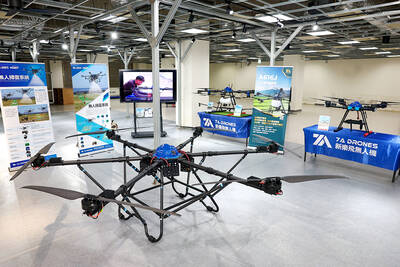
DRONE CENTRAL: Taiwan aims to become Asia’s democratic hub for drones, with most exports focused on high-quality military-grade models, an official said Taiwan’s drone industry is expected to expand significantly by 2030, producing 100,000 units per month and exporting half of them, the Ministry of Economic Affairs said yesterday. Current drone production capacity is about 15,000 units per month, but the industry can quickly scale up as demand increases, Industrial Development Administration Director-General Chiou Chyou-huey (邱求慧) told a news conference in Taipei. Taiwan’s drone output grew 2.5-fold last year to NT$12.9 billion (US$408.3 million) under a government program to develop the uncrewed vehicle sector, he said. The Executive Yuan in October last year approved plans to invest NT$44.2 billion into domestic production of uncrewed aerial
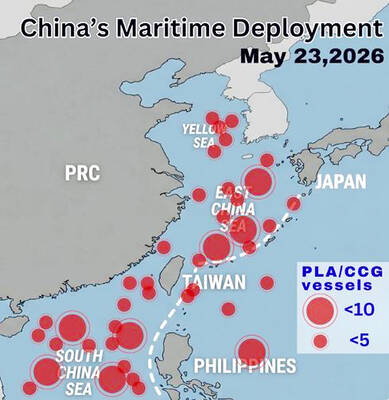
WARNING: China should stop engaging in actions that undermine regional peace and stability, as it would only build resentment among people across the Strait, the CGA said China has deployed more than 100 navy, coast guard and other vessels in waters from the Yellow Sea to the South China Sea and the western Pacific since US President Donald Trump and Chinese President Xi Jinping (習近平) met in Beijing, National Security Council Secretary-General Joseph Wu (吳釗燮) said yesterday. “In this part of the world, #China is the one & only PROBLEM wrecking the #StatusQuo & threatening regional peace & stability,” Wu wrote on X. In a separate post, he said Beijing was coercing Taiwan’s maritime domain, calling it illegal and provocative, after the Coast Guard Administration (CGA) expelled a

VERBOSE VESSELS: A CGA cutter and a China Coast Guard exchanged verbal barbs for more than a day in Taiwanese-controlled waters before the Chinese vessel left The Taiwanese and Chinese coast guards had a standoff near the strategically located Pratas Islands (Dongsha Islands, 東沙群島) in the north of the South China Sea, the Coast Guard Administration (CGA) said yesterday. The two sides engaged in intense radio exchanges over sovereignty claims during the 33-hour standoff. China Coast Guard vessel 3501 eventually left the restricted waters, 26.6 nautical miles (49.2km) west of the Pratas Islands, at 5pm yesterday, the CGA said. Lying approximately between southern Taiwan and Hong Kong, the Taiwan-controlled Pratas are seen by some security experts as vulnerable to Chinese attack due to their distance — more than

More than 8,000 people took part in a rally in Taipei yesterday to express support for more defense spending, after the opposition slashed the Cabinet’s proposed NT$1.25 trillion (US$39.6 billion) special defense budget and capped it at NT$780 billion. The demonstrators urged the Cabinet to propose another bill. Taiwan Economic Democracy Union convener Lai Chung-chiang (賴中強) said the main problem of the passed budget plan is the removal of funding for critical items, not just that the total amount is smaller. Critical budget items included purchasing or developing uncrewed vehicles, Strong Bow (強弓) missile systems, additional ammunition, artificial intelligence-powered combat systems and Taiwan-US


 RSS
RSS