


Three special budget bills, proposed by the Cabinet, the Chinese Nationalist Party (KMT) and the Taiwan People’s Party (TPP), advanced to committee yesterday after months of legislative deadlock over plans to acquire US weapons approved for sale to Taiwan.
Lawmakers unanimously agreed to send the bills to the Foreign Affairs and National Defense Committee and the Finance Committee for review, in line with an agreement reached during cross-caucus talks on Feb. 24.
The Cabinet in November last year proposed a special budget of NT$1.25 trillion (US$39.46 billion) to fund domestic weapons systems and US arms packages that have been approved for sale or could be approved.
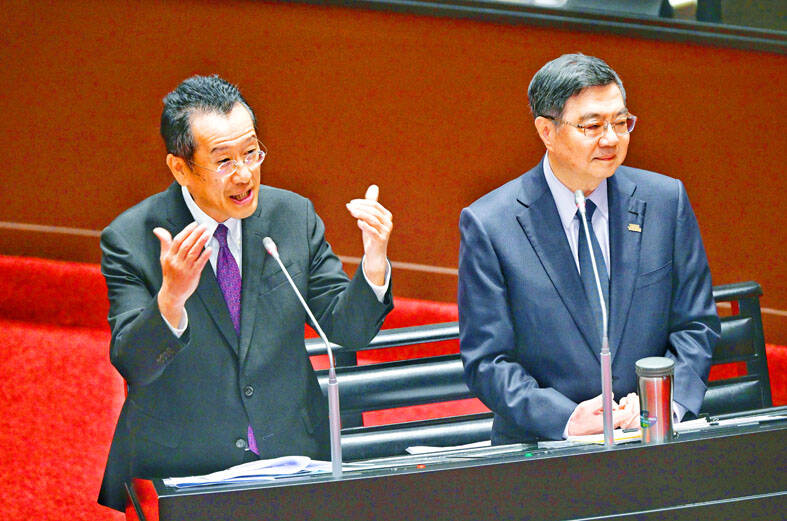
Photo: Fang Pin-chao, Taipei Times
It covers eight US weapons systems costing US$11.1 billion announced by Washington in December last year, undisclosed items and domestically manufactured weapons, notably drones and the “T-Dome” air defense system.
Opposition parties, who have been pressured by the Cabinet and the US government to pass the budget, submitted separate proposals.
The KMT proposed a bill with a spending cap of NT$380 billion — higher than its original proposal of NT$350 billion — which would only fund eight weapons sales from the US.
That includes high mobility artillery rocket systems, Javelin missiles, Altius-700M and Altius-600 drones, TOW missiles, M109A7 self-propelled howitzers, C5ISR systems, Harpoon missile follow-on support, and helicopter parts, the combined cost of which would be US$11.1 billion.
The TPP’s version set a ceiling of NT$400 billion, but would fund only five of the systems, while reserving NT$88.1 billion for potential new foreign military sales.
Meanwhile, a TPP motion to authorize the Ministry of National Defense to sign letters of acceptance (LOA) for three US weapons by their March 15 deadline advanced to a second reading.
The ministry last month said it had received LOAs for M109A7 self-propelled howitzers (US$4.03 billion), Javelin anti-armor missiles (US$375 million) and TOW missiles (US$353 million).
The TPP said it submitted the motion to avoid delays in acquiring the systems.
Minister of National Defense Wellington Koo (顧立雄) said the KMT’s version does not include the “NT$380 billion plus N” concept.
Any increase in funds would require a separate special law, meaning the maximum is NT$380 billion and “plus N” does not exist, he said.
The KMT’s version also sets an execution deadline of Dec. 31, 2028, for the delivery of items, including precision artillery, high mobility artillery rocket systems, TOW 2B anti-tank missiles, Javelin missiles, and anti-tank drone systems, Koo said.
If all deliveries must arrive by that deadline, five projects would not make it, as it is impossible to fulfill them by that timeline, he added.
The Cabinet’s proposal has undergone two years of research, taking into account enemy threats and overall operational need, he said, adding that it has been affirmed by the US government and Congress.
“Through three key areas — military procurement, commercial procurement and commissioned manufacturing — it aims to strengthen overall defense capabilities,” Koo said. “Missing any component would create significant gaps and setbacks, greatly compromising the enhancement of combat readiness.”
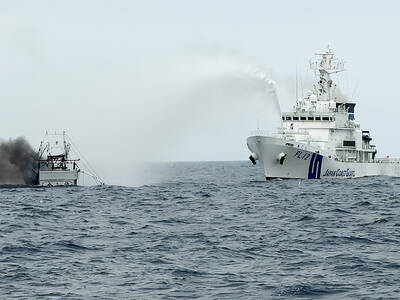
CREDIT-GRABBER: China said its coast guard rescued the crew of a fishing vessel that caught fire, who were actually rescued by a nearby Taiwanese boat and the CGA Maritime search and rescue operations do not have borders, and China should not use a shipwreck to infringe upon Taiwanese sovereignty, the Coast Guard Administration (CGA) said yesterday. The coast guard made the statement in response to the China Coast Guard (CCG) saying it saved a Taiwanese fishing boat. The Chuan Yu No. 6 (全漁6號), a fishing vessel registered in Keelung, on Thursday caught fire and sank in waters northeast of Diaoyutai Islands (釣魚台). The vessel left Keelung’s Badouzih Fishing Harbor (八斗子漁港) at 3:35pm on Sunday last week, with seven people on board — a 62-year-old Taiwanese captain surnamed Chang (張) and six
RISKY BUSINESS: The ‘incentives’ include initiatives that get suspended for no reason, creating uncertainty and resulting in considerable losses for Taiwanese, the MAC said China’s “incentives” failed to sway sentiment in Taiwan, as willingness to work in China hit a record low of 1.6 percent, a Ministry of Labor survey showed. The Directorate-General of Budget, Accounting and Statistics (DGBAS) also reported that the number of Taiwanese workers in China has nearly halved from a peak of 430,000 in 2012 to an estimated 231,000 in 2024. That marked a new low in the proportion of Taiwanese going abroad to work. The ministry’s annual survey on “Labor Life and Employment Status” includes questions respondents’ willingness to seek employment overseas. Willingness to work in China has steadily declined from
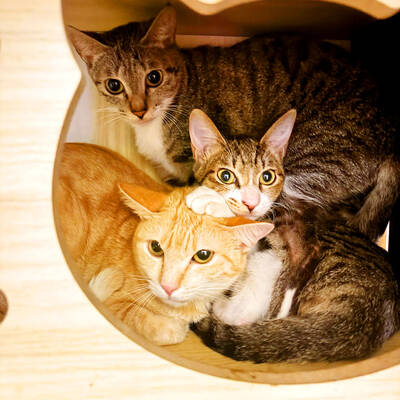
The number of pet cats in Taiwan surpassed that of pet dogs for the first time last year, reaching 1,742,033, a 32.8 percent increase from 2023, the Ministry of Agriculture said yesterday, citing a survey. By contrast, the number of pet dogs declined slightly by 1.2 percent over the same period to 1,462,528, the ministry said. Despite the shift, households with dogs still slightly outnumber those with cats by 1.2 percent. However, while the number of households with multiple dogs has remained relatively stable, households keeping more than two cats have increased, contributing to the overall rise in the feline population. The trend

LEVERAGE: China did not ‘need to fire a shot’ to deny Taiwan airspace over Africa when it owns ‘half the continent’s debt,’ a US official said, calling it economic warfare The EU has raised concerns about overflight rights following the delay of President William Lai’s (賴清德) planned state visit to the Kingdom of Eswatini after three African nations denied overflight clearance for his charter at the last minute. Taiwanese allies Paraguay and Saint Kitts and Nevis, as well as several US lawmakers and the Inter-Parliamentary Alliance on China (IPAC) condemned China for allegedly pressuring the countries. Lai was scheduled to fly directly to Taiwan’s only African ally from yesterday to Sunday to celebrate the 40th anniversary of King Mswati III’s accession and his 58th birthday, but Seychelles, Mauritius and Madagascar suddenly revoked


 RSS
RSS