


Taiwan would not have to ration power due to a shortage of natural gas, Minister of Economic Affairs Kung Ming-hsin (龔明鑫) said yesterday, after reports that the Strait of Hormuz was closed amid the conflict in the Middle East.
The government has secured liquefied natural gas (LNG) supplies for this month and contingency measures are in place if the conflict extends into next month, Kung told lawmakers.
Saying that 25 percent of Taiwan’s natural gas supplies are from Qatar, Chinese Nationalist Party (KMT) caucus secretary-general Lin Pei-hsiang (林沛祥) asked about the situation in light of the conflict.
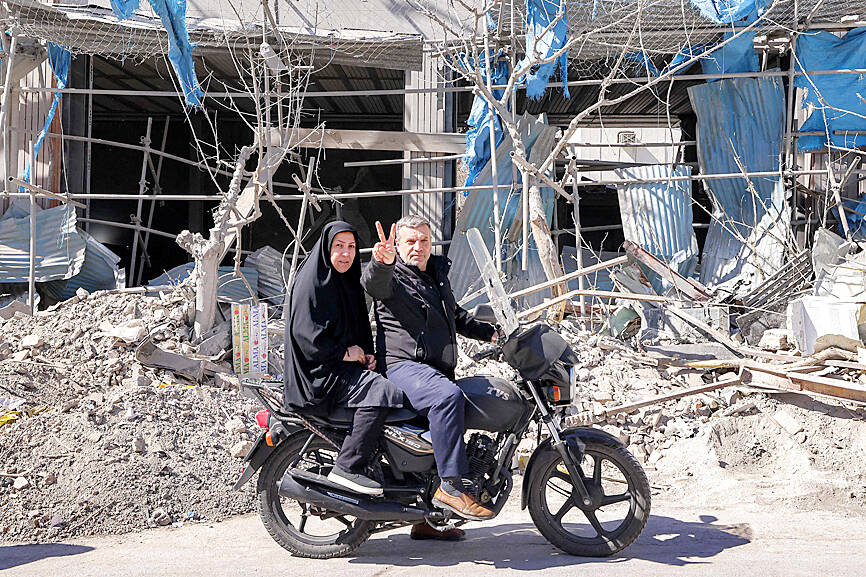
Photo: AFP
There would be “no problems” with LNG supplies for the first half of this month, as shipments have already cleared the Strait of Hormuz, Kung said.
Supplies for the latter half of the month have been secured from other markets, while non-gas backup generating units are also available and can be activated at any time, he said.
There would be absolutely no power rationing due to an LNG shortage, Kung said.
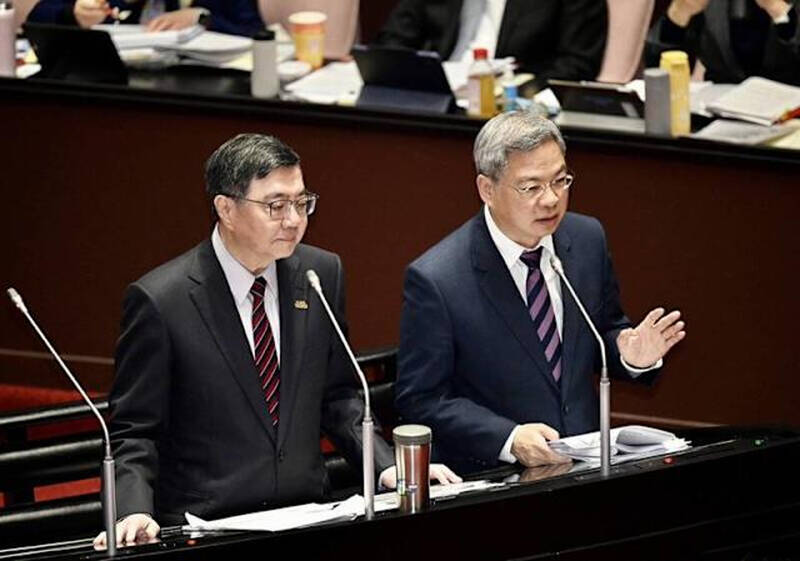
Photo: Peter Lo, Taipei Times
In the case of a prolonged blockade by Iran, Taiwan would look to sources outside the Middle East, including Australia and the US, the Ministry of Economic Affairs said in a statement.
Taiwan could also discuss mutual assistance with other LNG buyers, including Japan and South Korea, the ministry said.
The nation is also increasing LNG procurement from the US to strengthen energy resilience, it said.
CPC Corp, Taiwan (台灣中油) signed a roughly 25-year purchase agreement with US-based Cheniere Energy on Feb. 10, with deliveries set to begin in June and annual purchases of up to 1.2 million tonnes starting next year, the ministry said.
Asked if the situation could lead to higher electricity rates or the reactivation of coal-fired power plants, Kung said that any adjustment to electricity prices would be subject to review by the electricity price review committee.
If the conflict proves short-lived or limited in scope, it is less likely to affect rates, he said, adding that restarting coal-fired power plants would be a last resort.
Last year, crude oil from the Middle East accounted for 34.9 percent of total imports, down from 45 percent in 2022, while imports from the US rose to 61.8 percent from 44 percent over the same period, CPC said on Sunday.
Meanwhile, three major shipping firms have stopped accepting cargo for delivery to the Middle East or through the Red Sea, the Maritime and Port Bureau said yesterday.
Evergreen Marine Group (長榮海運), Yang Ming Marine Transport Corp (陽明海運) and Wan Hai Lines Ltd (萬海航運) have stopped shipping cargo to countries in the Middle East, including the United Arab Emirates, Saudi Arabia, Bahrain, Iran, Kuwait, Oman and Qatar, bureau Deputy Director-General Liu Chih-hung (劉志鴻) told a news conference in Taipei.
Container ships currently operating in the Persian Gulf have been told to comply with measures issued by local port authorities to ensure swift and efficient completion of cargo operations, Liu said.
Bulk shipping operators, including U-Ming Marine Transport Corp (裕民航運), Kuang Ming Shipping Corp (光明海運) and Wisdom Marine Group (慧洋海運), said that the closure of the Strait has yet to affect their businesses, as Taiwan handles only a limited volume of bulk cargo in the Persian Gulf region, Liu said.
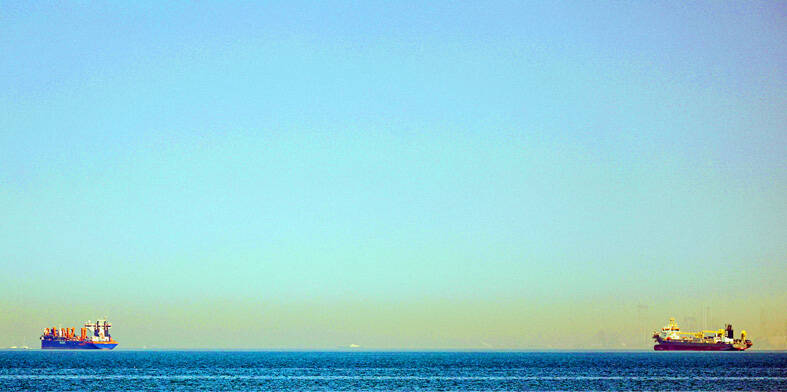
The Strait of Hormuz is mainly navigated by natural gas and oil tankers, he said.
The bureau is authorized to activate a coordination mechanism with shipping companies to safeguard the stability of import and export operations, he added.
Customs Administration data showed that Taiwan mainly imported crude oil from three countries last year — Saudi Arabia (28.9 percent), the US (28.3 percent) and Kuwait (13.6 percent).
Also yesterday, the Bureau of Consular Affairs issued a Level 3 “orange” travel warning for Egypt and Jordan, advising citizens to avoid traveling there.
The day before it issued “orange” alerts for Bahrain, Oman, Kuwait, the United Arab Emirates, Saudi Arabia and Qatar.
According to US assessments, the airspace in Jordan and Egypt might continue to experience missile, drone or rocket attacks over the coming days, it said.
Additional reporting by Lee I-chia
CHAOS: Iranians took to the streets playing celebratory music after reports of Khamenei’s death on Saturday, while mourners also gathered in Tehran yesterday Iranian Supreme Leader Ayatollah Ali Khamenei was killed in a major attack on Iran launched by Israel and the US, throwing the future of the Islamic republic into doubt and raising the risk of regional instability. Iranian state television and the state-run IRNA news agency announced the 86-year-old’s death early yesterday. US President Donald Trump said it gave Iranians their “greatest chance” to “take back” their country. The announcements came after a joint US and Israeli aerial bombardment that targeted Iranian military and governmental sites. Trump said the “heavy and pinpoint bombing” would continue through the week or as long
TRUST: The KMT said it respected the US’ timing and considerations, and hoped it would continue to honor its commitments to helping Taiwan bolster its defenses and deterrence US President Donald Trump is delaying a multibillion-dollar arms sale to Taiwan to ensure his visit to Beijing is successful, a New York Times report said. The weapons sales package has stalled in the US Department of State, the report said, citing US officials it did not identify. The White House has told agencies not to push forward ahead of Trump’s meeting with Chinese President Xi Jinping (習近平), it said. The two last month held a phone call to discuss trade and geopolitical flashpoints ahead of the summit. Xi raised the Taiwan issue and urged the US to handle arms sales to
BIG SPENDERS: Foreign investors bought the most Taiwan equities since 2005, signaling confidence that an AI boom would continue to benefit chipmakers Taiwan Semiconductor Manufacturing Co’s (TSMC, 台積電) market capitalization swelled to US$2 trillion for the first time following a 4.25 percent rally in its American depositary receipts (ADR) overnight, putting the world’s biggest contract chipmaker sixth on the list of the world’s biggest companies by market capitalization, just behind Amazon.com Inc. The site CompaniesMarketcap.com ranked TSMC ahead of Saudi Aramco and Meta Platforms Inc. The Taiwanese company’s ADRs on Tuesday surged to US$385.75 on the New York Stock Exchange, as strong demand for artificial intelligence (AI) applications led to chip supply constraints and boost revenue growth to record-breaking levels. Each TSMC ADR represents
State-run CPC Corp, Taiwan (CPC, 台灣中油) yesterday said that it had confirmed on Saturday night with its liquefied natural gas (LNG) and crude oil suppliers that shipments are proceeding as scheduled and that domestic supplies remain unaffected. The CPC yesterday announced the gasoline and diesel prices will rise by NT$0.2 and NT$0.4 per liter, respectively, starting Monday, citing Middle East tensions and blizzards in the eastern United States. CPC also iterated it has been reducing the proportion of crude oil imports from the Middle East and diversifying its supply sources in the past few years in response to geopolitical risks, expanding


 RSS
RSS