


President William Lai (賴清德) has “gladly accepted” and is willing to deliver a state of the nation report at the legislature, Legislative Speaker Han Kuo-yu (韓國瑜) said yesterday following a Lunar New Year tea reception hosted by the Presidential Office, to which the heads of the five branches of government were invited.
Questions would be submitted at once and answered all together in Lai’s address, he said, adding that this is a “basic courtesy” that would be respected by the legislature.
Speaking after the meeting, Presidential Office spokeswoman Karen Kuo (郭雅慧) said that Lai thanked Han in person for inviting him to address lawmakers and again expressed that he would “gladly” go to the Legislative Yuan to give a national affairs report “according to constitutional procedures”.
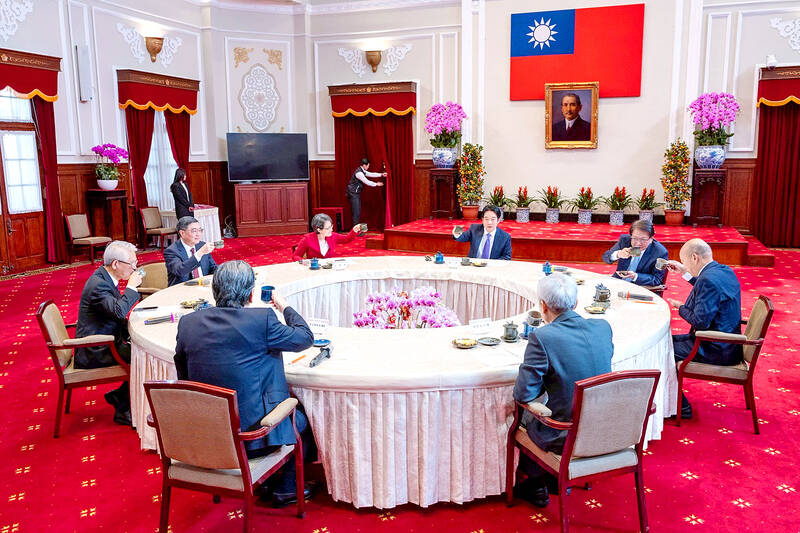
Photo courtesy of the Presidential Office
The tea gathering lasted an hour and a half and participants discussed issues of concern, including the general budget, US tariffs, the Act Governing the Allocation of Government Revenues and Expenditures (財政收支劃分法) and arms procurement legislation, Kuo said.
Han described the reception as a positive example of the government coming together despite political conflict, and said he hoped it would set a precedent going forward.
He added that he would relay Lai’s intentions to the three political parties to reach a consensus, upon which the Legislative Yuan would issue a formal invitation to the president.
The opposition parties have previously called for Lai to deliver an address to the legislature followed by a question-and-answer session.
However, the Lai administration and the Democratic Progressive Party maintain that subjecting the president to questioning by the legislature is unconstitutional and infringes on the balance of power among the branches of government.
Chinese Nationalist Party (KMT) caucus whip Fu Kun-chi (傅?萁) said the KMT caucus respected the arrangement, adding that clarifying issues face-to-face would be more effective than exchanging remarks from afar.
The format of the question-and-answer session would have to be determined through cross-party negotiations, he added.
Democratic Progressive Party (DPP) caucus secretary-general Chen Pei-yu (陳培瑜) said that based on past practice, a joint-question, joint-answer format could be constitutional, but that the matter should be resolved through cross-caucus consultations rather than decided unilaterally by Han.
The Taiwan People’s Party caucus said it respected the proposal and urged Lai to provide detailed explanations on major issues such as the military procurement budget and Taiwan-US tariffs.
Regardless of the format, the president should provide “substantive questions and substantive answers” to uphold accountable governance and respond to public opinion, it said.
The closed-door tea gathering was also attended by Vice President Hsiao Bi-khim (蕭美琴), Premier Cho Jung-tai (卓榮泰), Judical Yuan Acting President Shieh Ming-yan (謝銘洋), Examination Yuan President Chou Hung-hsien (周弘憲) and Control Yuan Acting President Lee Hung-chun (李鴻鈞). It was the first time in Taiwan’s history that the heads of all five government branches gathered for a reception.
During the reception, Lai called for transformation and unity, and said that the ruling and opposition parties should resolve issues together.
He also called for the government to turn misunderstandings into understandings, division into unity, personal interest into national interest and conflict into peace.
Hopefully, the reception would be a first step in enacting these changes, for the sake of the nation, society and the people of Taiwan, Lai said.
The meeting concerned family affairs, state affairs and world affairs, he added.
Lai recalled that last year, he hosted a reception for Han and his delegation before they departed for Washington to attend US President Donald Trump’s inauguration, at which he stressed that in Taiwan, there is no animosity that cannot be put aside.
The government missed many opportunities last year, but as a new year starts, it would take every opportunity to promote unity, especially as Taiwan faces a number of challenges domestically and internationally, he said.
Additional reporting by Lin Hsin-han, Lee Wen-hsin and Chen Chih-chen

‘NO SECURITY RISK’: The Railway Bureau reassured the public that the technicians’ activities were limited to technical guidance and did not involve sensitive systems The Railway Bureau yesterday said it had invited eight Chinese technicians to assist with an airport MRT construction project. The bureau issued the confirmation after an Internet user said Chinese nationals had entered the construction zone of Taiwan Taoyuan International Airport’s Terminal 3 project. They asked why “individuals from an enemy state” were allowed access to such a major national infrastructure project, which raised serious concerns over Taiwan’s industrial safety, sensitive systems and information security. The bureau’s Northern Region Engineering Branch Office said subcontractor Taiwan Handle Industrial Co (台灣手把工業) of the Taoyuan airport MRT’s “Contract No. CU05 Project A14 Station Civil, MEP &

A US uncrewed surface vessel (USV) encountered multiple Chinese warships during an autonomous transit of the Taiwan Strait, US defense company Seasats said in a statement on Wednesday. Seasats announced that a Lightfish USV had completed the first autonomous transit of the Taiwan Strait. Over five days, the USV traversed the entire length of the Strait while constantly monitoring surface vessel traffic, the company said. The Lightfish encountered multiple Chinese warships, one of which was a Chinese People’s Liberation Army Navy (PLAN) Type 056 corvette, it said. The Chinese vessels were operating “well within Taiwan’s exclusive economic zone without transmitting their identity via the

Taiwan is still in the process of assessing the possibility of recruiting workers from Eswatini, the Ministry of Foreign Affairs said yesterday, adding that its goal is to help Eswatini upgrade its vocational training centers. If there are plans to recruit workers from Eswatini, safeguarding national security, protecting public health and ensuring the employment rights of Taiwanese would be prerequisites, Department of West Asian and African Affairs Director-General Yen Chia-liang (顏嘉良) told a news conference. Key considerations would also include filling labor shortages in specific industries, and fostering bilateral professional and technical exchanges, he said. Yen was asked about the progress of labor
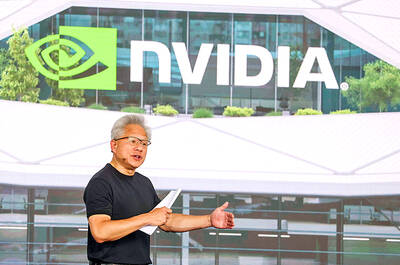
‘BOOMING’: ’ The number of partners we have here is incredible. You can see from their stock prices. They’re doing so well, they’re so happy,’ Jensen Huang said Nvidia Corp’s spending in Taiwan has ballooned to about US$150 billion a year, 10 times the US$10 billion to US$15 billion the company spent five years ago, Nvidia chief executive officer Jensen Huang (黃仁勳) said yesterday, suggesting Taiwan’s strategic importance in the global artificial intelligence (AI) supply chain. “Taiwan is the epicenter of the AI revolution. This is where the chips come, packaging comes. This is where the systems are made. This is where AI supercomputers were created,” Huang said at a meeting for the company’s employees in Beitou-Shilin Technology Park (北投士林科技園區) in Taipei, the planned site of Nvidia’s Taipei headquarters. “Taiwan


 RSS
RSS