


President William Lai (賴清德) yesterday said the government is closely monitoring the follow-up measures of the White House amid tariff shifts, adding that Taipei is in close contact with the US to ensure Taiwan’s most-favorable treatment would not be compromised.
US President Donald Trump on Friday imposed an additional 10 percent tariff, which he raised to 15 percent the next day, on imports from around the world starting tomorrow, after the US Supreme Court ruled his “reciprocal” tariffs unconstitutional.
Lai late on Saturday night said on social media that the US court’s ruling and the Trump administration’s subsequent decision to impose global import duty for 150 days under Section 122 of the Trade Act of 1974 would not only affect Taiwan, but the entire world.
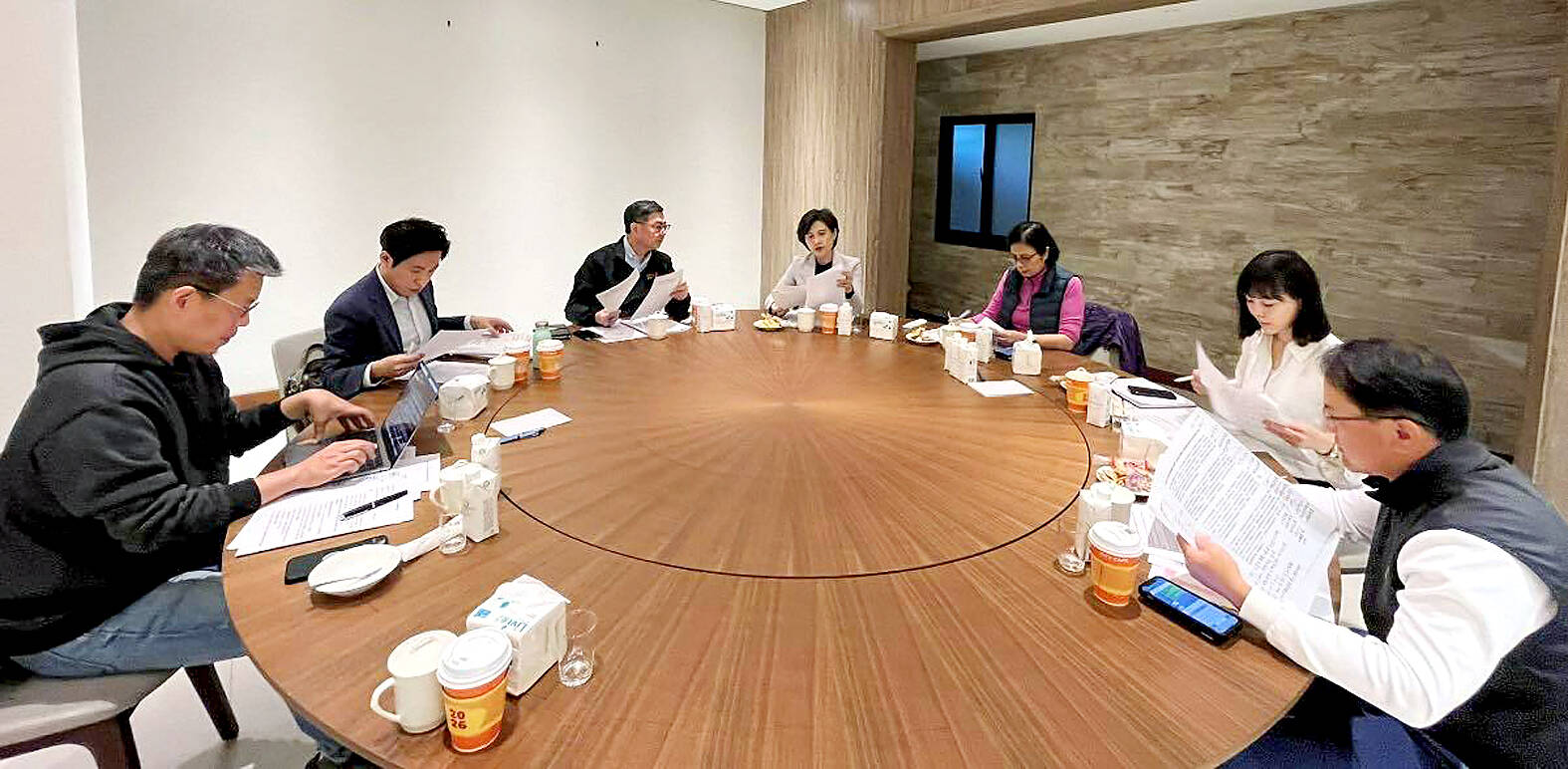
Photo: screengrab from Cho Jung-tai’s Facebook page
The government has a full grasp of the latest developments and is fully prepared for a turbulent and challenging global trade environment, he said, adding that Premier Cho Jung-tai (卓榮泰) and the negotiating team briefed him on the matter, asking the public and the industry sector to rest assured.
Regardless of how the situation evolves, the government’s goal is to ensure that Taiwan’s most-favorable treatment would not be compromised, while its advantages over major competitors would be maintained, mitigating any risks brought about by the new developments, he said.
Taiwan boasts the most competitive industries and the most united citizenry in the world, he said.
Despite turbulence in the global economy and trade environment, the government is to prioritize national, industrial, food security and public health interests, as it always does, striving for the best for the country, he said.
The government would remain the staunchest supporter of the public and industry, leading the nation steadily through the changes and continuing to move forward, he said.
Meanwhile, Cho, also posting on social media late on Saturday night, said that he has instructed the negotiation team to maintain close communication with Washington to ensure that the most-favorable treatment under Section 232 of the Trade Expansion Act remains unchanged.
Following his meeting with Vice Premier Cheng Li-chiun (鄭麗君), Executive Yuan Secretary-General Xavier Chang (張惇涵) and members of the negotiation team, Cho said he has instructed the team to cautiously assess the follow-ups of the Taiwan-US Agreement on Reciprocal Trade, which was signed earlier this month.
The negotiation team has brought fruitful results after two phases of negotiations with the US, laying a beneficial foundation in dealing with the new situation, he said.
He said he believes that the team, led by Cheng, could safeguard the country’s best interests and the industrial sector’s international competitiveness.
Facing a dynamic global trade situation amid US tariff changes, the government has to monitor changes, safeguard achievements and respond prudently, he said.
Taiwan would continue to improve its trade system, facilitate bilateral investment, stabilize its cooperation with the US, deepen bilateral strategic partnership and strive for their common goal to safeguard national and economic security, he said.
Taiwan has always been building its future amid challenges, he said, citing Japanese Prime Minister Sanae Takaichi’s remarks that “a nation that does not take on challenges has no future.”
“Taiwan’s resilience stems from its ability to turn challenges into opportunities,” Cheng said on Saturday.
Taiwan’s challenges in trade negotiations stem from its large trade surplus with the US, which made it the fourth-largest source of US trade deficit last year, with the deficit increasing to nearly US$150 billion, she said.
About 76 percent of Taiwan’s exports to the US fall within the scope of Section 232 investigations, which would require negotiations along with reciprocal tariffs, she said.
Citing the latest executive order signed by Trump and the statement issued by US Trade Representative Jamieson Greer, she said Taiwan has to closely monitor changes to be brought by not only Section 122 and 301 of the Trade Act of 1974, but also other US laws.
The most-favored nation status secured by the negotiation team under Section 232 would not be affected by the US Supreme Court’s ruling, she said.
The memorandum of understanding on Taiwan-US investment, which was signed on Jan. 15, says that the two countries are to continue negotiations on favorable treatments, she said.
The impact on industries is expected to be alleviated, such as uncertainties brought by tariffs potentially imposed on semiconductors and related products to the high-tech supply chains, she added.
Additional reporting by AFP, Reuters and AP

A signaling system malfunction disrupted high-speed rail (HSR) services beginning at 8am today, with trains temporarily reduced to three northbound and three southbound trains per hour as authorities conduct inspections. The malfunction occurred on a section of track in Miaoli County during pre-operation checks early this morning, forcing northbound and southbound trains to use a single track, the HSR operator said. The regular schedule has been replaced with three hourly trains offering only nonreserved seating in each direction, stopping at every station, it said, adding that business class cars would still have reserved seating. Departures from terminal stations are scheduled at the top

Taiwan is still in the process of assessing the possibility of recruiting workers from Eswatini, the Ministry of Foreign Affairs said yesterday, adding that its goal is to help Eswatini upgrade its vocational training centers. If there are plans to recruit workers from Eswatini, safeguarding national security, protecting public health and ensuring the employment rights of Taiwanese would be prerequisites, Department of West Asian and African Affairs Director-General Yen Chia-liang (顏嘉良) told a news conference. Key considerations would also include filling labor shortages in specific industries, and fostering bilateral professional and technical exchanges, he said. Yen was asked about the progress of labor

VERBOSE VESSELS: A CGA cutter and a China Coast Guard exchanged verbal barbs for more than a day in Taiwanese-controlled waters before the Chinese vessel left The Taiwanese and Chinese coast guards had a standoff near the strategically located Pratas Islands (Dongsha Islands, 東沙群島) in the north of the South China Sea, the Coast Guard Administration (CGA) said yesterday. The two sides engaged in intense radio exchanges over sovereignty claims during the 33-hour standoff. China Coast Guard vessel 3501 eventually left the restricted waters, 26.6 nautical miles (49.2km) west of the Pratas Islands, at 5pm yesterday, the CGA said. Lying approximately between southern Taiwan and Hong Kong, the Taiwan-controlled Pratas are seen by some security experts as vulnerable to Chinese attack due to their distance — more than
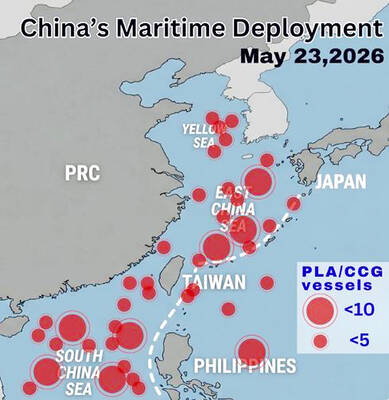
WARNING: China should stop engaging in actions that undermine regional peace and stability, as it would only build resentment among people across the Strait, the CGA said China has deployed more than 100 navy, coast guard and other vessels in waters from the Yellow Sea to the South China Sea and the western Pacific since US President Donald Trump and Chinese President Xi Jinping (習近平) met in Beijing, National Security Council Secretary-General Joseph Wu (吳釗燮) said yesterday. “In this part of the world, #China is the one & only PROBLEM wrecking the #StatusQuo & threatening regional peace & stability,” Wu wrote on X. In a separate post, he said Beijing was coercing Taiwan’s maritime domain, calling it illegal and provocative, after the Coast Guard Administration (CGA) expelled a


 RSS
RSS