


US President Donald Trump on Friday imposed an additional 10 percent tariff on imports after the US Supreme Court struck down many of his sweeping and often arbitrary duties, delivering a stinging rebuke on his signature economic policy.
Trump signed the tariff order in the Oval Office — saying on social media it was “effective almost immediately” — after spending the past year imposing various rates to cajole and punish countries.
The new duty is slated to take effect on Tuesday for 150 days, with exemptions remaining for sectors that are under separate probes, including pharmaceuticals, and goods entering the US under the US-Mexico-Canada agreement, a White House factsheet said.
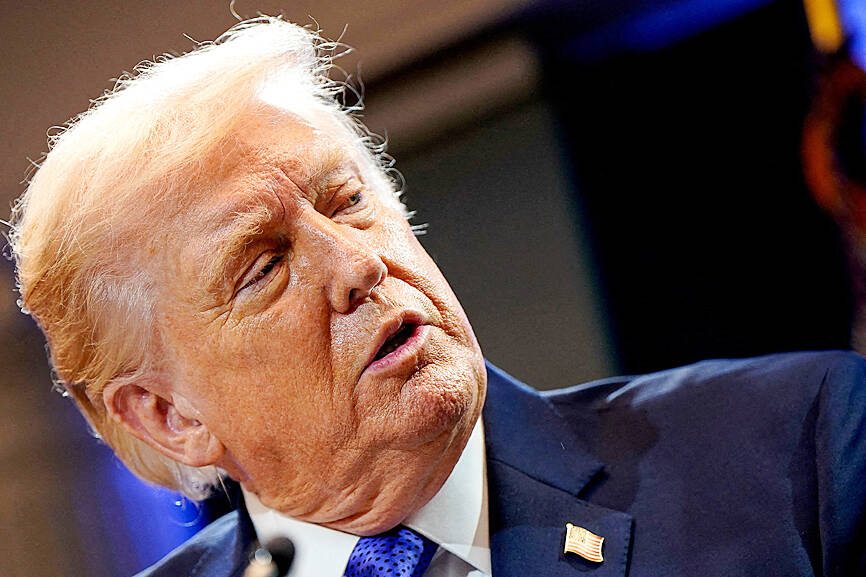
Photo: Reuters
US trading partners that reached tariff deals with Trump’s administration would now also face a 10 percent duty, despite higher levels they might have agreed on previously, the White House said.
However, the Trump administration would seek ways to “implement more appropriate or pre-negotiated tariff rates” down the line, a White House official said.
The conservative-majority high court ruled six to three that a 1977 law Trump has relied on to slap sudden rates on individual countries, upending global trade, “does not authorize the President to impose tariffs.”
Trump, who had nominated two of the justices who repudiated him, responded furiously, alleging without evidence that the court was influenced by foreign interests.
“I’m ashamed of certain members of the court, absolutely ashamed, for not having the courage to do what’s right for our country,” Trump said. “In order to protect our country, a president can actually charge more tariffs than I was charging in the past.”
The ruling did not impact sector-specific duties Trump separately imposed on steel, aluminum and various other goods. Government probes still underway could lead to additional sectoral tariffs.
The US said companies would receive refunds if the tariffs were deemed unlawful, but the ruling did not address the issue.
The University of Pennsylvania’s Penn Wharton Budget Model projected that the court decision on tariffs would generate up to US$175 billion in refunds.
The Budget Lab at Yale University estimates consumers face an average effective tariff rate of 9.1 percent, down from 16.9 percent.
Close US trading partners, such as the EU and the UK, said they were studying the decision.
French President Emmanuel Macron hailed “the existence of checks and balances in democracies” after the Supreme Court’s decision, adding that “a conciliatory approach” was necessary.
“We want to continue to export and do so under the fairest rules possible and not be subject to unilateral decisions,” he said.
In Taipei, the Executive Yuan said the new tariff would have limited impact on Taiwan.
The government would continue to monitor the situation, and is in close contact with the US to better understand how they intend to implement the surcharges and to facilitate a Taiwanese response, Executive Yuan spokeswoman Michelle Lee (李慧芝) said.
Taiwan has been engaging with the US since the first announcement of tariffs in April last year, demonstrating a commitment to protecting national interests and fostering constructive dialogue, Lee said.
The nation has consistently worked under four major principles — ensuring national, industrial, food security and public health interests — and consulted with the US to ensure Taiwan’s industrial competitiveness, she said.
Taiwan and the US signed a trade deal on Thursday last week that would bring down tariffs imposed by Trump from 20 percent to 15 percent, but it was not clear how that deal would be affected by the US Supreme Court’s decision.
The negotiation team’s efforts to secure most-favored nation status under Section 232 of the US Trade Expansion Act would reduce the impact of tariffs on Taiwanese industries and the uncertainty regarding semiconductor and high-tech product supply chains, Lee said.
Items that accounted for 76 percent of Taiwanese exports to the US in 2024 fall under Section 232 of the act, investigations of which “have been completed or are ongoing,” she added.
The government would continue to look after national interests and maintain the industrial sector’s international competitiveness, she said.
Additional reporting by Chung Li-hua and Jake Chung

A signaling system malfunction disrupted high-speed rail (HSR) services beginning at 8am today, with trains temporarily reduced to three northbound and three southbound trains per hour as authorities conduct inspections. The malfunction occurred on a section of track in Miaoli County during pre-operation checks early this morning, forcing northbound and southbound trains to use a single track, the HSR operator said. The regular schedule has been replaced with three hourly trains offering only nonreserved seating in each direction, stopping at every station, it said, adding that business class cars would still have reserved seating. Departures from terminal stations are scheduled at the top

Taiwan is still in the process of assessing the possibility of recruiting workers from Eswatini, the Ministry of Foreign Affairs said yesterday, adding that its goal is to help Eswatini upgrade its vocational training centers. If there are plans to recruit workers from Eswatini, safeguarding national security, protecting public health and ensuring the employment rights of Taiwanese would be prerequisites, Department of West Asian and African Affairs Director-General Yen Chia-liang (顏嘉良) told a news conference. Key considerations would also include filling labor shortages in specific industries, and fostering bilateral professional and technical exchanges, he said. Yen was asked about the progress of labor

VERBOSE VESSELS: A CGA cutter and a China Coast Guard exchanged verbal barbs for more than a day in Taiwanese-controlled waters before the Chinese vessel left The Taiwanese and Chinese coast guards had a standoff near the strategically located Pratas Islands (Dongsha Islands, 東沙群島) in the north of the South China Sea, the Coast Guard Administration (CGA) said yesterday. The two sides engaged in intense radio exchanges over sovereignty claims during the 33-hour standoff. China Coast Guard vessel 3501 eventually left the restricted waters, 26.6 nautical miles (49.2km) west of the Pratas Islands, at 5pm yesterday, the CGA said. Lying approximately between southern Taiwan and Hong Kong, the Taiwan-controlled Pratas are seen by some security experts as vulnerable to Chinese attack due to their distance — more than

A US uncrewed surface vessel (USV) encountered multiple Chinese warships during an autonomous transit of the Taiwan Strait, US defense company Seasats said in a statement on Wednesday. Seasats announced that a Lightfish USV had completed the first autonomous transit of the Taiwan Strait. Over five days, the USV traversed the entire length of the Strait while constantly monitoring surface vessel traffic, the company said. The Lightfish encountered multiple Chinese warships, one of which was a Chinese People’s Liberation Army Navy (PLAN) Type 056 corvette, it said. The Chinese vessels were operating “well within Taiwan’s exclusive economic zone without transmitting their identity via the


 RSS
RSS