


The Legislative Yuan could begin reviewing the Taiwan-US Agreement on Reciprocal Trade on March 12, a day after the election of conveners of legislative committees, sources said.
Based on the bilateral agreement signed on Thursday last week, the US would cap tariffs on Taiwanese goods at 15 percent without stacking them on existing rates, while Taiwan would grant preferential market access to US industrial and agricultural exports, including vehicles and beef and pork products.
The Executive Yuan is expected to approve the trade agreement as early as Thursday next week, sources said.
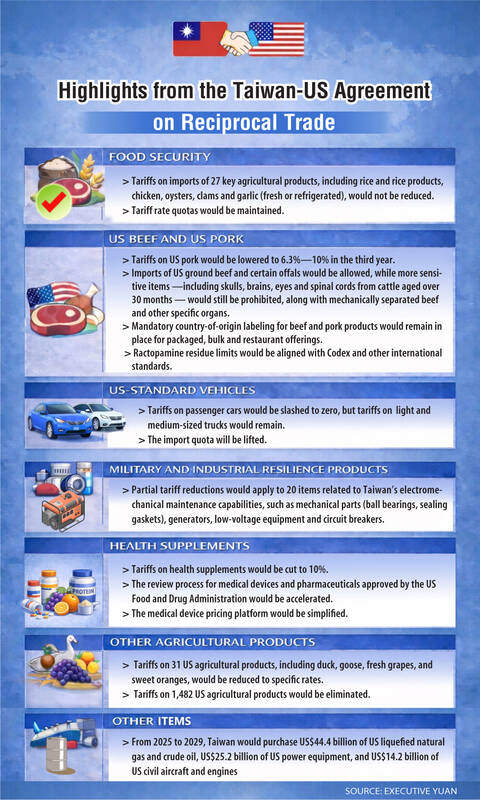
GRAPHIC: TT
If the agreement is delivered to the legislature on the same day, the first reading of the agreement could be secured at a plenary session on March 6, allowing the agreement to proceed to review at a joint session comprising members of the committee on foreign Affairs and national defense, finance and economics, they said.
With elections for legislative committee conveners set for March 11, lawmakers are expected to begin reviewing the trade agreement as early as March 12, they added.
The Chinese Nationalist Party (KMT) and Taiwan People’s Party (TPP) caucuses have pledged to expedite the review of the trade agreement.
However, the KMT has questioned a clause in the agreement requiring Taiwan’s defense expenditure to be no less than 3 percent of GDP, saying the US is interfering in Taiwan’s right to set its budget.
The Conclusion of Treaties Act (條約締結法) stipulates that any signed treaty must be returned to the administrative authority in charge if it is rejected or amended by the legislature, and might then be subject to renegotiation.
The KMT and TPP caucuses are widely expected to approve the agreement with nonbinding resolutions, after the US raised duties on South Korean goods, sources said.
US President Donald Trump last month raised the tariffs on South Korea from 15 percent to 25 percent after its parliament failed to quickly ratify a similar pact.
Separately, the Executive Yuan’s Office of Trade Negotiations said the agreement on reduced tariffs or tariff exemptions, as well as on the supply chain cooperation, is listed in the memorandum of understanding (MOU) on Taiwan-US investment signed on Jan. 15, rather than in the reciprocal trade agreement.
The two are different documents and deal with separate issues, the office said.
The reciprocal trade pact addresses issues related to trade barriers, economic security and business opportunities between the two countries, while the MOU states Taiwan’s pledge to invest in the US’ supply chain and Washington’s offer of preferential tariffs fro Taiwanese goods, the office said.
The MOU lays out a framework for Taiwan-US cooperation and does not stipulate the amount that specific private companies must invest, the office added.
Both documents state that the reciprocal tariff for Taiwanese exports to the US is set at 15 percent without stacking, it added.

‘NO SECURITY RISK’: The Railway Bureau reassured the public that the technicians’ activities were limited to technical guidance and did not involve sensitive systems The Railway Bureau yesterday said it had invited eight Chinese technicians to assist with an airport MRT construction project. The bureau issued the confirmation after an Internet user said Chinese nationals had entered the construction zone of Taiwan Taoyuan International Airport’s Terminal 3 project. They asked why “individuals from an enemy state” were allowed access to such a major national infrastructure project, which raised serious concerns over Taiwan’s industrial safety, sensitive systems and information security. The bureau’s Northern Region Engineering Branch Office said subcontractor Taiwan Handle Industrial Co (台灣手把工業) of the Taoyuan airport MRT’s “Contract No. CU05 Project A14 Station Civil, MEP &

A US uncrewed surface vessel (USV) encountered multiple Chinese warships during an autonomous transit of the Taiwan Strait, US defense company Seasats said in a statement on Wednesday. Seasats announced that a Lightfish USV had completed the first autonomous transit of the Taiwan Strait. Over five days, the USV traversed the entire length of the Strait while constantly monitoring surface vessel traffic, the company said. The Lightfish encountered multiple Chinese warships, one of which was a Chinese People’s Liberation Army Navy (PLAN) Type 056 corvette, it said. The Chinese vessels were operating “well within Taiwan’s exclusive economic zone without transmitting their identity via the
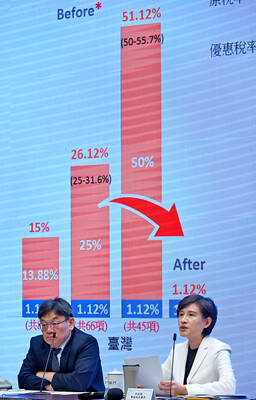
GREATER REACH? Auto parts and wood products would face tariffs of up to 15%, matching those targeting the EU, Japan and South Korea, Vice Premier said The US has announced that preferential tariff treatment for Taiwan’s non-semiconductor Section 232 goods would take effect retroactively from May 1, the Executive Yuan said yesterday. The US government yesterday posted a notice on the Federal Register’s public inspection Web site previewing tariff concessions for Taiwan under a memorandum of understanding (MOU) on Taiwan-US investment after two months of negotiations. The MOU signed on Jan. 15 stipulated three major preferential tariff arrangements: a 15 percent “reciprocal” tariff rate for Taiwan without stacking most-favored nation (MFN) rates; preferential Section 232 treatment for semiconductors and related products; and preferential Section 232 treatment for non-semiconductor

TIT-FOR-TAT: The US allegedly revoked the visa of a Chinese national working at Xinhua News Agency in the US in response to Beijing’s expulsion of Vivian Wang The Presidential Office yesterday condemned China for expelling a New York Times correspondent from Beijing following the newspaper’s interview with President William Lai (賴清德), saying the move highlighted Beijing’s suppression of press freedom and its threat to international news media. Taiwan has noted a series of recent incidents in which Beijing used similar tactics to “threaten and pressure international media outlets and journalists,” Presidential Office spokeswoman Karen Kuo (郭雅慧) said in a statement. “This concerns not only press freedom and freedom of expression, but also the safety of journalists, and Taiwan and relevant partners are paying close attention to the situation,” she


 RSS
RSS