


Radio Free Asia (RFA) has resumed broadcasts to China, its CEO said on Tuesday, after US President Donald Trump’s administration last year cut funding, forcing it to cease operations.
RFA and its sister outlets, including Voice of America (VOA), had for years been financed with funding approved by the US Congress and overseen by the US Agency for Global Media (USAGM).
Last year Kari Lake, a former news anchor appointed by Trump as acting CEO of USAGM, terminated their grants, alleging waste of taxpayer money and anti-Trump bias.
Photo: Reuters
Critics decried the move, which led to mass layoffs, as ceding ground to China and other US adversaries.
“We are proud to have resumed broadcasting to audiences in China in Mandarin, Tibetan, and Uyghur, providing some of the world’s only independent reporting on these regions in the local languages,” RFA president and CEO Fang Bay (方貝) wrote in a post on LinkedIn.
She said the ability to restart the broadcasts was “due to private contracting with transmission services.”
She did not provide details, but added that rebuilding the network would require consistently receiving newly approved congressional funding.
A bipartisan spending bill that Trump signed into law earlier this month included US$653 million for USAGM, which oversees RFA, VOA and other government-funded outlets.
That is down from the US$867 million appropriated for the agency each of the past two years, but more than the US$153 million Trump requested that Congress provide to shut down USAGM.
US lawmakers of both major parties had said Trump’s drive to dismantle the news outlets diminished Washington’s clout globally at a time when Beijing is expanding its own sphere of influence.
A spokesperson for China’s embassy in Washington declined to comment on what he said was US domestic policy, but accused RFA of having an anti-China bias.
“Radio Free Asia has long spread falsehoods and smeared China, and they have a poor record when it comes to reporting on China-related issues,” Chinese embassy spokesman Liu Pengyu (劉鵬宇) said.
“We hope more media outlets in the US can make objective and fair-minded reports on China and China-US relations,” Liu added.
Chinese state media had praised last year’s cuts.
Rights activists say RFA has for decades shone light on abuses by China and other authoritarian countries, raising awareness about the plight of oppressed minorities such as China’s Uighur Muslims.
On Friday, RFA spokesman Rohit Mahajan said the outlet had contracted with private companies to broadcast to audiences in Tibet, North Korea and Myanmar.
Mahajan said the outlet’s Mandarin audio content currently is online only, with the aim to resume regular broadcasts over airwaves soon.
Its Tibetan, Uighur, Korean and Burmese radio programming airs over short and medium-wave frequencies.
Previous satellite transmissions via USAGM have not resumed yet, he said.
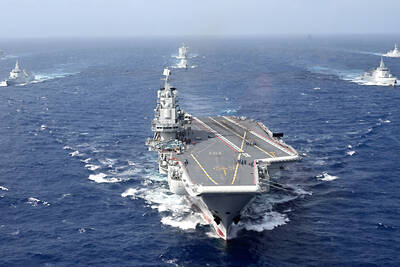
PROVOCATIVE: Chinese Deputy Ambassador to the UN Sun Lei accused Japan of sending military vessels to deliberately provoke tensions in the Taiwan Strait China denounced remarks by Japan and the EU about the South China Sea at a UN Security Council meeting on Monday, and accused Tokyo of provocative behavior in the Taiwan Strait and planning military expansion. Ayano Kunimitsu, a Japanese vice foreign minister, told the Council meeting on maritime security that Tokyo was seriously concerned about the situation in the East China and South China seas, and reiterated Japan’s opposition to any attempt to change the “status quo” by force, and obstruction of freedom of navigation and overflight. Stavros Lambrinidis, head of the EU delegation to the UN, also highlighted South China Sea
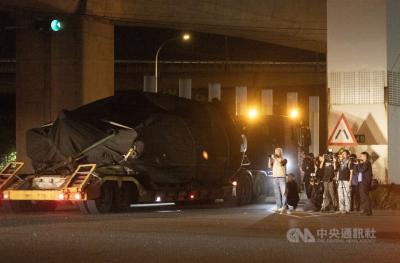
The final batch of 28 M1A2T Abrams tanks purchased from the US arrived at Taipei Port last night and were transported to the Armor Training Command in Hsinchu County’s Hukou Township (湖口), completing the military’s multi-year procurement of 108 of the tanks. Starting at 12:10am today, reporters observed more than a dozen civilian flatbed trailers departing from Taipei Port, each carrying an M1A2T tank covered with black waterproof tarps. Escorted by military vehicles, the convoy traveled via the West Coast Expressway to the Armor Training Command, with police implementing traffic control. The army operates about 1,000 tanks, including CM-11 Brave Tiger
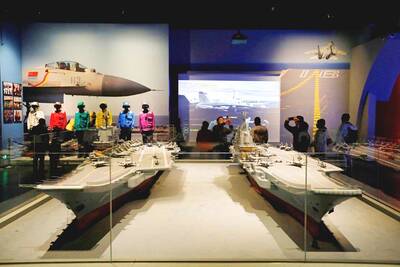
China on Wednesday teased in a video an aircraft carrier that could be its fourth, and the first using nuclear power, while making an allusion to Taiwan and vowing to further build up its islands, as it looks to boost maritime power, secure resources and bolster territorial claims. The video, issued on the eve of the 77th founding anniversary of the Chinese People’s Liberation Army Navy, featured fictional officers with names that are homophones of three commissioned aircraft carriers, the Liaoning (遼寧), Shandong (山東) and Fujian (福建). Titled Into the Deep, it showed a 19-year-old named “Hejian” (何劍) joining the group, sparking
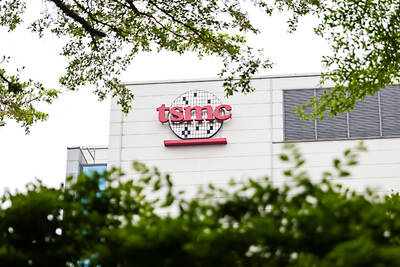
Taiwan Semiconductor Manufacturing Co (TSMC, 台積電), the world’s largest contract chipmaker, said it expects its 2-nanometer (2nm) chip capacity to grow at a compound annual rate of 70 percent from this year to 2028. The projection comes as five fabs begin volume production of 2-nanometer chips this year — two in Hsinchu and three in Kaohsiung — TSMC senior vice president and deputy cochief operating officer Cliff Hou (侯永清) said at the company’s annual technology symposium in Silicon Valley, California, last week. Output in the first year of 2-nanometer production, which began in the fourth quarter of last year, is expected to


 RSS
RSS