


The US Department of Homeland Security (DHS) entered a partial shutdown yesterday as US lawmakers fight over funding the agency overseeing much of US President Donald Trump’s immigration crackdown.
Thousands of government workers, from airport security agents to disaster relief officials, would either be furloughed or forced to work without pay until funding is agreed upon by the US Congress.
At the center of the budget dispute is the department’s Immigration and Customs Enforcement (ICE), whose agents killed two US citizens amid sweeping raids and mass protests in Minneapolis, Minnesota.
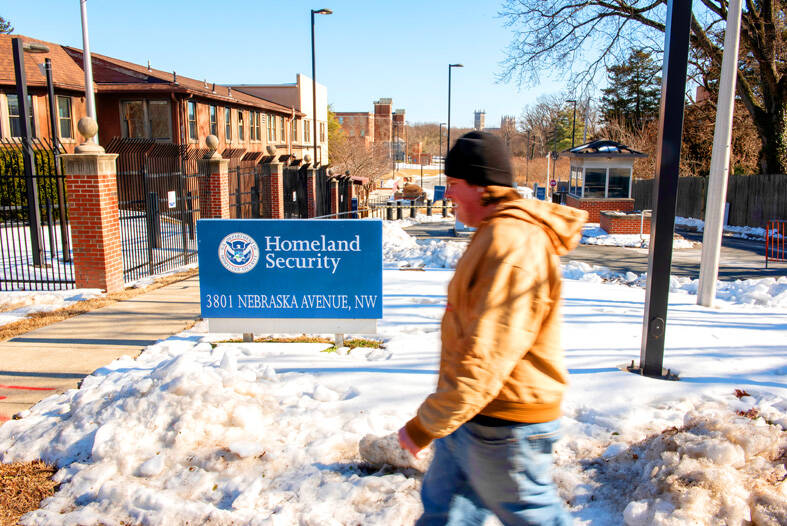
Photo: AP
Democrats oppose any new funding for the DHS until major changes are implemented over how ICE conducts its operations.
In particular, they have demanded curtailed patrols, a ban on ICE agents wearing masks during operations and the requirement that they obtain a judicial warrant to enter private property.
“Donald Trump and Republicans have decided that they have zero interest in getting ICE under control,” US House Minority Leader Hakeem Jeffries said on Friday.
“Dramatic changes are needed,” Jeffries told a news conference. “Absent that, Republicans have decided to shut down parts of the federal government.”
White House press secretary Karoline Leavitt put the blame on the opposition, telling Fox News that “Democrats are barreling our government towards another shutdown for political and partisan reasons.”
While DHS faces a shutdown, ICE itself would remain operational under funds approved in last year’s government spending bill.
US Senator John Fetterman pushed against his fellow Democrats, saying: “This shutdown literally has zero impact on ICE.”
The primary impact would land on other agencies, including the US Federal Emergency Management Agency (FEMA), which oversees emergency response to natural disasters.
The US Transportation Security Administration, which runs airport safety, wrote on social media that a prolonged shutdown could result in longer wait times and canceled flights.
The shutdown would be the third of Trump’s second term, including a record 43-day government closure in October and November last year.
The government just reopened from a smaller, four-day partial shutdown earlier this month, also over DHS funding.
Even if all 53 Republican senators vote to fund the DHS, US Senate rules require support from 60 of the body’s 100 members to advance the budget bill, meaning several Democrats would need to get on board.
In response to the Democrats’ demands, the White House said it was ready to negotiate over immigration enforcement policy.
Senate Majority Leader John Thune called it “an extremely serious offer,” but warned Democrats are “never going to get their full wish list.”
Some concessions were made during the previous shutdown amid Democratic pressure and national outcry after federal agents shot and killed Renee Good, a mother of three, and Alex Pretti, a nurse who worked with military veterans, in Minneapolis last month.
US Secretary of Homeland Security Kristi Noem said federal agents in the city would wear body cameras “effective immediately” in a move that would be later “expanded nationwide.”
The Senate went into recess for a week on Thursday, but senators could be called back to Washington in case of a rapid leap in negotiations.
However, for the moment talks between the White House and Democrats appear to be at a standstill.

The National Chungshan Institute of Science and Technology yesterday showcased its locally developed variants of the Vision 60 robotic patrol dog, which it plans to deploy on the nation’s outlying territories in the South China Sea. The variants were produced under the Joint Lab project — created by the institute and domestic companies — and assembled with domestically produced motors, lenses and artificial intelligence (AI) systems alongside licensed tech from the US, Missile and Rocket Systems Research Division deputy director Jen Kuo-kang (任國光) told the media event at a military base in Taipei’s Dazhi (大直) area. Taiwan has built up its strengths

RIGHT DIRECTION: Taiwan’s efforts to prevent forced labor include a proposal to ‘fully prohibit’ employers from withholding workers’ documents, an official said Taiwan is to establish a mechanism to restrict imports of goods linked to forced labor, the Executive Yuan said yesterday, after the US proposed imposing additional tariffs on Taiwanese goods over labor concerns. “The Ministry of Labor and the Ministry of Economic Affairs are to establish an interministerial review procedure,” Executive Yuan spokesperson Michelle Lee (李慧芝) said at a news briefing in Taipei. “The government is to use the Foreign Trade Act [貿易法] as the legal basis to restrict imports of goods produced with forced labor” and bring its supply chain governance more in line with international standards on human rights, resilience

NOT IMMEDIATE: Taiwan has a chance to appeal the proposed 10 percent tariff before it starts, while other countries face a 12.5 percent tariff from the trade office Taiwan is among 60 economies determined by the US to have failed to impose or enforce a ban on the importation of goods produced with forced labor, according to a notice released on Tuesday by the Office of the US Trade Representative (USTR), which proposed imposing an additional 10 percent or more tariff on them. The USTR in a statement said that following an investigation, it had determined under Section 301 of the Trade Act of 1974 that the failure of the 60 economies to impose and effectively enforce a prohibition on the importation of goods produced with forced labor is

TIT-FOR-TAT: The US allegedly revoked the visa of a Chinese national working at Xinhua News Agency in the US in response to Beijing’s expulsion of Vivian Wang The Presidential Office yesterday condemned China for expelling a New York Times correspondent from Beijing following the newspaper’s interview with President William Lai (賴清德), saying the move highlighted Beijing’s suppression of press freedom and its threat to international news media. Taiwan has noted a series of recent incidents in which Beijing used similar tactics to “threaten and pressure international media outlets and journalists,” Presidential Office spokeswoman Karen Kuo (郭雅慧) said in a statement. “This concerns not only press freedom and freedom of expression, but also the safety of journalists, and Taiwan and relevant partners are paying close attention to the situation,” she


 RSS
RSS