


Taiwanese trade negotiators told Washington that Taipei would not relocate 40 percent of its semiconductor production to the US, and that its most advanced technologies would remain in the nation, Vice Premier Cheng Li-chiun (鄭麗君) said on Sunday.
“I told the US side very clearly — that’s impossible,” Cheng, who led the negotiation team, said in an interview that aired on Sunday night on Chinese Television System.
Cheng was referring to remarks last month by US Secretary of Commerce Howard Lutnick, in which he said his goal was to bring 40 percent of Taiwan’s chip supply chain to the US
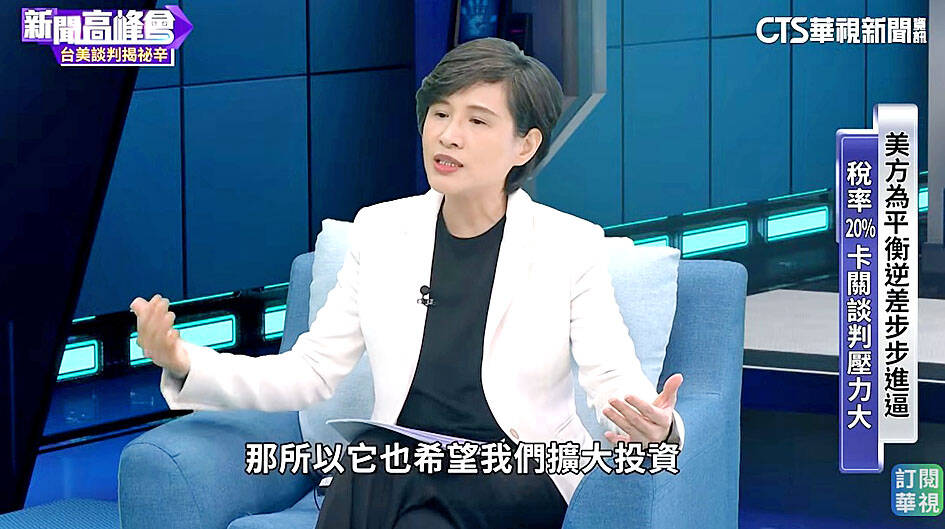
Photo: screen shot from CTS television channel’s livestream
Taiwan’s almost 90 percent market share of advanced semiconductor production was the result of an ecosystem developed over several decades and could not be “moved” to the US, Cheng said.
“I told the US side, we can’t distribute production capacity, but we can expand our layout in the US,” she said.
Cheng also defended the broad outline of the agreement with the US, under which Washington would lower tariffs on Taiwanese goods from 20 percent to 15 percent, placing Taiwan on an equal footing with competitors such as Japan, South Korea and the EU.
In return, Taiwanese semiconductor and tech companies would invest US$250 billion in the US based on their own plans, while the Taiwanese government would provide US$250 billion in credit guarantees to facilitate the investments.
The structure of the deal — independent investment by companies combined with government financial guarantees — was an example of the “Taiwan model,” and differed from the investment pledges made by Japan and South Korea, she said.
It also means that Taiwan and the US will have to work together, using the Taiwan model, to build supply chains and meet their strategic goals, she said.
Taiwan’s science parks would not be relocated to the US, she said, adding that she had made it clear during negotiations that Taiwan’s most advanced semiconductor technology would not be transferred to other countries.
“It needs to be carried out in Taiwan, where there is a comprehensive ecosystem for continuous research and development [R&D],” Cheng said.
Taiwanese semiconductor companies “will only rationally expand their investments to other countries after they have set up factories in Taiwan and confirmed they can mass produce,” Cheng said.
For that reason, the most advanced R&D and manufacturing processes must be “carried out first in Taiwan,” she added.
Taiwanese and US officials are expected to sign and release the full terms of the tariff agreement in the coming days or weeks.
The deal must then be sent to the opposition-controlled Legislative Yuan for approval.
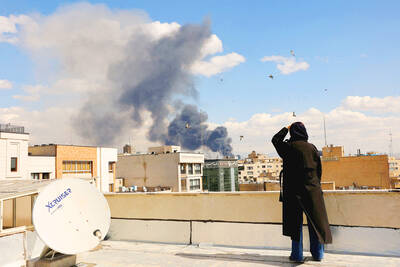
CHAOS: Iranians took to the streets playing celebratory music after reports of Khamenei’s death on Saturday, while mourners also gathered in Tehran yesterday Iranian Supreme Leader Ayatollah Ali Khamenei was killed in a major attack on Iran launched by Israel and the US, throwing the future of the Islamic republic into doubt and raising the risk of regional instability. Iranian state television and the state-run IRNA news agency announced the 86-year-old’s death early yesterday. US President Donald Trump said it gave Iranians their “greatest chance” to “take back” their country. The announcements came after a joint US and Israeli aerial bombardment that targeted Iranian military and governmental sites. Trump said the “heavy and pinpoint bombing” would continue through the week or as long
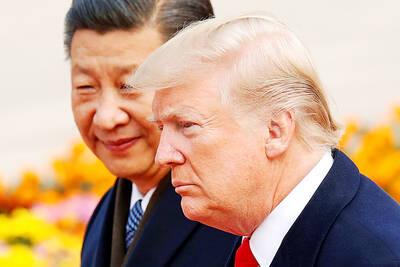
TRUST: The KMT said it respected the US’ timing and considerations, and hoped it would continue to honor its commitments to helping Taiwan bolster its defenses and deterrence US President Donald Trump is delaying a multibillion-dollar arms sale to Taiwan to ensure his visit to Beijing is successful, a New York Times report said. The weapons sales package has stalled in the US Department of State, the report said, citing US officials it did not identify. The White House has told agencies not to push forward ahead of Trump’s meeting with Chinese President Xi Jinping (習近平), it said. The two last month held a phone call to discuss trade and geopolitical flashpoints ahead of the summit. Xi raised the Taiwan issue and urged the US to handle arms sales to

State-run CPC Corp, Taiwan (CPC, 台灣中油) yesterday said that it had confirmed on Saturday night with its liquefied natural gas (LNG) and crude oil suppliers that shipments are proceeding as scheduled and that domestic supplies remain unaffected. The CPC yesterday announced the gasoline and diesel prices will rise by NT$0.2 and NT$0.4 per liter, respectively, starting Monday, citing Middle East tensions and blizzards in the eastern United States. CPC also iterated it has been reducing the proportion of crude oil imports from the Middle East and diversifying its supply sources in the past few years in response to geopolitical risks, expanding
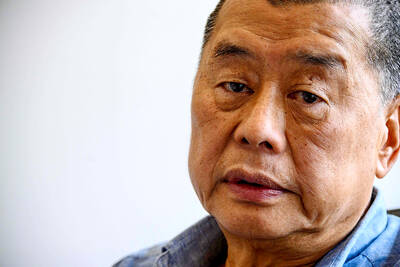
Pro-democracy media tycoon Jimmy Lai’s (黎智英) fraud conviction and prison sentence were yesterday overturned by a Hong Kong court, in a surprise legal decision that comes soon after Lai was jailed for 20 years on a separate national security charge. Judges Jeremy Poon (潘兆初), Anthea Pang (彭寶琴) and Derek Pang (彭偉昌) said in the judgement that they allowed the appeal from Lai, and another defendant in the case, to proceed, as a lower court judge had “erred.” “The Court of Appeal gave them leave to appeal against their conviction, allowed their appeals, quashed the convictions and set aside the sentences,” the judges


 RSS
RSS